

For most Australian local businesses, the right next step is to commission a focused local business SEO service that prioritises Google Business Profile (GBP) optimisation, consistent NAP (name, address, phone) data, and a structured review-generation process. Start by auditing your GBP and checking NAP consistency across your key directory listings.
According to local search data, 46% of Google searches have local intent, and many of those queries convert into a visit or phone call within 24 hours. That figure alone explains why local search optimisation deserves a dedicated budget line rather than a footnote in a broader digital marketing plan. Marzipan Media, based in Sydney, works with purpose-driven Australian organisations on exactly this kind of structured, maintenance-first approach.
Table of Contents
- What does a local business SEO service actually include?
- What do local SEO providers actually do week to week?
- How long does local SEO take, and what does it cost?
- How do you choose the right local SEO provider?
- Why Google Business Profile matters more than most owners realise
- How to read case studies and evaluate vendor KPIs
- Key takeaways
- A note on stewardship-led local SEO
- Marzipan’s local search visibility services
- Sources and further reading
What does a local business SEO service actually include?
A well-scoped local SEO package covers several distinct work streams. Each one addresses a different reason a business may not appear when nearby customers search.
- Google Business Profile optimisation — claiming, verifying, and completing every GBP field so the profile is eligible for the local pack.
- NAP audit and citation management — finding and correcting inconsistent name, address, and phone data across directories, which is one of the most common fixable reasons local rankings plateau.
- Localised on-page SEO — creating or improving service-plus-suburb pages, adding LocalBusiness schema, and aligning title tags and headings with local search queries.
- Review and reputation management — building a repeatable process for requesting and responding to Google reviews.
- Local content and link building — producing content that earns mentions and links from local organisations, media, and directories.
- Technical and site performance work — mobile speed, canonical URLs, and accessibility improvements that affect both rankings and user experience.
- Measurement and reporting — tracking GBP actions (calls, direction requests, website clicks), local pack positions, and organic visits from service-area pages.
Packages differ in scope. Some providers offer a one-off setup and audit; others run ongoing maintenance retainers or growth programmes that include content production and link outreach. Knowing which model you need before you approach a provider saves time on both sides.
What do local SEO providers actually do week to week?
The headline list above describes categories. The table below shows the specific tasks a provider should be completing and the outputs you should expect to receive.
| Work stream | Specific tasks | Deliverable / proof of work |
|---|---|---|
| GBP optimisation | Claim/verify profile; complete all fields; select precise primary category; add photos and posts | Screenshot of completed profile; category change log |
| NAP reconciliation | Audit existing citations; correct mismatches on Google, Apple Maps, and key industry directories | Spreadsheet of citations audited and corrected |
| On-page SEO | Create or update service-plus-suburb pages; add LocalBusiness, Service, and AggregateRating schema; fix title tags | Updated page URLs; schema validation report |
| Review workflow | Set up post-service SMS or email request sequence; draft response templates | Workflow documentation; review count baseline |
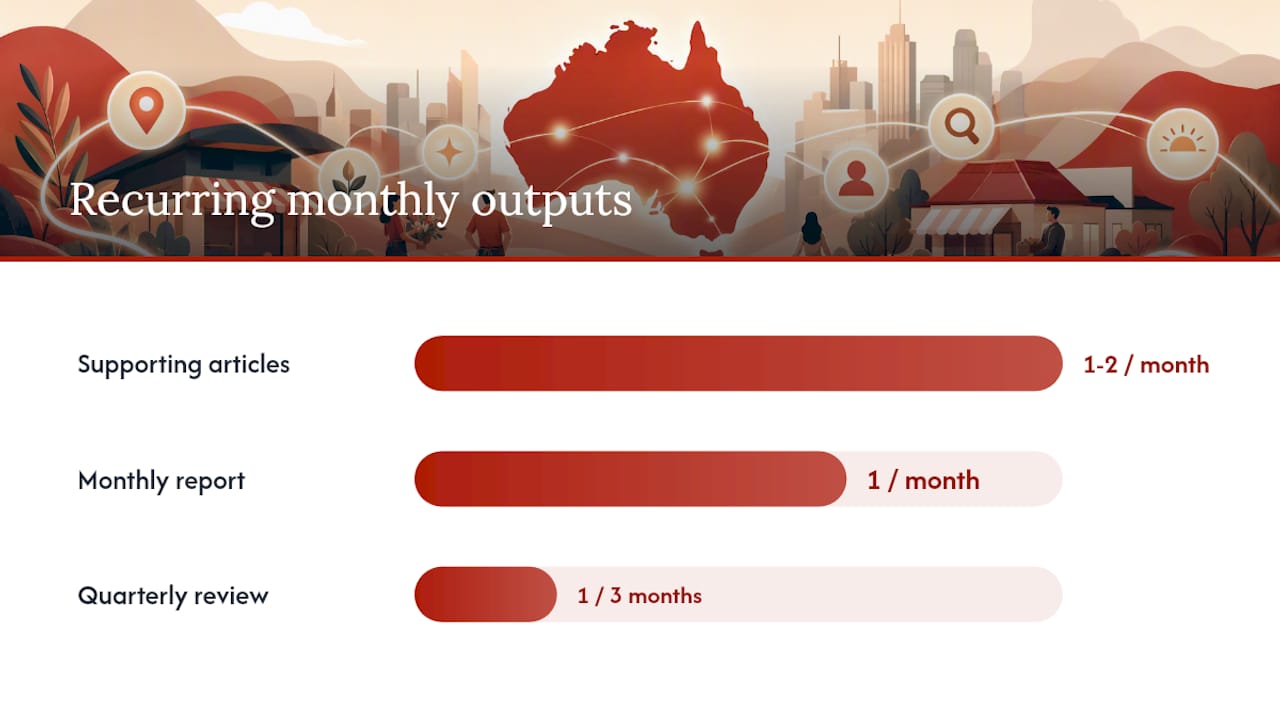
| Local content and links | Identify local link opportunities; produce one or two supporting articles or resources per month | Published URLs; link acquisition log |
| Technical fixes | Mobile speed audit; canonical URL review; accessibility check | PageSpeed Insights before/after; issue log |
| Reporting | Monthly report covering GBP views, actions, new reviews, local pack positions, organic visits | PDF or dashboard report with month-on-month comparison |
On schema: adding LocalBusiness, Service, and AggregateRating markup to your site does not guarantee a local pack position, but it does give Google structured signals about your location, services, and review aggregate. For businesses with multiple service types or locations, schema is worth the implementation time.
On citations: verified, consistent presence on a small number of core platforms — Google Business Profile, Apple Maps, and the most relevant industry directories — produces better results than bulk submissions to dozens of obscure sites. Volume without accuracy creates ranking noise rather than ranking gains.
On reporting cadence: monthly reports are standard for ongoing retainers. A good report shows GBP profile views, actions (calls, direction requests, website clicks), new reviews received, and any movement in local pack positions for target queries. Quarterly reviews should assess whether the agreed scope is still aligned with business priorities.
How long does local SEO take, and what does it cost?
Realistic timelines
Local SEO results are cumulative. Initial eligibility gains from GBP completion and citation fixes typically become visible within several weeks. Consistent, cost-positive ROI usually takes several months, which is the window most well-run campaigns need to build review velocity, establish local page authority, and compound the early technical gains.
A phased programme typically looks like this:
- Weeks 1–4: GBP claim and completion, NAP audit, citation corrections on core platforms, baseline reporting setup.
- Weeks 5–12: Service-plus-suburb page creation, schema implementation, review workflow launch, first local content pieces.
- Months 3–6: Review velocity building, local link outreach, technical refinements, monthly reporting and adjustments.
- Ongoing maintenance: Profile updates, review responses, content additions, quarterly strategy review.
Pricing in Australia
Pricing for local SEO in Australia varies by scope and provider type. Based on published guidance for Australian tradies and SMBs, quality monthly retainers generally fall within a mid-range price bracket excluding GST. One-off setup or audit packages sit below that range and cover the initial fixes without ongoing management.
What each band typically includes and omits:
- Under AU$800/month: Usually automation-heavy, often relying on bulk citation tools or templated content. Higher risk of inconsistent NAP data, low-quality links, and, in the worst cases, Google Maps penalties.
- AU$1,000–AU$2,500/month: Covers GBP management, citation work, on-page optimisation, review workflow, and monthly reporting. Content production and link outreach may be limited or priced separately.
- Above AU$2,500/month: Growth-focused programmes with regular content, active link acquisition, and more granular reporting. Appropriate for businesses competing in high-volume or multi-location markets.
Pro Tip: Before comparing monthly fees, calculate cost per lead. If a AU$1,500/month retainer generates 20 qualified enquiries, the cost per lead is AU$75. That figure is more useful than the headline fee when assessing value.
How do you choose the right local SEO provider?
Criteria that matter
A provider’s ability to demonstrate local results is more useful than a long list of services on their website. Look for evidence of GBP work, NAP corrections, and review growth for businesses similar to yours. Evaluating SEO suppliers from an ethical standpoint also means asking about account ownership, data governance, and whether you retain access to your own GBP and analytics accounts if the relationship ends.
Accessibility and sustainability considerations matter too, particularly for purpose-driven organisations. A provider who builds inaccessible pages or uses practices that risk penalties is creating a governance liability, not a marketing asset.
Questions to ask on a first call
- Can you show a before-and-after example of a GBP you have optimised, with time-stamped screenshots?
- How do you handle NAP inconsistencies across directories, and which platforms do you prioritise?
- What does your review-generation workflow look like, and who owns the review request templates?
- What does a sample monthly report contain, and how do you measure success beyond rankings?
- What are the contract terms, and what happens to our GBP access and content if we end the engagement?
Red flags
A provider who guarantees specific rankings within a fixed timeframe, offers bulk citation submissions as a primary tactic, or cannot clearly explain who owns your GBP account after the contract ends is a provider worth avoiding. Opaque deliverables and unclear account ownership are the two most common sources of long-term risk in local SEO engagements.
Sanity-check any vendor’s claims by asking for time-stamped screenshots, a sample report from a current client (anonymised is fine), and a straightforward case example with a named metric. Generic testimonials without numbers or timeframes are not sufficient evidence of performance.
Why Google Business Profile matters more than most owners realise
The evidence
Only 36% of GBP profiles are currently complete, yet complete profiles are 2.7x more likely to appear in the local pack. That gap between what most businesses have and what Google rewards is where the majority of quick wins sit.
Around 68% of customers will leave a review when asked, and a post-service SMS or email sent within 48 hours is the most effective trigger. That means a structured ask-for-review process is one of the highest-return activities in any local SEO programme.
A 90-day plan for GBP and local visibility
- Weeks 1–2: Claim and verify GBP; complete every field including services, description, and opening hours; select the most specific primary category available for your actual service.
- Weeks 3–4: Add at least ten photos; audit existing reviews and draft a response template; check NAP consistency on Google, Apple Maps, and your top two industry directories.
- Month 2: Launch a review-request workflow (SMS or email within 48 hours of service); begin responding to all new reviews within 48 hours.
- Months 2–3: Create or update two to three service-plus-suburb pages on your website; add LocalBusiness schema; submit corrected NAP to any remaining priority directories.
Pro Tip: Switching from a broad primary GBP category to a specific sub-category — for example, from “Plumber” to “Emergency Plumber” — narrows the competitive set and improves relevance for targeted queries. Keep your hours accurate; incorrect hours are a common source of negative reviews from customers who arrive at a closed premises.
Marzipan’s approach to this work is grounded in accessibility and long-term maintenance rather than short-term ranking tactics. Local SEO for small businesses is most durable when it is built on accurate data and accessible pages rather than volume-based shortcuts.
How to read case studies and evaluate vendor KPIs
What credible proof looks like
A useful case study from a local SEO provider specifies a baseline, the intervention, and a measurable outcome within a defined timeframe. For example: a business with an incomplete GBP and no review process, after profile completion and a 90-day review workflow, saw GBP actions increase from a low baseline to a figure above the industry average. Service-area pages added in month two produced measurable organic visits and phone calls within three months.
Generic testimonials that say “great results” without numbers or timeframes are not useful evidence. Ask for the specific metrics, the starting point, and the duration.
Industry benchmarks for GBP performance
The table below shows average monthly GBP metrics that can help you assess whether a vendor’s reported figures are plausible or inflated.
| Metric | Industry average (monthly) |
|---|---|
| GBP profile views | ~1,260 |
| Total actions (calls, directions, website clicks) | ~59 |
| Action rate (actions ÷ views) | ~4.7% |
| Phone calls from GBP | ~16 |
These are averages across business types and markets. A well-optimised profile in a competitive urban area may exceed them; a niche trade in a small regional market may sit below. Use them as a reference point, not a target.
A vendor who reports 5,000 monthly GBP views for a single-location local business without a clear explanation of the profile’s category, location, and competitive context is presenting a figure that warrants scrutiny.
KPIs to request on every monthly report: profile views, actions broken down by type (calls, direction requests, website clicks), new reviews received and average rating, local pack position for two or three target queries, and organic visits from service-area pages.
Combining local SEO with broader small business marketing — such as email campaigns or community partnerships — tends to compound the visibility gains from a well-maintained GBP.
Key takeaways
A well-run local business SEO service delivers the most consistent results when it starts with Google Business Profile completion, NAP accuracy, and a structured review process before moving to content and link work.
| Point | Details |
|---|---|
| GBP completeness is the first priority | Complete profiles are 2.7x more likely to appear in the local pack; only 36% of profiles are currently complete. |
| NAP consistency prevents ranking plateaus | Inconsistent name, address, and phone data across directories is one of the most common fixable causes of stalled local rankings. |
| Review velocity matters more than total count | A post-service SMS or email within 48 hours is the most effective trigger; 68% of customers will leave a review when asked. |
| Expect 6–12 months for consistent ROI | Initial gains appear in 4–8 weeks; compounding, cost-positive returns typically take 6–12 months for a well-run campaign. |
| Marzipan Media offers GBP audits and local SEO | Marzipan provides GBP and NAP audits, review workflow setup, local pages, and ongoing maintenance for Australian businesses. |
A note on stewardship-led local SEO
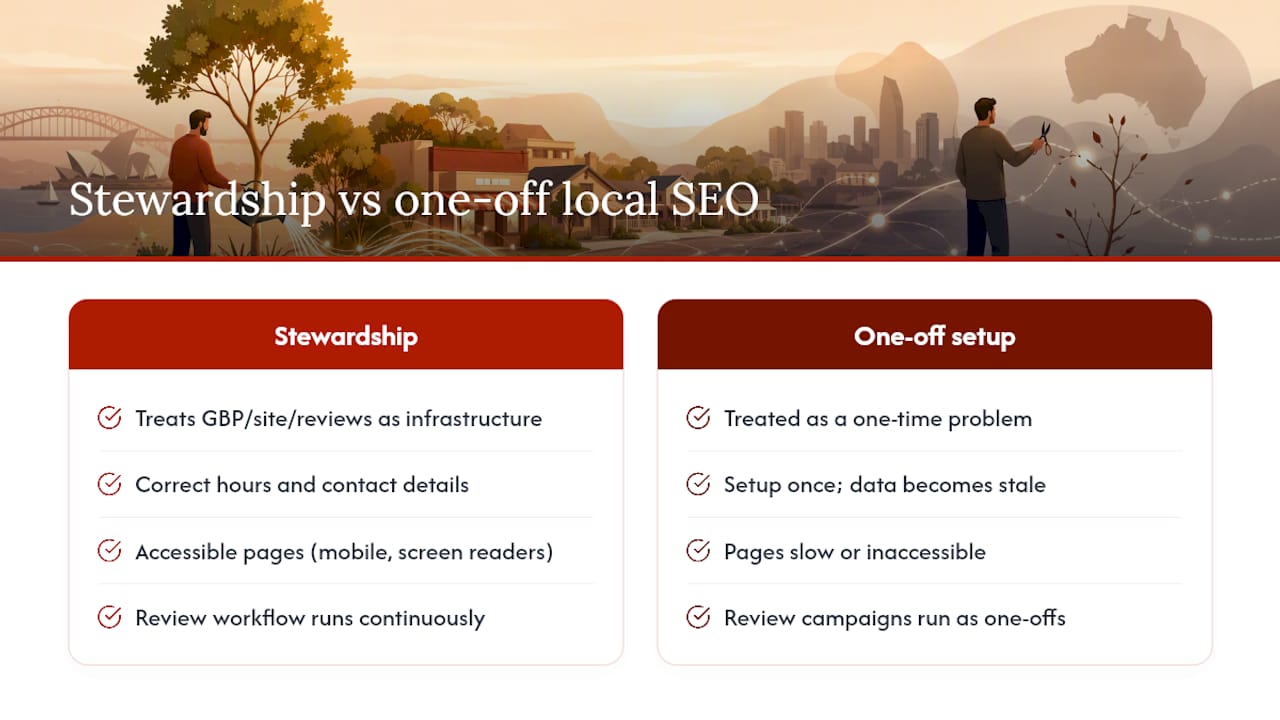
Most local SEO advice focuses on tactics: which categories to select, how many citations to build, how to phrase a review request. That guidance is useful, but it tends to treat local search as a problem to be solved once rather than a system to be maintained.
The organisations that see the most durable local search results are the ones that treat their GBP, their website, and their review process as infrastructure — something to be kept accurate, accessible, and up to date over time. That means correct hours, accessible pages, consistent contact details, and a review workflow that runs as a matter of course rather than a one-off campaign.
Accessibility deserves particular mention. A local page that loads slowly on a mobile device, or that is difficult to navigate for someone using a screen reader, is not just a technical issue. It is a governance issue for any organisation that takes its public responsibilities seriously. Local SEO and on-site accessibility are not in tension; they reinforce each other when the work is done carefully.
The gap between a well-maintained local presence and a neglected one widens over time. Businesses that invest in accurate data and accessible pages compound their advantages; those that rely on a one-off setup gradually lose ground to competitors who maintain theirs.
Marzipan’s local search visibility services
Marzipan Media offers Australian local businesses a concrete starting point: a GBP and NAP audit that identifies the specific gaps holding your profile back from local pack eligibility. From there, the scope can extend to review workflow setup, service-plus-suburb page creation, schema implementation, and ongoing monthly maintenance.
Engagement models are flexible. A one-off audit and setup is available for businesses that want to understand their current position before committing to ongoing work. Monthly maintenance retainers cover GBP management, review monitoring, citation upkeep, and reporting. Growth programmes add local content and link outreach for businesses competing in higher-volume markets.
Marzipan works from Sydney with purpose-driven organisations across Australia. The work is grounded in accessible, well-maintained websites rather than volume-based shortcuts that carry long-term risk.
To request a GBP and NAP audit or discuss a proposal, visit Marzipan’s search visibility services and use the contact form to describe your business and current situation. Have your GBP URL and your top two or three target search queries ready — that information makes the initial conversation more productive.
Sources and further reading
The following sources informed this article and provide useful further reading for businesses evaluating local SEO options in Australia.
- Local SEO for Small Businesses: A 2026 Guide — Marzipan: Marzipan’s own guide covering fundamentals and sector-specific examples for Australian businesses.
- SEO Trends in 2025: Growth Strategies for Founders — Nomad Excel: Broader strategic context on SEO positioning and growth for founders and business owners.


