

Local search engine optimisation helps nearby customers find and choose your business through Google Search and Maps. The single most useful first step for any Australian organisation is to claim and verify your Google Business Profile — the free listing that controls how your name, address, hours and reviews appear across Google Search and Google Maps. Without a verified profile, your organisation is largely invisible to the people searching on Google.com.au right now with intent to visit or call.
Key takeaways
Local search engine optimisation is a sustained practice, not a one-time setup — and the organisations that maintain it consistently are the ones that hold map pack positions over time.
| Point | Details |
|---|---|
| Claim and verify your GBP first | A verified Google Business Profile is the single highest-impact local SEO action for any Australian organisation. |
| Relevance and prominence can be improved | Distance is fixed, but complete profiles, consistent citations and genuine reviews directly improve the other two ranking factors. |
| NAP consistency matters across directories | Inconsistent name, address or phone details across Australian directories dilute your prominence signals. |
| Measure the right KPIs | Track GBP interactions, direction requests, local rankings and review volume monthly — not just website traffic. |
| Com supports ongoing local SEO management | Com provides structured, governance-aligned local SEO for purpose-driven Australian organisations, with transparent reporting and no opaque retainers. |
Table of Contents
- What is local search engine optimisation, and how does it differ from general SEO?
- Why local visibility matters for community organisations in Australia
- How Google finds and ranks local businesses
- Core local SEO tactics and why each one helps
- A 90-day starter checklist for Australian businesses
- Australia-specific considerations for local SEO
- Timeline, typical costs and realistic expectations
- How to measure local SEO success
- A perspective on local SEO for purpose-driven organisations
- Local SEO services for purpose-driven organisations
- Sources
What is local search engine optimisation, and how does it differ from general SEO?
Local SEO is the practice of improving an organisation’s visibility in location-based search results: the map pack that appears at the top of a Google results page, the pins on Google Maps, and the organic listings that follow. It is distinct from national or general SEO, which focuses on ranking for broad queries regardless of where the searcher is located.
The practical difference comes down to intent and the signals that influence ranking. A national SEO campaign targets domain authority, content depth and inbound links at scale. Local SEO targets a narrower set of signals tied to a specific place: the completeness of a Google Business Profile, the consistency of a business name and address across directories, the volume and quality of local reviews, and the relevance of on-page content to a suburb or region.
A short comparison makes the distinction concrete:
- Ranking surface: Local SEO targets the map pack and local organic results; national SEO targets standard organic results.
- Primary signal: Local SEO prioritises Google Business Profile completeness and NAP (name, address, phone) consistency; national SEO prioritises domain authority and content quality.
- Proximity factor: Local SEO is directly influenced by the searcher’s physical location; national SEO is not.
- Review signals: Reviews carry significant weight in local rankings; they are largely irrelevant to national rankings.
- Keyword intent: Local queries include place modifiers (“dentist Newtown”) or implicit location intent (“plumber near me”); national queries do not.
An organisation that serves a defined geographic area — a community health centre, a neighbourhood law firm, a regional disability support provider — benefits most from local SEO. A national charity publishing policy research does not.
Why local visibility matters for community organisations in Australia
Organisations that serve a local community depend on being found by people who are ready to act. A person searching “counselling services Parramatta” or “aged care Ballarat” is not browsing — they are making a decision. That distinction matters for how you allocate limited resources.
Academic research on high-revenue customer behaviour supports the view that nearby, high-intent visitors tend to deliver higher lifetime value for local service providers. For a community organisation, that translates to more meaningful engagement: a phone call that becomes a referral, a directions request that becomes a regular client.
Consider two practical examples. A neighbourhood dental practice in Brunswick that appears in the local map pack for “dentist Brunswick” receives calls from people who have already decided they want a local provider — the conversion work is largely done before the call is placed. A regional counselling service in Wagga Wagga that ranks for “mental health support Wagga” reaches people at a moment of genuine need, where proximity and trust signals (reviews, a verified address, clear opening hours) carry real weight.
The local SEO impact for community brands is not primarily about traffic volume. It is about reaching the right person at the right moment, which aligns directly with the governance and service values that most purpose-driven organisations hold.
How Google finds and ranks local businesses
Google’s local ranking algorithm draws on three primary factors, which Google names explicitly in its own guidance: relevance, distance, and prominence. Understanding how they interact helps an organisation decide where to focus its effort.
Relevance measures how well a business profile and website match what the searcher is looking for. A complete, accurate Google Business Profile with the correct primary category, services listed, and consistent on-page content signals strong relevance.
Distance is the physical proximity between the business and the searcher (or the location specified in the query). Distance cannot be changed, but it can be partially offset by strong relevance and prominence signals.
Prominence reflects how well-known and trusted a business appears across the web: review volume and ratings, citations in directories, inbound links, and overall online presence.
The table below summarises what Google measures for each factor and what an organisation can supply to improve its standing. As MPD Australia’s analysis of the local search algorithm notes, local pack candidates are first filtered by proximity, then ordered by relevance and prominence — so distance sets the playing field, but the other two factors determine where you finish.
| Ranking factor | What Google measures | What you can supply |
|---|---|---|
| Relevance | Match between profile/website and search query | Complete GBP categories, services, description; localised on-page content |
| Distance | Physical proximity to the searcher | Fixed — cannot be changed; offset by stronger relevance and prominence |
| Prominence | Authority, trust and reputation signals across the web | Reviews, citations, local backlinks, website authority |
Google draws its data from several sources: the Google Business Profile itself, the content of the linked website, third-party citations (directories, data aggregators), and user-generated signals such as reviews and Q&A responses.
Core local SEO tactics and why each one helps
Google Business Profile completeness
A complete, verified Google Business Profile is the single highest-leverage action in local SEO. Google’s own guidance confirms that completeness and accuracy improve local ranking directly. Choose the most specific primary category available — “community health centre” rather than “health” — because the primary category carries more weight than secondary ones. Add services, a thorough business description, opening hours (including public holidays), and photos updated regularly.
Pro Tip: When adding photos, include images of your physical premises, signage and team. Google’s systems use image content as a relevance signal, and profiles with recent, varied photos tend to perform better in the map pack.
Review generation and responses
Reviews influence prominence. A steady flow of genuine reviews, responded to promptly, signals an active and trusted organisation. The quality of review text matters too: a review that mentions your suburb, your service type, and a specific outcome gives Google richer relevance signals than a five-star rating with no text.
Ask clients or community members for reviews at a natural point in the relationship — after a successful appointment, at the close of a programme, or following a positive interaction. Never offer incentives for reviews; Google’s policies prohibit it and the reputational risk is real.
NAP consistency and citations
NAP stands for name, address, and phone number. Inconsistencies across directories — a different phone format here, an abbreviated street name there — dilute the prominence signals Google reads from citations. Audit your listings on the major Australian directories (Yellow Pages, True Local, Hotfrog, Yelp Australia) and correct any discrepancies. Use the same address format and phone number format (+61 prefix for international consistency) everywhere.
Localised on-page content and schema
A dedicated location page for each suburb or region you serve, with genuine content about that area and the services available there, strengthens relevance signals. Add LocalBusiness schema markup to your website so Google can read your address, hours and service area in a structured format. Schema does not guarantee a ranking lift, but it removes ambiguity about what your organisation does and where.
Local backlinks and community signals
Links from other Australian organisations — a council website, a local chamber of commerce, a community newspaper — carry more weight for local prominence than generic directory links. Sponsorships, partnerships and community events are practical ways to earn these links naturally, and they align with the relationship-building that purpose-driven organisations already do.
Technical essentials
A mobile-friendly, fast-loading website is a baseline requirement. Most local searches happen on mobile devices, and a slow or inaccessible site undermines every other signal. Accessibility is not a separate concern here — a site that meets WCAG 2.1 AA standards is also more likely to be technically sound in the ways Google values.
Pro Tip: Use Google Search Console’s Core Web Vitals report to identify specific pages with performance issues before investing in broader technical work. Fix the pages that receive the most local traffic first.
A 90-day starter checklist for Australian businesses
The steps below are organised by milestone. A small team can work through them without specialist tools in the first three months.
Days 0–7: Foundations
- Claim and verify your Google Business Profile at business.google.com. Verification by postcard typically takes 5–14 days in Australia; request it immediately.
- Complete every field in the profile: primary and secondary categories, services, business description (750 characters), phone number in +61 format, website URL, and opening hours including public holidays.
- Audit your existing NAP across the top five Australian directories (Yellow Pages, True Local, Hotfrog, Yelp Australia, Bing Places). Note every discrepancy in a simple spreadsheet.
Weeks 2–6: Building consistency
- Correct NAP discrepancies across directories, starting with the highest-traffic ones. Update your website’s contact page and footer to match exactly.
- Create one location page on your website for your primary service area. Include the suburb name, a description of local services, your address, and an embedded Google Map.
- Add LocalBusiness schema markup to your homepage and location page. Free schema generators are available; validate the output with Google’s Rich Results Test.
- Set up a simple review request process: a follow-up email or SMS after a client interaction with a direct link to your Google review page. Keep it brief and genuine.
Months 2–3: Momentum and measurement
- Add 3–5 photos to your Google Business Profile each month. Include premises, team and service-related images.
- Publish at least two Google Business Profile posts per month — short updates about services, events or community news.
- Set up Google Search Console and connect it to your website. Review the ‘Search results’ report for local query impressions.
- Identify two or three local organisations (councils, peak bodies, community groups) and explore partnership or listing opportunities for natural local backlinks.
- Review your progress against the KPIs listed in the measurement section below, and adjust your focus accordingly.
For a more detailed audit framework, the SEO audit guide for Australian nonprofits covers technical and content checks suited to small teams.
Australia-specific considerations for local SEO
Domain, hosting and directory choices
A .com.au domain signals Australian presence to Google and carries measurable prominence advantages in competitive suburbs, as QX137’s guide to ranking on Google Australia notes. If your organisation currently uses a .com domain, a .com.au is worth registering and redirecting, or at minimum listing as a secondary domain in your GBP. Hosting your website on Australian servers or using a CDN with Australian edge nodes reduces latency for local users and is a minor but consistent technical signal.
For citations, prioritise Australian directories over global ones. Yellow Pages Australia, True Local, Hotfrog, and industry-specific directories (for health, legal, community services) carry more local weight than generic international aggregators.
Address and contact formatting
Use the Australian address format consistently: street number and name, suburb, state abbreviation, postcode. Phone numbers should appear in both local format (02 9XXX XXXX) and international format (+61 2 9XXX XXXX) depending on context. Suburb names must match Australia Post’s official spelling — “St Kilda” not “Saint Kilda”, “Surry Hills” not “Surrey Hills” — because inconsistencies here create citation mismatches.
AI-driven answers and profile freshness
Local SEO in Australia changed meaningfully in 2026, with Google’s AI-driven summaries drawing more heavily on profile content and recent reviews. A half-finished profile or one that has not been updated in months is now more likely to be passed over in favour of a complete, current competitor. Treat your Google Business Profile as a living document, not a one-time setup task.
Timeline, typical costs and realistic expectations
Local SEO does not produce overnight results, and any supplier who promises guaranteed rankings within weeks should be treated with caution.
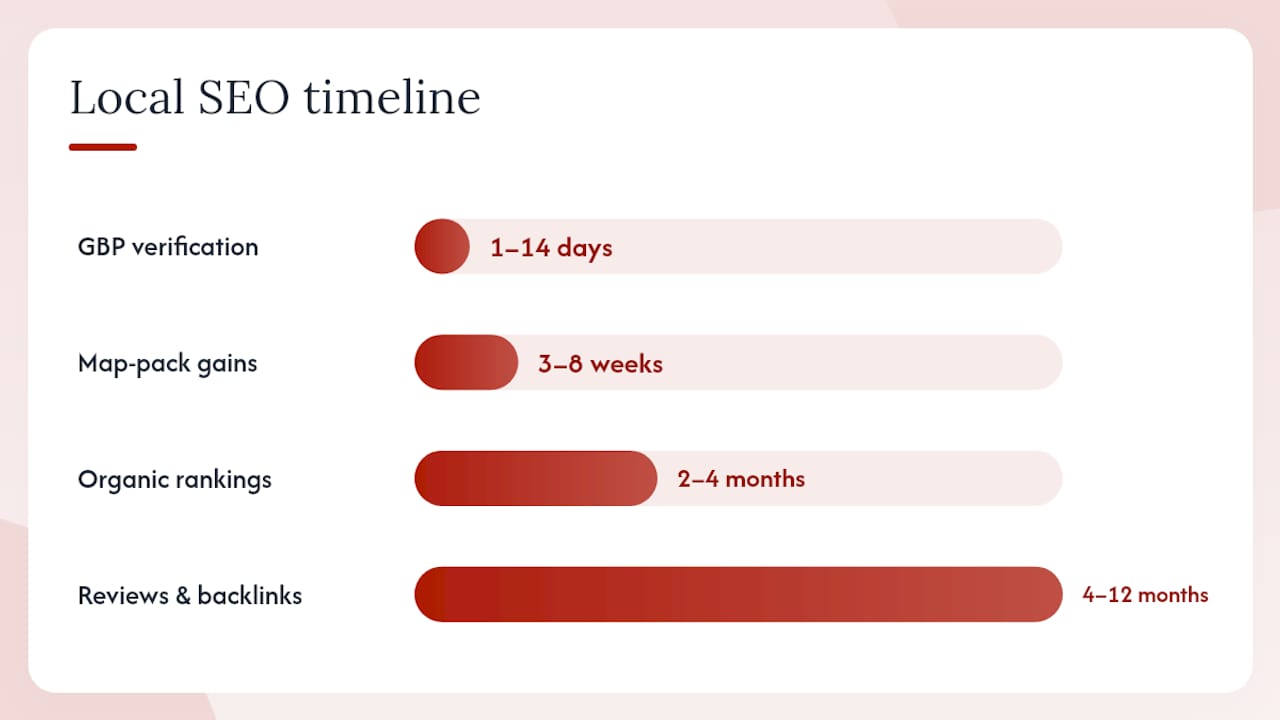
Typical timeline:
- Days 1–14: GBP verification and profile changes appear in Google within days of verification. Basic listing corrections are visible quickly.
- Weeks 3–8: Improvements in map pack visibility for lower-competition queries may begin to appear, particularly after NAP corrections and profile completion.
- Months 2–4: Organic local ranking improvements become measurable as on-page content, schema and early review volume accumulate.
- Months 4–12: Sustained review growth and local backlink acquisition produce more consistent prominence gains. Competitive suburbs take longer.
Indicative costs (these are ranges, not quotes):
- In-house effort: The foundational work — GBP setup, NAP audit, location page, schema — can be completed by a capable staff member in 10–20 hours. Ongoing maintenance requires roughly 2–4 hours per month.
- Listings management tools: Affordable subscription tools for citation management and rank tracking are available for small organisations, typically in the range of a few hundred Australian dollars per year.
- Agency support: Ongoing local SEO management from a reputable Australian agency typically involves a monthly retainer. Costs vary considerably by scope and market competitiveness. Governance-minded organisations should request a clear scope of work, defined KPIs and a minimum contract term that allows for realistic assessment.
Red flags to avoid:
- Promises of guaranteed first-page rankings or specific positions within a fixed timeframe.
- Agencies that create duplicate location pages with near-identical content for multiple suburbs.
- Any scheme involving paid or incentivised reviews.
- Suppliers who cannot explain their approach in plain terms or who resist sharing access to your own GBP and Search Console accounts.
For guidance on choosing an ethical SEO provider, the ethical SEO guidance for nonprofits covers procurement considerations relevant to community organisations.
How to measure local SEO success
Measuring the right things prevents wasted effort and supports sound governance. The KPIs below are practical for small teams and community organisations.
Key performance indicators:
- Map pack visibility: How often your listing appears in the local three-pack for target queries. Track manually or with an affordable rank tracker.
- GBP views and interactions: Profile views, website clicks, direction requests and phone calls, available directly in Google Business Profile Insights.
- Direction requests: A reliable proxy for intent to visit in person.
- Phone calls from GBP: Tracked via the calls feature in GBP Insights.
- Organic local rankings: Position for your primary local keywords, tracked monthly.
- Review volume and average rating: Total reviews and trend over time, across Google and relevant sector directories.
- Website sessions from local organic search: Visible in Google Analytics (or a privacy-conscious alternative such as Plausible Analytics) filtered by organic channel and local landing pages.
- Conversion actions: Phone calls, booking form completions, or contact form submissions from local pages.
Recommended tools:
- Google Business Profile Insights: Free, built-in, and the primary source for GBP-specific data.
- Google Search Console: Free; shows which queries drive impressions and clicks to your website, including local queries.
- Google Analytics 4: Free; tracks on-site behaviour and conversion actions. Plausible Analytics is a privacy-focused alternative suitable for organisations with data governance requirements.
- Local rank trackers: Several affordable tools allow weekly rank tracking for specific suburb-level queries. Choose one that supports Australian postcode-level tracking.
Measurement cadence: Review GBP Insights monthly. Run a quarterly review of organic rankings, review volume and conversion metrics. Annual reviews should assess whether the overall local SEO strategy remains aligned with the organisation’s service areas and community priorities.
A perspective on local SEO for purpose-driven organisations
Local SEO is often framed as a growth tactic, but for community and purpose-driven organisations, the more useful frame is stewardship. Your Google Business Profile is, in many cases, the first point of contact between your organisation and someone who needs your services. Getting it right — accurate, complete, accessible, current — is a form of care for the people you serve.
The temptation to chase rankings through shortcuts (duplicate pages, paid reviews, keyword-stuffed descriptions) is understandable when resources are limited. But these approaches carry real governance risk: Google’s systems are increasingly effective at identifying and penalising them, and the reputational damage to a high-trust organisation is disproportionate to any short-term gain.
The more durable approach is to treat local SEO as an extension of your existing commitment to transparency and accessibility. A complete profile, honest reviews, clear service descriptions and a website that works on any device are not just ranking signals — they are expressions of how your organisation operates. That alignment between digital practice and organisational values is, in my view, the strongest foundation for sustainable local visibility.
My recommendation for governance-minded decision-makers: before engaging any external supplier, complete the foundational work yourself — claim and verify your GBP, correct your NAP, and publish one genuine location page. That baseline gives you the context to evaluate any agency proposal with clear eyes.
Local SEO services for purpose-driven organisations

Com works with mission-led and community organisations across Australia that want their local search presence to reflect the quality and integrity of their work. The focus is on sustainable, governance-aligned local SEO: complete and maintained Google Business Profiles, technically sound websites, and citation strategies built on accurate, consistent information rather than volume shortcuts.
For organisations that have completed the foundational steps and want structured, ongoing local SEO management, Com offers a clear scope of work, defined KPIs and transparent reporting. There are no lock-in contracts that outlast the evidence of results.
If your organisation is ready to move from ad hoc fixes to a managed local SEO process, view the search visibility services to understand what that looks like in practice.
Sources
The following sources are reliable starting points for deeper research on local SEO in Australia.
- Tips to improve your local ranking on Google – Google Business Profile Help
- How to Rank on Google Australia — SEO Guide for Aussie Businesses — QX137
- Local SEO Australia: How Australian Businesses Win Local Search | Fokal Guides


