

TL;DR:
- Consumer behavior in local search has rapidly evolved due to AI’s growing role, making profile completeness and review recency crucial for visibility. Small businesses must focus on optimizing their Google Business Profile, building local relevance through location-specific content, and maintaining a consistent review strategy across multiple platforms. An ongoing, operational approach to local SEO, including citation management and competitor analysis, ensures durable search presence amid AI-driven discovery.
Consumer behaviour in local search has shifted more in the past eighteen months than in the previous five years. Local SEO for small businesses is no longer a matter of claiming a listing and waiting. AI tools now account for 45% of local business recommendations, up from just 6% in 2025, and review expectations have tightened considerably. For Australian small businesses trying to attract nearby customers, the traditional checklist approach is showing its age. This guide explains how local search actually works in 2026, which factors matter most, and where to focus effort to see a genuine difference.
Table of Contents
- Key takeaways
- Local SEO fundamentals for small businesses
- Understanding Google’s three-pillar ranking model
- Building a review strategy that works in 2026
- Website content that supports local relevance
- Building prominence with citations and local links
- My perspective on local SEO in 2026
- How Marzipan supports local search visibility
- FAQ
Key takeaways
| Point | Details |
|---|---|
| Google Business Profile is foundational | An incomplete or unclaimed profile is the most common reason small businesses fail to appear in local search. |
| Three pillars determine local rankings | Relevance, proximity, and prominence each require different tactics. Diagnose your weakest pillar before investing effort. |
| Review recency matters as much as volume | Businesses with 20 or more recent reviews consistently outperform those with older, higher totals. |
| AI discovery demands breadth | AI tools draw on signals across multiple platforms, so reputation management cannot focus on Google alone. |
| Content depth supports local relevance | Substantive, location-specific pages outperform thin templates and help both search engines and AI tools understand your offer. |
Local SEO fundamentals for small businesses
The starting point for any small business improving its local search visibility is the Google Business Profile (GBP). Despite its documented importance, many SMBs still lack a fully completed profile. A missing or incomplete GBP limits visibility across Google Search, Google Maps, and increasingly, AI-generated results.
Getting the profile right involves more than filling in basic details. The following elements carry the most weight:
- Business name, address, and phone number (NAP): These must match exactly across every directory, social platform, and website listing. Even minor inconsistencies, such as “St” versus “Street”, can undermine trust signals.
- Category selection: Choose the most specific primary category available. Secondary categories can be added, but the primary choice heavily influences which searches trigger your listing.
- Services and products: Detail what you offer inside the GBP. This content feeds directly into relevance matching.
- Photos and updates: Profiles with regular photos and posts signal an active business to Google’s systems.
- Opening hours: Keep these accurate and update them for public holidays. Incorrect hours erode both trust and ranking signals.
On the website side, location signals must be explicit. A contact page with an address helps, but it is not sufficient on its own. Each service page should reference the suburb, city, or region served. Structured data using LocalBusiness schema markup helps search engines and AI tools correctly interpret your location, operating hours, and services without ambiguity.
Pro Tip: Run a simple NAP audit by searching your business name across Google, Apple Maps, Yelp, and major Australian directories such as True Local and Yellow Pages. Correct any discrepancies before investing in other tactics.
Understanding Google’s three-pillar ranking model
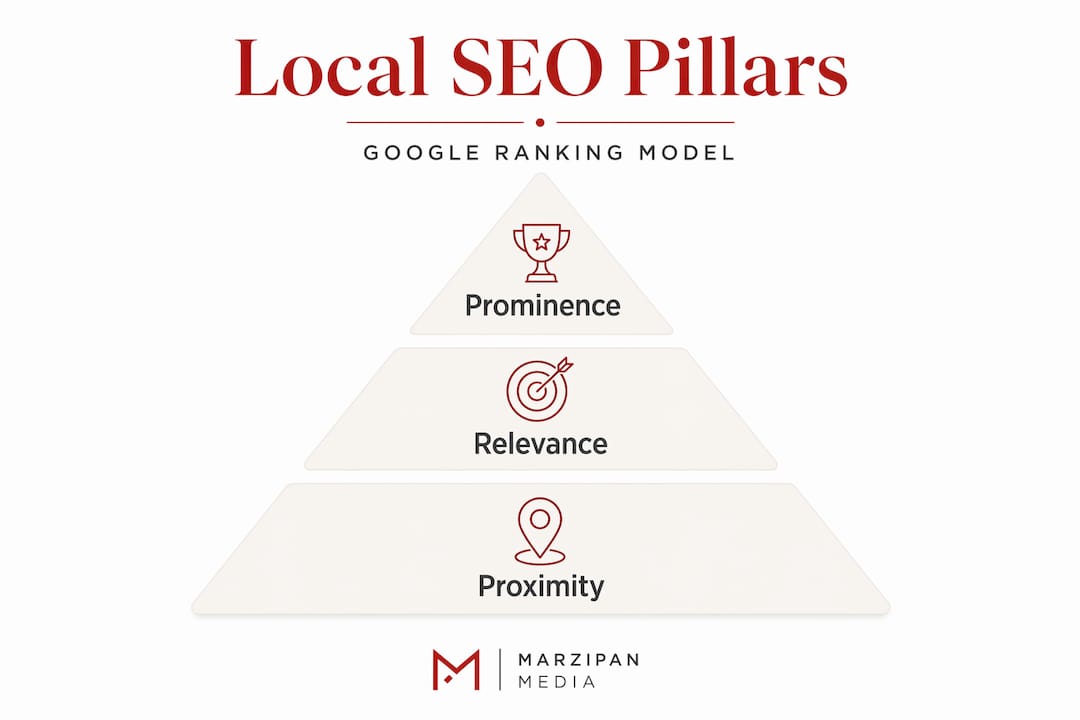
Google’s local ranking model operates on three distinct pillars: relevance, proximity, and prominence. Understanding how each one works prevents wasted effort and allows for more deliberate prioritisation.
Proximity refers to the physical distance between the searcher and the business. It is largely outside your control. A business located outside a suburb’s centre will always face a disadvantage for searches originating in the heart of that suburb. Accepting this limitation is part of realistic planning.
Relevance measures how closely your profile and website match what someone is searching for. This is where category choices, service descriptions, and on-site content do their work. A business that describes its services clearly and specifically will rank more relevantly than one with a sparse or generic profile.
Prominence reflects how well-known and trusted Google perceives the business to be. It draws on reviews, inbound links, citation consistency, and the volume of branded searches. Diagnosing the weakest pillar relative to competitors is the most efficient way to identify where effort will have the greatest impact.
The table below summarises the key differences between the three pillars and their associated tactics:
| Pillar | What it measures | Primary tactics |
|---|---|---|
| Proximity | Distance from searcher to business | Location page optimisation, service-area clarity |
| Relevance | Match between query and business profile | Category selection, service detail, on-site content |
| Prominence | Trust and authority signals | Reviews, citations, local backlinks, brand search volume |
To identify your weakest pillar, compare your profile against the top three local competitors for your main search terms. If your reviews are fewer or older, prominence needs attention. If your category or services are vague, relevance is the gap. Proximity issues require either a change in strategy or a realistic acceptance of geographic limits.
- Search your primary service term in your target suburb or area while signed out of Google.
- Open the top three competitor profiles and note their review counts, rating scores, and category choices.
- Compare their website location pages against your own for content depth and specificity.
- Identify which pillar shows the largest gap and build your next three months of activity around closing it.
Building a review strategy that works in 2026
Reviews have become a core decision factor in local business discovery, not an optional extra. 47% of consumers will not use a business with fewer than 20 reviews, and 31% only use businesses with a rating of 4.5 stars or higher. These figures make review acquisition a non-negotiable part of small business local marketing.

What many businesses overlook is the importance of recency. 74% of consumers only care about reviews from the past three months. A business with 80 reviews from 2022 and 2023 may perform worse than one with 15 reviews from the last four weeks. Review velocity matters more than accumulated totals, and a pause in review acquisition can cause a visible drop in local ranking visibility even when the overall count remains high.
The strategic response involves building a consistent, repeatable review request process:
- Ask at the right moment. The best time is immediately after a positive interaction, whether in person, by email, or via SMS.
- Make it easy. Send a direct link to the Google review form rather than asking customers to find it themselves.
- Diversify platforms. Collect reviews on Facebook, True Local, and any industry-specific directories relevant to your sector.
- Respond to every review. Replies to both positive and negative reviews signal engagement to Google and, increasingly, to AI tools that pull from review content.
Reviews are no longer just about star ratings. AI tools draw on review content, recency, and platform breadth to generate recommendations. A consistent reputation across multiple platforms is now a functional requirement for appearing in AI-driven local discovery.
Pro Tip: Set a weekly calendar reminder to send review requests to recent customers. Five minutes each week compounds into a material advantage over the course of a quarter.
Website content that supports local relevance
A well-structured website reinforces the signals set in a Google Business Profile and gives search engines the context needed to connect searches to services. For businesses serving multiple areas, this means creating dedicated pages for each location rather than relying on a single generic contact page.
Substantive service-area pages consistently outperform thin template pages. Each location page should include a genuine description of services offered in that area, local context such as nearby landmarks or community references, and unique content that is not simply duplicated across other location pages. Strong local SEO for multi-area businesses requires this level of specificity to earn both search engine rankings and AI citations.
Beyond location pages, content that answers common local customer questions builds relevance for voice search and AI queries. A plumber in Brisbane benefits from a page addressing “what to do when a hot water system fails in winter” more than a generic “our services” page. This kind of question-based content aligns with how people search conversationally.
- Use LocalBusiness schema on every relevant page to provide structured signals about address, opening hours, and service type.
- Include suburb-level keywords in page titles, headings, and body content, without forcing them unnaturally.
- Avoid duplicate content across location pages. Each page should earn its place with genuine, locally relevant information.
- Structure FAQ sections on service pages to address common local queries, which increases the chance of appearing in AI-generated answers above organic results.
Pro Tip: Check your existing location pages by reading each one aloud. If it could describe any business in any suburb, it needs more local specificity before it will perform well.
Building prominence with citations and local links
Prominence is the most competitive pillar to improve and the one that takes the longest to move. The two main levers are citations and inbound links, but quality counts far more than quantity for both.
Citations from authoritative, relevant directories outperform a large number of low-quality listings. For Australian businesses, priority directories include Google Business Profile, Apple Maps, Bing Places, True Local, Yellow Pages Australia, and any relevant industry-specific directories such as Houzz for trades or Zomato for hospitality.
Building local backlinks takes a different approach:
- Contact local news outlets and community publications with stories genuinely worth covering. A new service, a local event, or a community initiative can generate a mention with a link.
- Sponsor local events, sporting clubs, or community organisations. These relationships often produce links from organisation websites as a natural by-product.
- Partner with complementary local businesses for cross-referrals and co-authored content. A mortgage broker and a conveyancer serving the same area have clear grounds for mutual linking.
- Maintain accurate and consistent opening hours across all platforms. Discrepancies signal unreliability and reduce the trust signals that feed prominence scores.
- Monitor competitor prominence by checking their citation sources using tools such as Semrush or Moz Local, then identify directories where your listing is absent.
For local SEO in Sydney community contexts, the same principles apply: prioritise depth over breadth and focus on sources your audience and Google both recognise as credible.
My perspective on local SEO in 2026
I’ve observed a consistent pattern with small businesses that struggle with local search. They invest in the area they’re most comfortable with rather than the area where the gap is largest. A business with a polished website but ten reviews from 2022 will almost always benefit more from a structured review programme than from another round of website changes.
The shift toward AI-based local discovery makes this even more pressing. AI is not just a new search channel. It is a filter that layers trust signals from multiple platforms simultaneously. A business that only manages its Google presence is working with one hand tied behind its back.
What I’ve found works in the Australian market is a simple maintenance rhythm rather than a campaign mindset. Update the GBP monthly. Request reviews weekly. Audit citations quarterly. Review competitors twice a year. These habits compound over time and build the kind of signal consistency that is very difficult for a competitor to disrupt quickly.
The businesses that perform well in local search tend to be the ones that treat it as an ongoing operational responsibility rather than a one-time project. That shift in mindset, more than any single tactic, is what distinguishes durable local visibility from short-term wins.
— Ben
How Marzipan supports local search visibility

Marzipan works with purpose-driven Australian businesses and organisations that want to grow online without compromising their values. For local businesses looking to improve their search presence, that means building websites with clean technical foundations, creating location content that genuinely earns its rankings, and taking an ethical approach to reputation and link-building.
If you are reassessing how your business appears in local search, Com’s digital marketing services and AI-informed SEO are designed for exactly this kind of work. Sustainable, measured, and built around what actually moves the needle for small businesses in the Australian market.
FAQ
What is the most important factor in local SEO?
Google Business Profile completeness, NAP consistency, and review volume together form the foundation. No single factor dominates, but an incomplete GBP is the most common reason a business fails to appear in local results.
How many reviews does a small business need?
47% of consumers will not consider a business with fewer than 20 reviews. The focus should be on maintaining a steady flow of recent reviews rather than reaching a fixed total and stopping.
Does AI search affect local SEO for small businesses?
Yes. 45% of consumers now use AI for local business recommendations. AI tools draw on review content, profile completeness, and multi-platform reputation signals, so businesses need consistent information across all platforms, not just Google.
How do Google My Business and local SEO connect?
Google My Business, now called Google Business Profile, is the primary asset that feeds Google’s local ranking algorithm. A complete, active profile directly improves relevance and prominence scores, which are two of the three ranking pillars.
How often should local SEO be reviewed and updated?
Monthly updates to the Google Business Profile and weekly review requests are a practical baseline. A fuller audit covering citations, backlinks, and competitor positioning is worth conducting every three to six months.


