

For most Australian organisations without a dedicated technical team, the right starting point depends on one question: how much does your website need to do? A simple brochure site with five pages and no complex integrations can be built quickly with a no-code builder. A growing organisation that needs content control, accessibility compliance, and long-term SEO should consider a CMS. A mission-led organisation where the website is a primary credibility signal — a charity, a professional services firm, a community group — is best served by a specialist web design studio that treats the site as a governed asset, not a launch-day deliverable.
Australian government guidance from Business Queensland frames this clearly: builders suit simple, budget-constrained sites; a CMS suits expanding teams; an agency suits organisations where trust and conversion are priorities. Before committing to any route, confirm who will own the domain, the code, and the hosting. That single governance question eliminates more bad decisions than any feature comparison.
Run through the checklist in Section 3 before you sign anything. If you would prefer a short conversation first, Marzipan Media offers a no-obligation discovery call.
Table of Contents
- Which route suits your organisation: builders, CMS, or a studio?
- How do you decide which route is right for you?
- What do websites typically cost and how long do they take in Australia?
- What features should you prioritise for a site that is easy to manage long-term?
- What should you expect when you hire a specialist web design studio?
- Why does an ethical studio suit mission-led organisations?
- Key takeaways
- Design choices that respect mission and resources
- How Marzipan Media can help your organisation
- Further reading and Australian references
Which route suits your organisation: builders, CMS, or a studio?
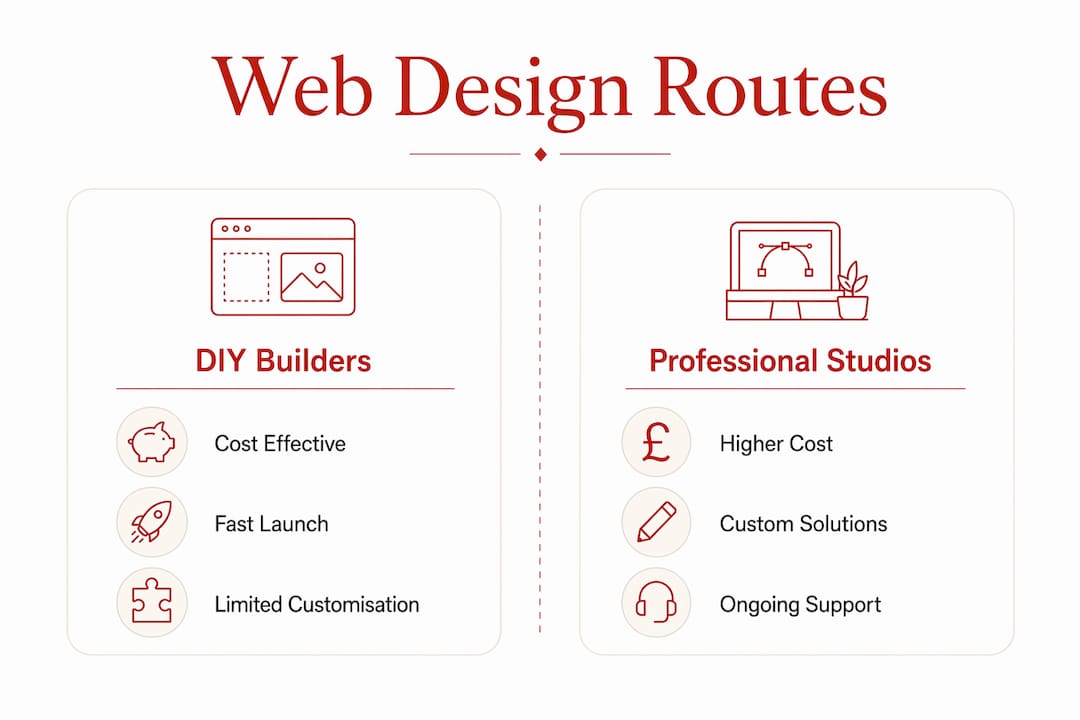
The three routes differ most sharply in ownership, scalability, and what happens after launch — not in how the finished site looks.
| Dimension | DIY no-code builder | CMS (e.g. WordPress) | Professional web design studio |
|---|---|---|---|
| Best for | Simple brochure sites, tight budgets, fast launch | Growing teams needing content control and scalability | High-trust organisations where the site is a credibility signal |
| Cost shape | Low monthly subscription; limited upfront | Moderate upfront; ongoing hosting and maintenance | Higher upfront costs typical for small business sites; lower ongoing costs if well-built |
| Control and ownership | Platform owns the template; export options vary | Full code and content ownership possible | Full ownership if contract specifies it — always confirm in writing |
| Scalability and maintenance | Limited; platform dictates feature roadmap | High; plugins and custom code extend capability | High; built to specification, maintained by studio or in-house |
| Time to launch | Launches take a short time, often within a few weeks | Builds generally take several weeks depending on complexity | Builds typically require several weeks for a small business site |
| Technical skill required | Minimal | Moderate; some configuration needed | None from the client side |
| Accessibility and sustainability | Varies by platform; often limited control | Configurable; depends on theme and plugins | Can be built to WCAG standards and sustainable design practices |
| SEO and performance | Basic; platform-level controls only | Strong with correct configuration | Strongest; strategy and technical SEO built in from the start |
Template-based no-code builders accelerate launch and require no coding knowledge, but they often limit how much you can customise structure, metadata, or accessibility settings. A CMS offers the best balance of control and scalability for teams that plan to grow, though it requires governance and ongoing technical maintenance. For professional services and other high-trust organisations, a specialist studio is the appropriate choice because the website functions as a primary credibility signal that must convert visitors to clients or supporters.
How do you decide which route is right for you?
Start by mapping two things: how complex the project is, and how much internal capacity you have to manage it after launch.
Project complexity indicators:
- Does the site need to integrate with a CRM, booking system, or payment gateway?
- Will multiple staff members need to update content regularly?
- Does the organisation serve a public audience with accessibility obligations?
- Is the site expected to generate enquiries, donations, or sales?
- Will you need ongoing SEO, analytics reporting, or conversion tracking?
If you answered yes to two or more of those questions, a DIY builder is unlikely to serve you well past the first six months.
Questions to ask any provider before you commit:
- Who owns the domain name, and can it be transferred if you leave?
- Who holds the source code, and will it be handed over at project end?
- What analytics are set up at launch, and who has access?
- What does post-launch support include, and at what cost?
- How are scope changes handled and priced?
Red flags that should stop the process:
- No clear answer on domain and code ownership
- A timeline shorter than six weeks for a custom build (see Section 4)
- No mention of accessibility, Core Web Vitals, or technical SEO
- Lock-in clauses that prevent you from migrating your content
- Opaque pricing with no itemised scope of work
Pro Tip: Ask to see two or three live client sites that are at least 18 months old. A portfolio of recent launches tells you how a studio designs; older live sites tell you how well those sites hold up under real-world use and whether the studio supports clients after go-live.
For organisations in the charity and community sector, the nonprofit website checklist from Marzipan Media covers the governance and content questions specific to that context.
What do websites typically cost and how long do they take in Australia?
Cost and timeline vary considerably depending on route, content readiness, and the complexity of integrations. The figures below reflect the Australian market.
| Route | Typical cost (AUD) | Typical timeline | Notes |
|---|---|---|---|
| DIY no-code builder | Low monthly subscription | Launches take a short time, often within a few weeks | Content must be ready; limited customisation |
| CMS build (professionally configured) | Moderate upfront cost range | Builds generally take several weeks | Includes theme, plugins, basic SEO setup |
| Small business studio build | $5,000–15,000 | 6–10 weeks | Discovery, design, build, testing, handover |
| eCommerce studio build | $10,000–30,000+ | 10–16 weeks | Catalogue, payments, fulfilment integrations |
| Enterprise or complex build | Starting from $30,000+ | 4–6 months | Custom functionality, multiple integrations |
| Ongoing maintenance | $1,500–5,000 per year | Ongoing | Hosting, updates, security, analytics |
A standard professional small business website typically requires six to ten weeks from contract to launch. Timelines shorter than six weeks for a custom build usually mean discovery or testing has been reduced. If a provider quotes four weeks for a bespoke site, ask explicitly what has been removed from the process to meet that date.
Very low quotes — well below AU$5,000 for a professionally designed site — often indicate a templated build with minimal strategy or discovery. That is not always wrong, but it should be understood for what it is.
Variables that shift cost and time include content readiness (the single biggest delay in most projects), the number of integrations, eCommerce requirements, accessibility work, and whether the brief changes after the project starts.
For practical guidance on delivering quality within a tighter budget, the affordable web design resource from Marzipan Media is worth reading before you request quotes.
What features should you prioritise for a site that is easy to manage long-term?
A site that is easy to launch is not always easy to maintain. These features reduce long-term risk and administrative burden.
- CMS ownership and exportability. You should be able to export your content and move to another platform without starting from scratch. Confirm this before signing.
- Responsive design. Every page must work correctly on mobile devices. This is a baseline, not a premium feature.
- Accessibility (WCAG basics). Australian organisations serving the public have obligations under the Disability Discrimination Act 1992. At minimum, the site should meet WCAG 2.1 Level AA. Detailed guidance for Australian not-for-profits is available on WCAG requirements.
- Basic SEO foundations. Page titles, meta descriptions, structured headings, and a sitemap should be configured at launch, not added later.
- Privacy and compliance. The site must comply with the Australian Privacy Act 1988, including a clear privacy policy and correct cookie handling.
- Analytics and conversion tracking. Post-launch analytics and goal tracking are not optional for organisations that need to demonstrate impact or justify spend.
- Sustainable performance. Optimising images, limiting third-party scripts, and sensible caching reduce carbon output and improve page speed, which benefits both accessibility and SEO together.
Pro Tip: To check a provider’s sustainability commitment quickly, ask whether they measure the carbon footprint of the sites they build and whether they can point to a published approach. A provider with no answer to that question has not thought seriously about sustainable web design.
What should you expect when you hire a specialist web design studio?
A well-run studio engagement follows a clear sequence. Understanding each stage helps you evaluate proposals and hold providers to account.
- Discovery. The studio interviews stakeholders, reviews existing analytics, and documents goals, audiences, and constraints. This stage produces a brief or strategy document that governs the rest of the project.
- Strategy and information architecture. Page structure, user journeys, and content hierarchy are agreed before any visual design begins.
- Design. Visual concepts are presented, revised, and approved. A good studio will present accessibility and mobile considerations at this stage, not after build.
- Build. The approved design is developed in the chosen CMS or platform. Integrations, forms, and SEO foundations are configured here.
- Testing. The site is tested across devices and browsers, accessibility is checked, and performance is measured before launch.
- Launch and handover. The site goes live. A proper handover includes CMS training, documentation, and written confirmation of who owns the domain, hosting, and source files.
- Post-launch support. Agree in writing what is included: bug fixes, content updates, analytics reporting, and a schedule for technical audits.
Deliverables to insist on: discovery artefacts, source files, full CMS access, analytics configuration, staff training, and a written maintenance plan.
Governance clauses to check in any contract:
- Explicit statement of who owns the domain, code, and hosting
- Export rights for all content and design assets
- How scope changes are priced and approved
- Uptime commitments and response times for critical issues
- Conditions under which the contract can be ended by either party
Verify that domain and code ownership is documented before making the final payment. This is the single most common governance failure in web projects.
Why does an ethical studio suit mission-led organisations?
For professional services and mission-led organisations, the website is often the primary credibility signal. Spending more on strategy and discovery can return its cost in a single client or donor engagement. A studio that understands this treats the site as a long-term asset, not a one-time deliverable.
Marzipan Media, based in Sydney, works with purpose-driven organisations that need websites aligned with their values. The studio combines ethical AI, sustainable web design, and performance-driven SEO to build sites that hold up over time. Its approach prioritises governance, accessibility, and measurable outcomes over visual novelty.
Key service characteristics:
- Sustainable design practices baked into every build, not added as an afterthought
- Accessibility considered from the strategy stage, not retrofitted after launch
- Long-term SEO and site maintenance as a core offering, not an optional extra
- Transparent ownership: clients leave with their domain, code, and content
For community groups and charities considering a studio engagement, the web design studio guide for nonprofits sets out what to expect and what to ask.
Key takeaways
The most important decision in any web project is not which platform to use — it is confirming, in writing, who owns the domain, the code, and the content before any payment is made.
| Point | Details |
|---|---|
| Match route to complexity | Use a no-code builder for simple brochure sites; a CMS for growing teams; a studio for high-trust, mission-critical sites. |
| Budget realistically | Professionally designed small business websites in Australia commonly range from $5,000–15,000; eCommerce builds commonly range from $10,000–30,000+. |
| Confirm ownership first | Before signing, get written confirmation of who owns the domain, source code, and CMS access. |
| Plan for post-launch | Analytics, conversion tracking, and a yearly technical audit are not optional for organisations that need to demonstrate impact. |
| Marzipan Media | A Sydney-based studio specialising in ethical, sustainable web design and long-term SEO for purpose-driven Australian organisations. |
Design choices that respect mission and resources
The most consistent mistake in web projects is treating launch as the finish line. A site that goes live without a maintenance plan, analytics configuration, or a clear owner for ongoing updates will degrade within twelve months. Speed to launch and long-term stewardship are genuinely in tension, and the organisations that manage this well are the ones that invest in discovery and governance before they invest in visual design.
There is also a tendency to over-specify. A modest, well-maintained site with clear navigation, fast load times, and correct accessibility settings will outperform a feature-heavy build that nobody has the capacity to update. For non-technical managers, the practical question is not “what can we build?” but “what can we govern?”
Accessibility and sustainability are worth treating as governance requirements, not design preferences. Both reduce long-term risk: accessible sites avoid legal exposure under the Disability Discrimination Act 1992, and sustainable sites load faster, rank better, and cost less to run. Neither requires a large budget; both require a provider who takes them seriously from the start.
How Marzipan Media can help your organisation
Marzipan Media offers a concrete alternative to the generic agency model for mission-led organisations in Australia. Rather than a large-scale rebuild with a long delivery timeline, the studio focuses on right-sized builds, sustainable design, and ongoing SEO and maintenance that organisations can actually afford to sustain.
The engagement starts with a free discovery conversation: a short call to understand your goals, current site, and governance situation before any proposal is made. There is no obligation and no sales pressure. If the fit is right, Marzipan will outline a clear scope, a realistic timeline, and transparent pricing.
For organisations that need ongoing search visibility alongside a well-built site, Marzipan’s SEO and maintenance service keeps performance measurable and the site technically sound over time. Get in touch to arrange a discovery conversation.
Further reading and Australian references
These sources were used in preparing this article and are worth consulting directly for due diligence.
- Build and manage your website, Business Queensland — Australian government guidance on choosing between builders, CMS, and agencies.
- How to Choose a Web Design Agency in Australia, Velacore — Practical cost benchmarks and timeline guidance for the Australian market.
- How to choose a web design agency, Studio Slate — Governance and ownership questions to ask before signing.
- Sustainable web design, Marzipan Media — Practical guidance on carbon, performance, and accessibility in web design.
- WCAG accessibility requirements for Australian not-for-profits, Marzipan Media — Accessibility obligations and practical steps for Australian organisations.
When evaluating any provider, ask to see live client sites that are at least 18 months old. A recent portfolio shows design quality; older live sites show whether the studio supports its clients after launch and whether those sites remain performant over time.


