

TL;DR:
- Brand story marketing organizes communication around a coherent narrative that connects purpose to audiences, fostering emotional bonds and clearer positioning. Using the customer as the hero instead of the organization enhances persuasion, builds preference, and strengthens advocacy through deep emotional involvement. Effective stories are supported by strong governance, consistent channel execution, and measurement before launch.
Brand story marketing is the practice of organising a brand’s communications around a coherent narrative that connects the organisation’s purpose to the people it serves. Done well, it produces three outcomes that matter to marketing professionals:
- Emotional connection with audiences who share the brand’s values
- Clearer positioning that distinguishes the brand from competitors on grounds other than price
- A decision-guiding narrative that makes product, channel and content choices easier to evaluate
Nike’s “Just Do It” is the familiar shorthand: a single narrative frame that has held across decades, product categories and markets without requiring a new strategy for each campaign.
Table of Contents
- What a brand story actually is, and how it differs from your other assets
- Why brand storytelling matters: the business and behavioural case
- The five core elements of a powerful brand story
- Types of brand stories and the channels that suit each
- How to build a brand story: a workshop-ready process
- Typical timelines and costs for a brand story programme in Australia
- How to measure whether your brand story is working
- Common mistakes in brand storytelling, and how to fix them
- Brand storytelling in practice: four short case studies
- Why narratives work: evidence from consumer psychology
- Key takeaways
- Brand story as a business principle, not a campaign
- How Marzipan supports brand story marketing
- Further reading and sources
What a brand story actually is, and how it differs from your other assets
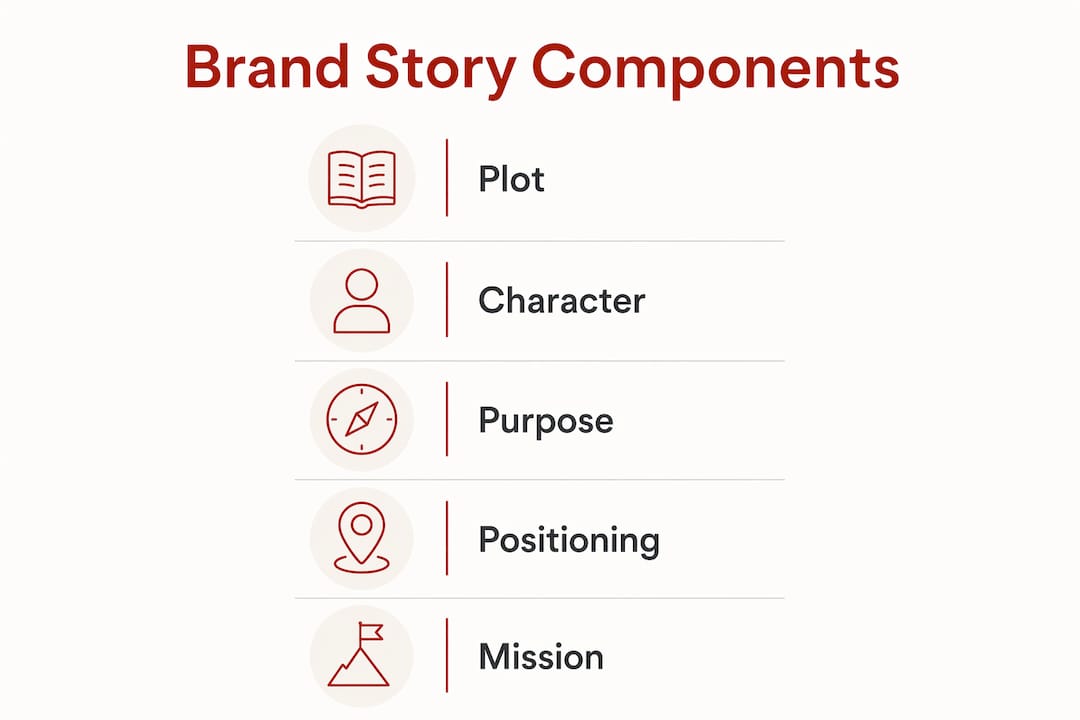
Strategic brand management research identifies plot, character and purpose as the three core components of a brand story. Plot is the sequence of events that explains why the brand exists and what it is trying to change. Character is the protagonist whose journey the audience follows. Purpose is the reason the story matters beyond commercial gain.

These three components work together to create positioning that is consistent over time. A mission statement, by contrast, is a governance document. Brand messaging is tactical copy. Neither is a story.
| Asset | Primary purpose | Time horizon | Tactical use |
|---|---|---|---|
| Brand story | Organising narrative for all communications | Long-term (3–10 years) | Briefs, creative strategy, culture |
| Mission statement | Internal governance and accountability | Ongoing | Annual reports, hiring, board papers |
| Brand messaging | Conversion and clarity at each touchpoint | Short-term | Ads, web copy, sales materials |
The hero question is the most consequential decision in brand storytelling. Many organisations default to making the founder or the organisation the hero. The stronger choice, in most cases, is to position the customer as the protagonist and the brand as the guide or enabler. This shifts the story from “look what we built” to “here is what becomes possible for you,” which is a more persuasive frame for audiences who are deciding whether to trust an unfamiliar brand.
Why brand storytelling matters: the business and behavioural case
Narrative-based advertising produces more favourable product evaluations than factual, feature-led copy. The mechanism is ad message involvement: when a consumer follows a narrative, they process brand information more deeply and map it to their own identity goals. The result is not just recall but preference.
The business outcomes that follow from this are well-documented in practitioner research:
- Brand preference increases when audiences identify with the story’s protagonist
- Willingness to pay rises because the brand occupies a distinct position rather than competing on features
- Advocacy grows when customers feel the brand’s story reflects their own values
- Product decisions become easier for buyers because the narrative provides a consistent frame of reference
Statistic: Consumers form self-brand connections when they process advertising narratively. Experimental evidence shows this increases both brand attitudes and behavioural intentions, including purchase intent.
For mission-driven organisations, the case is particularly direct. When the organisation’s purpose is genuinely embedded in the story, audiences who share that purpose become advocates without being prompted.
The five core elements of a powerful brand story
These five elements provide a working framework for workshops and creative briefs. Each prompt is designed for a team session of 60–90 minutes.
-
Purpose. Why does this organisation exist beyond revenue? Prompt: Complete this sentence — “We exist so that [audience] can [outcome] without [barrier].”
-
Protagonist/hero. Who is the story about? Prompt: Describe your ideal customer at the moment they most need what you offer. What are they trying to do? What is getting in the way?
-
Conflict or challenge. What tension does the brand resolve? Prompt: What would your customer lose, miss, or fail at if your organisation did not exist?
-
Transformation. What changes for the protagonist because of the brand? Prompt: Describe the before and after state in two sentences. What is measurably or meaningfully different?
-
Proof. What evidence supports the transformation claim? Prompt: List three real examples — a customer outcome, a product result, or a community impact — that demonstrate the transformation is genuine.
These elements map directly to positioning. Purpose anchors the brand’s category and values. Protagonist and conflict define the audience segment and the problem the brand owns. Transformation and proof translate into the claims that appear in advertising, web copy and sales materials.
Types of brand stories and the channels that suit each
Brand stories take several forms, and the right choice depends on the organisation’s objectives, audience and resources.
Founder stories work well when the founder’s personal experience is directly relevant to the audience’s problem. Mailchimp’s origin as a tool built by a small agency for small businesses is a founder story that has remained credible because the company’s product decisions have consistently reflected it.
Product stories focus on how something was made or why it works. They suit technical categories where credibility is at stake. Authentic, lower-production content on platforms such as TikTok frequently outperforms high-production assets for trust and engagement when it aligns with the brand story and audience expectations. This is a useful corrective for organisations that assume production quality and persuasion are the same thing.
Purpose-led stories are most common in the not-for-profit and social enterprise sectors. Guinness has used purpose-led storytelling across decades, most notably in campaigns that connect the act of waiting for a pint to broader themes of patience, character and community. The format is long-form brand film, and the channel is broadcast and online video.
Customer stories place the audience at the centre and let their experience carry the narrative. R.M. Williams uses this approach by evolving its hero archetypes to reflect contemporary Australian consumer identity rather than relying solely on the brand’s pastoral heritage. The result is a community of advocates who see the brand as part of their own story.
Channel fit matters as much as story type. Brand film suits purpose-led and founder stories where emotional depth is the goal. Social-native formats suit product and customer stories where authenticity and frequency matter more than production. Owned content (blog, email, podcast) suits organisations building long-term trust with a specific community. PR and retail experiences suit brands whose story is best understood through direct encounter.
How to build a brand story: a workshop-ready process
The process below is replicable for a team of four to eight people. It assumes a facilitator and a note-taker.

Step 1: Discovery (half-day)
Gather existing brand assets, customer research, and staff perspectives on why the organisation exists. The output is a raw narrative inventory.
Step 2: Positioning (two hours)
Apply the five-element framework from the previous section. Identify the protagonist, the conflict and the transformation. Decide whether the hero is the customer or the organisation.
Step 3: Creative concepting (two hours)
Draft three story directions, each with a different protagonist or conflict frame. Test each against the organisation’s values and the audience’s stated needs.
Step 4: Validation (one to two weeks)
Test the draft story with a small group of customers or staff. Use these prompts: Does this sound like us? Does it reflect your experience? Would you share it?
Step 5: Governance (one hour)
Define who owns the story, how it will be updated, and which assets are canonical. For high-trust organisations, this step is not optional.
Half-day schedule (4 hours)
- 0:00–1:00 Discovery: review existing assets and customer input
- 1:00–2:00 Positioning: apply the five-element framework
- 2:00–3:00 Concepting: draft two story directions
- 3:00–4:00 Validation planning: agree testing method and timeline
Full-day schedule (7 hours)
- 0:00–1:30 Discovery: stakeholder interviews and asset review
- 1:30–3:00 Positioning: five-element framework with full team
- 3:00–4:30 Concepting: three story directions with channel mapping
- 4:30–5:30 Validation: live testing with a small customer group
- 5:30–6:30 Governance: ownership, update cycle, canonical assets
- 6:30–7:00 Next steps: brief for production or agency
After the workshop, the immediate next steps are a written story brief (one page), a channel plan that maps story types to formats, and a measurement baseline established before any content goes live.
Pro Tip: When treating the brand story as an organising principle for product, distribution and PR decisions, the story brief becomes the filter for every significant business choice, not just the communications plan.
Typical timelines and costs for a brand story programme in Australia
The table below reflects general market conditions for Australian organisations in 2026. Figures are indicative of a typical range and vary by scope, sector and supplier.
These ranges estimate costs for a single hero asset (brand film or long-form content piece) with channel adaptations. A lower-budget approach focuses production spend on fewer assets, then repurposes content for social, owned channels and PR to control cost while maintaining measurement consistency.
For high-trust organisations, procurement notes: require the agency to demonstrate experience with governance and accessibility standards, not just creative awards. Ask for examples of brand story work that has been maintained and updated over time, not just launched.
Internal resourcing typically requires a brand or marketing lead (0.3–0.5 FTE during development), a content producer or copywriter, and a channel manager for rollout. External partners add strategic and creative capacity but require clear briefing and governance from the internal team.
How to measure whether your brand story is working
Measurement should be established before content goes live, not after. The baseline matters as much as the post-campaign read.
Primary quantitative KPIs:
- Brand awareness (prompted and unprompted) measured via survey
- Brand preference and consideration lift, tracked quarterly
- Purchase intent, measured at key decision points
- Net Promoter Score, as a proxy for advocacy
Secondary metrics:
- Video watch time and completion rate
- On-site time-on-page and scroll depth for story-led content
- Email open and click rates for narrative-driven sequences
- Social share rate (a signal of identification, not just consumption)
Qualitative signals to monitor:
- Sentiment in comments, reviews and direct messages
- Whether customers use the brand’s own language when describing it
- Unsolicited advocacy: mentions, referrals, user-generated content
A simple A/B testing plan for brand story content: run two versions of a key asset, one narrative and one factual, to the same audience segment over four weeks. Measure watch time, click-through and post-exposure survey responses. The narrative processing mechanism predicts the narrative version will produce higher involvement scores; the test confirms whether that holds for your specific audience.
| Metric | Tool | Frequency |
|---|---|---|
| Brand awareness/preference | Survey (e.g. Google Surveys, Qualtrics) | Quarterly |
| Video watch time | YouTube Analytics, Meta Insights | Weekly |
| On-site behaviour | Google Analytics 4 | Monthly |
| Sentiment | Social listening tool | Monthly |
| NPS | Survey platform | Bi-annually |
Common mistakes in brand storytelling, and how to fix them
-
Hero confusion. The organisation casts itself as the hero rather than the customer. Fix: rewrite the story brief with the customer as protagonist and the brand as guide.
-
Overclaiming. The transformation promise exceeds what the product or service can deliver. Fix: anchor every claim to a real customer outcome from the proof element of the framework.
-
Disjointed channel execution. The story is coherent in the brand film but absent from the website, email and sales materials. Fix: create a one-page story brief that every channel team uses as a filter before publishing.
-
Ignoring governance. The story is launched but never updated or maintained. Fix: assign a named owner and schedule an annual story review.
-
Ignoring accessibility. Video content lacks captions; written content uses complex language that excludes part of the audience. Fix: build accessibility requirements into the production brief, not as an afterthought.
-
Cultural misstep. The story uses imagery, language or archetypes that do not translate across the organisation’s audience segments. The Dolce & Gabbana China campaign is a well-documented example of a brand story that failed because it did not account for cultural context. Fix: test story concepts with representative members of each key audience segment before production.
-
Sustainability as decoration. Purpose-led claims are not backed by organisational practice. Fix: audit the organisation’s actual practices against the story’s purpose claim before publishing.
For high-trust organisations, the ethical risks are particularly acute. A story that claims community benefit but cannot be substantiated will damage credibility faster than no story at all.
Brand storytelling in practice: four short case studies
R.M. Williams
Objective: Maintain relevance for a heritage brand across changing consumer demographics.
Core idea: The R.M. Williams story is built on the hero archetype: the self-reliant Australian who operates with quiet competence in demanding conditions. Research published in Business Horizons shows that hero archetypes remain persuasive in contemporary branding but require active maintenance. R.M. Williams has updated its archetype to include urban professionals and women without abandoning the pastoral origin narrative.
Formats and channels: Long-form editorial, retail experience, social content, PR.
Learning: Heritage narratives do not need to be preserved intact. They need to be extended to include new protagonists while keeping the core archetype credible.
Nike
Objective: Create a single narrative frame that works across every product category and market.
Core idea: “Just Do It” positions the customer as the athlete and the obstacle as internal rather than external. The story is not about the shoe; it is about the person wearing it. This is the customer-as-hero model at scale.
Formats and channels: Broadcast, digital, experiential, social, athlete partnerships.
Learning: A story frame that is genuinely about the customer’s transformation can hold across decades and product lines without requiring a new strategy for each.
Mailchimp
Objective: Differentiate a marketing platform in a crowded category without competing on features.
Core idea: Mailchimp’s brand story centres on the small business owner who is trying to do something meaningful with limited resources. The brand’s visual identity, tone of voice and product decisions have consistently reflected this protagonist.
Formats and channels: Owned content, documentary-style video, social-native formats, in-product experience.
Learning: When the story is genuinely about the customer’s situation, product and communications decisions become easier to evaluate. Mailchimp’s story brief functions as an organising principle for the whole business.
Guinness
Objective: Build emotional depth for a commodity product in a competitive category.
Core idea: Guinness has used the theme of patience and character across multiple campaigns, most notably “Good things come to those who wait.” The story is not about the product’s ingredients; it is about what the act of waiting reveals about a person.
Formats and channels: Long-form brand film, broadcast, out-of-home, social.
Learning: A purpose-led story can elevate a commodity product by connecting it to a universal human experience. The format must match the emotional depth of the story: short-form content would not carry the same weight.
Why narratives work: evidence from consumer psychology
The cognitive mechanism behind narrative effectiveness is well-established. When a consumer encounters a narrative, it creates what researchers describe as a narrative shell: a processing frame that primes the consumer to map incoming brand information to their own personal story. This increases involvement and the probability of forming a self-brand connection.
The practical implication is that narrative advertising is not simply more engaging than factual copy. It operates through a different cognitive pathway. Factual messaging is processed analytically; narrative messaging is processed experientially. The two approaches are not interchangeable, and the choice between them should be deliberate.
Narrative tends to outperform factual messaging when the audience’s decision is values-driven or identity-related. Factual messaging tends to outperform narrative when the decision is primarily technical or when the audience is in a late-stage evaluation mode. The most effective approach often combines both: a narrative frame that establishes emotional relevance, followed by factual proof that confirms the rational case.
Stanford’s research on memory and storytelling supports this: information embedded in a narrative is retained more reliably than the same information presented as a list of facts. For brand managers, this means the story is not just a communications tool. It is a memory architecture.
Key takeaways
Brand story marketing works when the customer is the protagonist, the story is consistent across every channel, and governance ensures it is maintained over time.
| Point | Details |
|---|---|
| Customer as protagonist | Position the customer as the hero of the story; the brand functions as guide or enabler. |
| Five-element framework | Use purpose, protagonist, conflict, transformation and proof to draft or audit any brand story. |
| Governance is not optional | Assign a named story owner and schedule an annual review to keep the narrative credible. |
| Measure before you publish | Establish awareness and preference baselines before content goes live, not after. |
| Com’s approach | Marzipan helps mission-driven organisations build story-led digital presences that hold up over time. |
Brand story as a business principle, not a campaign
There is a tendency in marketing practice to treat brand storytelling as a creative exercise: something that happens at the beginning of a campaign cycle and is then handed to a production team. The organisations that get the most from their brand story treat it differently.
When a story is genuinely embedded in how an organisation makes decisions, it becomes a filter. Product choices, distribution partnerships, PR opportunities and content investments are all evaluated against the same question: does this reinforce or contradict the story we are telling? Sundae Body’s scaling strategy is a recent Australian example of this approach: the brand’s story about making body care joyful and accessible was used to vet retail placements, packaging decisions and influencer partnerships, not just advertising creative.
For mission-driven organisations, this matters more, not less. A story that claims community benefit but is contradicted by the organisation’s procurement practices or digital accessibility standards will erode trust faster than silence. The story has to be true at the operational level, not just the communications level.
The organisations Marzipan works with typically come to brand story work not because they lack a story, but because the story they have been telling is not reflected in their digital presence. The website uses different language from the social channels. The SEO strategy is optimised for volume rather than for the audience the story is actually for. Fixing that gap is not a creative problem. It is a governance problem, and it requires the same rigour as any other organisational decision.
How Marzipan supports brand story marketing
Marzipan works with purpose-driven organisations in Sydney and across Australia to build digital presences that reflect and sustain their brand story. That includes brand strategy, web design built to accessibility and sustainability standards, and search visibility work that connects the right audiences to the right content over time.
The work is not about producing more content. It is about ensuring that the story an organisation has worked to develop is consistently expressed across every digital touchpoint, from the homepage to the search result to the email sequence. If you are working on a brand story and want to understand how your digital presence supports or undermines it, the Marzipan services page is a practical starting point.
Further reading and sources
-
Three core components of a brand story — peer-reviewed strategic brand management research identifying plot, character and purpose as the structural foundation of a brand story.
-
Narrative versus factual advertising: ad message involvement — experimental research demonstrating why narrative advertising produces stronger product evaluations than feature-led copy.
-
Narrative processing and self-brand connections — academic paper on the cognitive mechanism linking narrative processing to brand attitudes and behavioural intentions.
-
R.M. Williams: hero brands and brand heroes — Business Horizons case study on how an iconic Australian brand has evolved its hero archetype to remain relevant.
-
Sundae Body: brand story as organising principle — Australian FMCG case study on using brand story to vet product, distribution and PR decisions at scale.
-
Dermal Therapy: authentic content and technical credibility — practitioner case study on how a challenger brand combined founder narrative with platform-native content and scientific credibility.
-
Memory and storytelling — Stanford resource on why information embedded in narrative is retained more reliably than list-based presentation.
-
Dolce & Gabbana China campaign — NPR coverage of a brand story failure caused by cultural misreading; useful reference for risk and governance sections.
-
Brand storytelling examples for mission-driven organisations — Marzipan resource with Australian-relevant examples and practical repurposing guidance.
-
Brand storytelling guide for marketing professionals — Marzipan guide covering templates and governance considerations for purpose-driven organisations.


