

TL;DR:
- Brand storytelling uses narrative to express a brand’s identity and build emotional connections. It centers on the customer as protagonist and remains a stable asset unless strategy changes. Effective stories boost engagement, loyalty, and recruitment results across all channels.
Brand storytelling is the strategic use of narrative to communicate a brand’s identity, values, and purpose in ways that build emotional connection and lasting audience loyalty. Unlike advertising copy or product descriptions, a brand story gives an organisation a consistent voice and point of view that persists across every channel and campaign. Marketing professionals who treat narrative as a foundational asset, rather than a creative afterthought, report measurably stronger engagement and recruitment outcomes. This guide explains the core frameworks, the evidence behind them, and the practical steps to develop a narrative that holds.
What is brand storytelling and why does it matter?
Brand storytelling is defined as the deliberate use of narrative structure to express what a brand stands for and why it exists. The practice draws on the same principles as any effective story: a character facing a problem, a turning point, and a resolution that carries meaning. Applied to marketing, those elements map onto the customer’s experience, not the brand’s own history.
The distinction matters. Protagonist-focused narratives build deeper emotional connections and customer loyalty than brand-centred content. That finding reflects a broader shift in narrative marketing: audiences respond to stories in which they recognise themselves, not stories in which a company celebrates its own achievements.
The business case is concrete. Brands using storytelling in recruitment report up to 10x more job applications than competitors who rely on standard job listings. That figure shows how a well-constructed brand narrative extends well beyond the marketing function and into talent acquisition, culture, and organisational reputation.
What are the core elements of a compelling brand story?
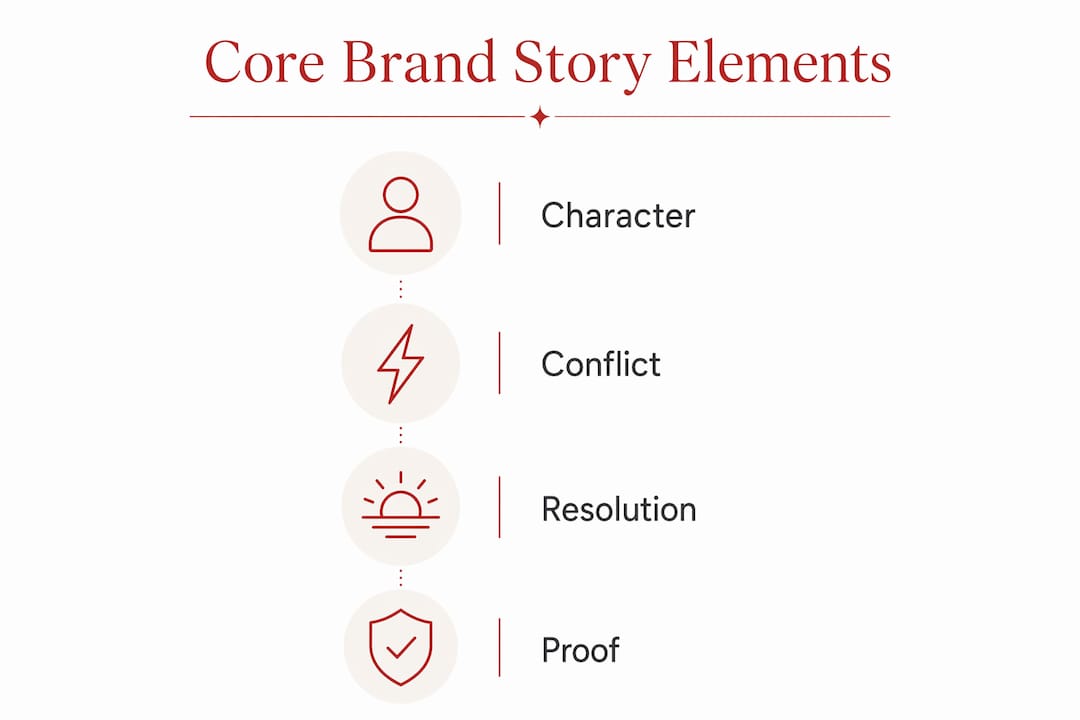
Four pillars form the foundation of any effective brand story: character, conflict, resolution, and proof. Omitting any one of these pillars causes a narrative to feel hollow or promotional. Each element carries specific weight.
Character is the customer, not the brand. The brand’s role is that of guide or catalyst. Conflict is the real problem the customer faces before encountering the brand. Resolution is the transformation the customer experiences. Proof is the evidence that the transformation is genuine, drawn from real outcomes, testimonials, or data.
Frameworks that structure the narrative
Several frameworks help marketing teams organise these pillars into a coherent through-line. The People, Places, Purpose, Plot model asks teams to identify who the story is about, where it takes place, what the brand believes, and what happens as a result. The classic narrative arc, adapted from screenwriting, moves through situation, complication, and resolution. Both frameworks share one principle: the brand must equip customers, not position itself as the central hero.
| Framework | Core question | Best used for |
|---|---|---|
| People, Places, Purpose, Plot | Who, where, why, what happens? | Building a foundational brand narrative |
| Narrative arc | Situation, complication, resolution | Campaign-level and video storytelling |
| Customer as protagonist | What does the customer overcome? | Case studies and testimonial content |
| Mission-to-story translation | What conviction drives the brand? | Internal alignment and brand guidelines |
Pro Tip: Before choosing a framework, map out two or three real customer outcomes. The framework that best contains those stories is the one to use.
How does brand storytelling affect engagement and business results?
The evidence for narrative marketing’s impact is specific and measurable. Embedding QR codes on product packaging that link to storytelling videos increased post-purchase email engagement by 17%. That result demonstrates that story touchpoints placed at the right moment in the customer journey extend engagement well beyond the point of sale.

The recruitment effect is equally significant. Brands that apply storytelling to their employer communications attract up to 10 times more applicants than those relying on functional job descriptions alone. A compelling brand narrative signals organisational culture and values in ways that a list of responsibilities cannot.
Across marketing functions, effective brand stories produce a consistent set of outcomes:
- Increased customer loyalty through emotional identification with the brand’s values
- Stronger differentiation in crowded markets where product features are similar
- Greater consistency across teams and channels when a core narrative is clearly defined
- Improved pipeline quality in recruitment, as candidates self-select based on cultural fit
- Higher content engagement rates when stories are placed at relevant customer touchpoints
Pro Tip: Integrate authentic customer stories into post-purchase communications. A brief, real account of a customer’s experience at that moment carries more weight than any promotional message.
Data-informed storytelling offers a further advantage by identifying precisely whose story to tell and when it will be most relevant. Modern narrative marketing is insight-led rather than instinct-led. That shift means brand managers can make decisions about story selection with the same rigour applied to media planning or conversion rate analysis.
How does brand storytelling differ from a mission statement?
Mission statements and brand stories serve different functions, and conflating them weakens both. Mission statements aim for consensus and broad alignment, while brand stories highlight a distinct conviction or point of view. A mission statement says what an organisation does. A brand story shows why that matters and to whom.
The table below illustrates the practical differences:
| Dimension | Mission statement | Brand story |
|---|---|---|
| Purpose | Internal alignment and governance | External connection and differentiation |
| Tone | Declarative and inclusive | Narrative and specific |
| Audience | Broad stakeholders | Defined customer or community |
| Stability | Reviewed periodically | Permanent unless strategy shifts |
| Outcome | Consensus | Conviction |
A foundational brand story acts as a permanent asset, remaining stable unless the organisation’s core strategy or market positioning changes. That permanence is what distinguishes it from campaign content, which is seasonal and tactical. Brand managers who treat their narrative as a campaign risk rebuilding from scratch every financial year.
Storytelling in advertising draws on the brand story but is not the same thing. An advertisement uses narrative techniques to drive a specific response within a defined window. The brand story is the source material from which those advertisements draw their coherence. Without a stable source narrative, advertising becomes a series of disconnected creative executions.
How to develop a brand storytelling strategy: practical steps
The most common obstacle to effective brand narrative development is not a lack of creativity. Most brands face a discovery problem: the stories exist within the organisation and its customer base, but no one has extracted them. The work begins with listening, not writing.
A structured approach to building and activating a brand story follows these steps:
- Conduct discovery interviews. Speak with long-term customers, frontline staff, and recent recruits. Ask what changed for them. The answers contain the raw material of the narrative.
- Identify the core conviction. What does the organisation believe about its field that others do not? This conviction becomes the brand’s distinct point of view.
- Position the customer as protagonist. Rewrite any draft narrative that centres the brand’s achievements. The customer’s transformation is the story.
- Build a core narrative anchor. Start with a 90-second to 3-minute film or long-form piece that contains the full story. All shorter content is cut from this anchor, not created independently.
- Adapt for funnel stages. The core narrative remains constant. The format, length, and emphasis shift depending on whether the audience is discovering the brand or considering a decision.
- Measure and refine. Track engagement at each touchpoint. Use the data to identify which story elements resonate most strongly, then weight future content accordingly.
A core narrative simplifies cross-team alignment and messaging consistency across channels. When every team member understands the through-line, content decisions become faster and more coherent. Brand managers spend less time correcting off-message material and more time building on what works.
Pro Tip: Avoid reverse-engineering content from trending hooks or platform formats. Derive all content from the core narrative anchor. Thematic coherence is what makes a brand story recognisable over time.
For purpose-driven brands, the discovery process often surfaces stories of genuine community impact. Those stories carry particular credibility because they are grounded in real relationships rather than marketing objectives.
Key takeaways
Brand storytelling is most effective when it positions the customer as protagonist, draws on real experience, and maintains a stable core narrative across all channels and formats.
| Point | Details |
|---|---|
| Customer as protagonist | Place the customer’s transformation at the centre of every brand story, not the brand’s achievements. |
| Discovery over invention | Extract authentic stories from real customer and organisational experience rather than creating narratives from scratch. |
| Permanent core narrative | Treat the brand story as a stable asset that changes only when core strategy shifts, not with each campaign. |
| Film-first production model | Build a core long-form narrative first, then cut shorter formats from it to maintain thematic coherence. |
| Data-informed selection | Use engagement data to identify which story elements resonate, then prioritise those in future content. |
Brand narrative in practice: what I have observed
The shift from gut-feeling to data-informed narrative marketing is real, and it changes what brand managers need to do well. The creative instinct still matters, but it now needs to be paired with a clear understanding of which stories are actually landing and why.
The most consistent mistake I see is brands positioning themselves as the hero of their own story. It is an understandable impulse. Organisations are proud of what they have built. But audiences do not come to a brand story to hear about the brand. They come to see their own situation reflected back at them, with a credible path forward. The moment a brand places itself at the centre, it loses the audience.
Authenticity is not a tone of voice. It is a commitment to using real stories, real outcomes, and real proof. Invented narratives, however well-crafted, tend to feel thin over time because there is nothing underneath them. The brands that sustain strong storytelling over years are the ones that keep returning to their customers for new material.
Persistence matters more than polish. A consistent narrative told plainly over several years builds more recognition than a beautifully produced campaign that runs once. Brand managers who invest in the foundational story, and then protect it across every channel, are the ones who see compounding returns on that investment.
— Ben
How Marzipan supports brand narrative development online

Marzipan works with purpose-driven and mission-led organisations in Sydney and beyond to build digital presences that reflect their values and carry their stories effectively. That means websites designed to perform, SEO built to last, and digital marketing services structured around authentic, outcome-focused communication rather than volume and noise. For organisations whose brand narrative is central to their community impact, search visibility matters. Marzipan’s AI-informed SEO services help ensure that the right audiences find the right stories at the right moment, without compromising the integrity of the content. If your organisation has a story worth telling, the digital infrastructure should be built to support it.
FAQ
What is brand storytelling?
Brand storytelling is the strategic use of narrative to communicate a brand’s identity, values, and purpose. It differs from advertising in that it creates a stable, ongoing narrative rather than a time-limited message.
How does brand storytelling differ from a mission statement?
Mission statements aim for broad consensus and internal alignment. Brand stories express a distinct conviction and are designed to create emotional connection with a specific audience.
What are the four core pillars of a brand story?
The four pillars are character (the customer as protagonist), conflict (the problem they face), resolution (the transformation), and proof (evidence that the transformation is real).
How do you measure the impact of brand storytelling?
Track engagement at specific story touchpoints across the customer journey. Post-purchase email engagement, recruitment application rates, and content interaction rates are all reliable indicators of narrative effectiveness.
How often should a brand story change?
A foundational brand story should remain stable unless the organisation’s core strategy or market positioning changes. Campaign content adapts frequently; the core narrative does not.


