

TL;DR:
- SEO marketing improves a website’s visibility in unpaid search results to attract relevant visitors without paid ads.
- It relies on technical, on-page, and off-page strategies working together to build durable organic rankings.
SEO marketing is the practice of improving a website’s visibility in unpaid, organic search results so that relevant visitors find it without paid advertising. The industry term is search engine optimisation, and it sits within the broader field of digital marketing alongside paid search, social media, and email. For small business owners in Australia, understanding what SEO marketing involves is the first step towards building an online presence that does not depend entirely on advertising spend. Organic search visibility is distinct from Search Engine Marketing, which relies on paid placements for immediate results.
What are the core components of SEO marketing?
SEO involves three core areas: technical SEO, on-page SEO, and off-page SEO. Each one addresses a different aspect of how search engines find, read, and rank a website. Neglecting any one of the three weakens the others.
Technical SEO
Technical SEO covers the infrastructure of a website. Search engines send automated crawlers to read and index pages, and technical problems block that process. Common issues include slow page load times, broken links, missing XML sitemaps, and pages that are not accessible on mobile devices. A technical SEO audit identifies these problems before they quietly suppress rankings.
On-page SEO
On-page SEO focuses on the content of each page. This means writing clearly about topics that match what your audience is actually searching for, using relevant headings, and structuring pages so both readers and search engines can follow the logic. Keyword relevance matters, but user intent matters more. A page that answers a question thoroughly will consistently outperform one that simply repeats a keyword phrase.

Off-page SEO
Off-page SEO builds a website’s authority through external signals, primarily backlinks from other reputable websites. When credible sources link to your content, search engines treat that as a vote of confidence. Reputation management and consistent brand mentions across the web also contribute. Off-page authority building takes time, but it produces durable results that paid advertising cannot replicate.
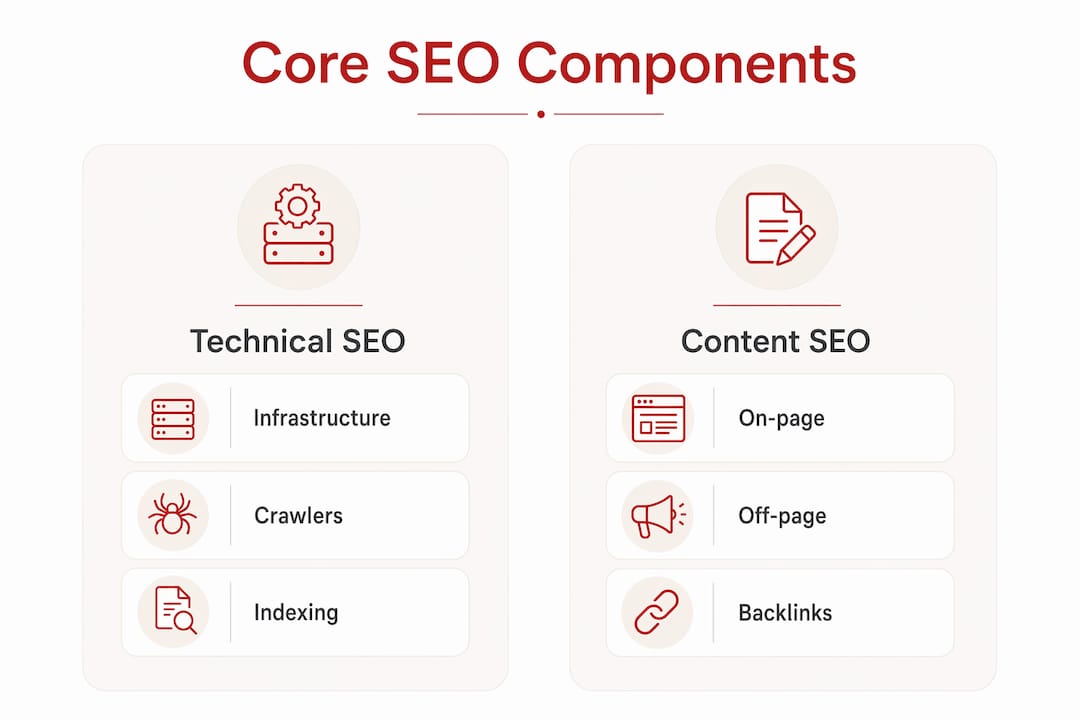
The three pillars work together. A technically sound site with strong content and credible backlinks gives search engines everything they need to rank it well.
Pro Tip: Run a free crawl of your website using a tool like Screaming Frog to identify technical errors before investing in content. Fixing crawl issues first means your content work is not wasted.
How does SEO differ from SEM and paid advertising?
Search Engine Marketing, or SEM, is the umbrella term that includes both SEO and pay-per-click advertising. The two approaches differ significantly in cost, speed, and longevity.
| Factor | SEO | Paid search (PPC) |
|---|---|---|
| Cost model | Time and resource investment | Direct cost per click |
| Speed of results | Months of sustained effort | Immediate placement |
| Longevity | Rankings persist after work stops | Traffic stops when budget stops |
| Primary focus | Organic authority and relevance | Paid visibility and targeting |
Paid advertising delivers traffic immediately, which makes it useful for product launches or time-sensitive campaigns. SEO builds a foundation that continues to attract visitors long after the initial work is done. Paid campaigns stop delivering traffic the moment a budget runs out. SEO does not have that cliff edge.
Digital marketing as a whole encompasses SEO alongside social media, email, and paid advertising. SEO is one channel within that mix, not a replacement for the others. The most effective approach integrates SEO’s long-term growth with the immediacy of paid channels and the relationship-building of social media.
Why does SEO marketing matter for Australian small businesses?
SEO targets users who are actively searching for a product or service. That intent makes organic search visitors more likely to convert than audiences reached through interruption-based advertising. For a small business with a limited marketing budget, that distinction is significant.
The practical benefits for Australian small business owners include:
- Sustainable traffic. Organic rankings continue to deliver visitors without ongoing spend, unlike paid ads that require constant funding.
- Brand credibility. Appearing consistently in search results builds trust with potential customers before they even visit your site.
- Local reach. Local SEO helps businesses appear in geographically relevant searches, which is particularly valuable in Australian cities and regional markets where local intent is strong.
- Cost efficiency over time. The upfront investment in SEO typically costs less per visitor over a 12-month period than maintaining equivalent paid search coverage.
SEO is a long-term investment where measurable results often take months of consistent work. That timeline can feel slow, but the compounding effect of sustained effort means rankings and traffic grow over time rather than resetting each month.
Pro Tip: For local businesses in Australia, claim and fully complete your Google Business Profile. It is one of the fastest ways to appear in local search results and Google Maps without waiting for organic rankings to build.
How is SEO evolving with AI-driven search?
Modern SEO extends beyond traditional search engines to include optimisation for AI-powered platforms, chatbots, and discovery tools. When someone asks an AI assistant a question, the answer it provides is drawn from content that has been written clearly, structured logically, and published on credible websites. The principles of good SEO apply directly to that process.
Semantic search has shifted the focus from matching exact keyword phrases to satisfying the underlying intent behind a query. A page that thoroughly addresses a topic, uses natural language, and organises information with clear headings is better positioned for both traditional search engines and AI-driven results.
Outdated tactics like keyword stuffing, thin content, and manipulative link schemes actively harm rankings under current algorithms. Search engine algorithms now prioritise user experience, page relevance, and content depth. The practical implication is that good writing and clear site structure are not just user experience considerations. They are ranking factors.
Ethical SEO practices that prioritise user experience and accessibility also align with the direction search algorithms are moving. Sustainable SEO is not a compromise between values and performance. It is increasingly the most effective approach available.
Key takeaways
SEO marketing is a long-term practice built on three interconnected pillars: technical infrastructure, on-page content, and off-page authority, each of which must be maintained consistently to produce durable organic visibility.
| Point | Details |
|---|---|
| SEO is not paid advertising | Organic rankings persist after work stops; paid traffic stops when budget stops. |
| Three pillars work together | Technical, on-page, and off-page SEO each support the others and cannot be treated in isolation. |
| Local SEO matters in Australia | Geographically relevant searches reward businesses with complete local profiles and location-specific content. |
| AI search follows the same principles | Content written clearly for users performs well in both traditional and AI-driven search results. |
| Results take time | Consistent effort over months produces compounding growth that short-term tactics cannot replicate. |
SEO marketing and the patience it actually requires
When small business owners ask me about SEO, the conversation almost always turns to timelines. They want to know how quickly they will see results. My honest answer is that meaningful organic visibility typically takes six months of consistent work, sometimes longer. That is not a failure of the method. It is how the method works.
What I have observed over years of working with purpose-driven organisations is that the businesses which treat SEO as a short-term campaign almost always underinvest and then conclude that SEO does not work. The ones that treat it as an ongoing discipline, the same way they treat customer service or financial management, build something genuinely durable.
There is also a values dimension that does not get discussed enough. Ethical SEO, the kind that focuses on accessibility, clear writing, and honest representation of what a business does, is not just the right approach. It is the approach that holds up when algorithms change. Shortcuts that game the system tend to produce fragile rankings. Substance produces stable ones.
For Australian small businesses and community organisations, I think the most underused opportunity is local SEO content. Writing clearly about the specific communities you serve, the locations you operate in, and the problems you solve for people in your area is both good SEO and good communication. Those two things should not be in tension.
— Ben
How Com approaches SEO for Australian organisations
Com works with mission-led organisations across Australia to build search visibility that reflects their values and serves their audiences well. The approach combines technical foundations, content clarity, and ethical off-page authority building.
For small businesses and community organisations looking to grow their organic presence without compromising on quality or values, Com’s AI-informed SEO services are designed to produce results that last. The work is grounded in accessibility, sustainability, and a clear understanding of how search engines and AI platforms evaluate content in 2026. If you are ready to build an online presence that does not depend on ongoing ad spend, Com is based in Sydney and works with organisations across Australia.
FAQ
What is SEO marketing in simple terms?
SEO marketing is the process of improving a website so it appears higher in unpaid search results. The goal is to attract visitors who are actively searching for what the business offers.
How long does SEO take to show results?
SEO typically requires months of consistent effort before significant ranking improvements are visible. Most organisations see meaningful results within six to twelve months of sustained work.
What is the difference between SEO and Google SEO?
Google SEO refers to optimising specifically for Google’s search algorithm, which dominates search in Australia. The principles of technical, on-page, and off-page SEO apply directly to Google’s ranking criteria.
What does an SEO service include?
An SEO service typically covers technical audits, on-page content improvements, keyword research, and off-page authority building. The scope varies depending on the provider and the organisation’s goals.
Why is local SEO important for Australian small businesses?
Local SEO helps businesses appear in searches tied to a specific location, such as suburb or city. For Australian small businesses, this is often the fastest route to attracting nearby customers through organic search.


