

Digital content marketing is the practice of producing and distributing useful, relevant material online to attract a defined audience, build trust, and drive profitable action. It is not advertising. It does not interrupt. It earns attention by answering questions, solving problems, and demonstrating expertise over time.
Three goals sit at the centre of most content programmes:
- Attract qualified visitors through search, social, and referral channels
- Inform and build credibility with people who are evaluating their options
- Convert interested readers into enquiries, subscribers, or clients
Australian note: Australian audiences expect transparency. The Spam Act 2003 governs commercial electronic messages, and the ACCC monitors misleading claims in marketing material. Compliance is not a legal formality here; it is a trust signal. Organisations that treat it as such tend to build more durable audiences.
Table of Contents
- What is digital content marketing, and how does it fit inside a broader digital strategy?
- Why does content marketing matter for Australian organisations?
- What types of digital content should you consider?
- How do you build a content marketing strategy from scratch?
- How long does content marketing take, and what does it cost in Australia?
- How do you measure whether content marketing is working?
- Who does the work, and what tools do you need?
- What Australian organisations need to know about compliance, trust, and accessibility
- Two short Australian examples of content marketing in practice
- Key takeaways
- Content strategy as stewardship, not just marketing
- How Marzipan supports mission-led organisations with search visibility
- Useful sources and further reading
What is digital content marketing, and how does it fit inside a broader digital strategy?
Digital marketing is the broader plan: it covers paid advertising, SEO, email, social media, and every other online channel a business uses to reach customers. Content marketing is one approach within that plan, and a specific one. Where paid advertising rents attention, content marketing builds an owned asset that continues to work after publication.
The distinction matters practically. A Google Ads campaign stops generating traffic the moment the budget runs out. A well-structured article, guide, or video can attract search traffic for years. Content marketing is the production and distribution of useful, relevant content to attract, inform, and build trust with a defined audience, then drive profitable action from that audience.
Content marketing also differs from direct-response email and outbound tactics. Those approaches push a message to a list. Content marketing pulls people in by being genuinely useful before any commercial relationship exists.
How content maps to the buyer journey:
- Awareness stage: Blog posts, social content, and short videos answer broad questions and introduce the organisation to new audiences.
- Consideration stage: Guides, case studies, webinars, and email sequences help people evaluate whether the organisation is a credible fit.
- Decision stage: Testimonials, detailed service pages, and comparison content give the final reassurance needed to act.
Each format serves a different moment. A single piece of content rarely moves someone from stranger to client. The system does.
Why does content marketing matter for Australian organisations?
The practical case for content marketing rests on three things: discoverability, trust, and cost efficiency over time.
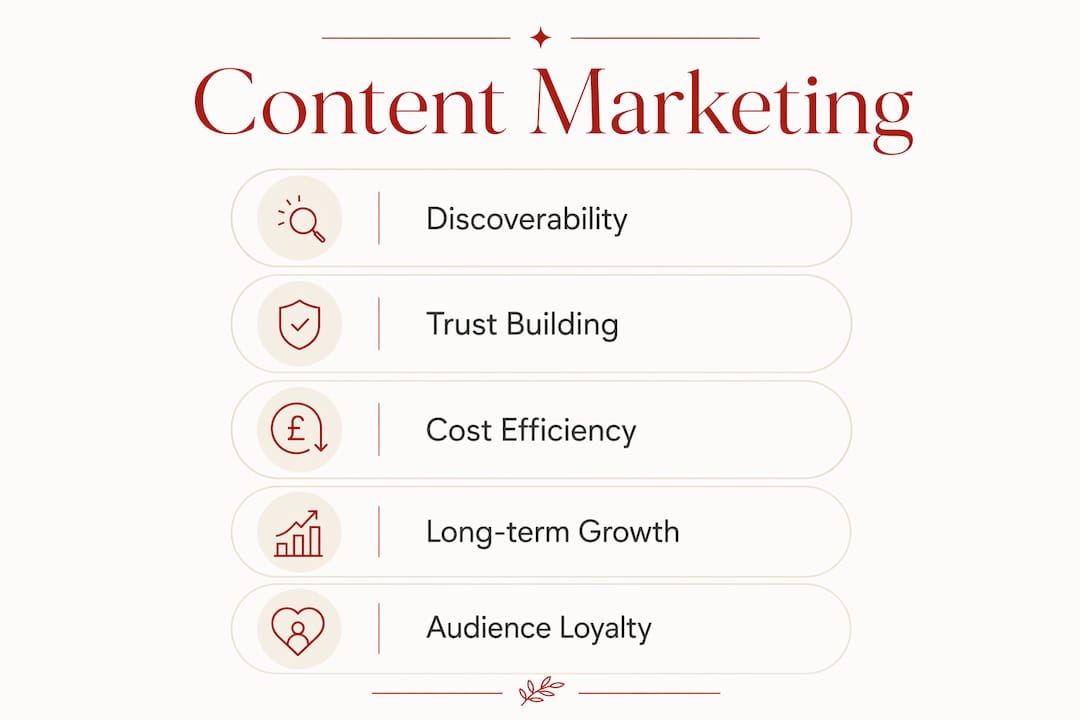
Organisations that publish consistently on topics their audience is searching for become easier to find without paying for every click. In competitive Australian metro markets, businesses that treat content as a system that turns search traffic into qualified leads tend to outperform those that rely on ad spend alone.
Key benefits include:
- Organic search visibility that compounds over time as more content earns rankings
- Shorter sales cycles because prospects arrive already informed and pre-qualified
- Lower cost per lead compared to paid channels once a content library is established
- Thought leadership that supports talent attraction and partnership conversations
- Audience ownership through email lists and returning visitors, independent of algorithm changes
For high-trust organisations, the non-monetary benefits carry particular weight. Consistent, accurate, accessible content builds the kind of reputation that sustains referrals and retains staff. A community legal centre or health service that publishes plain-language guides is demonstrating competence, not just marketing itself.
The honest caveat: content marketing is not fast. Results accumulate rather than spike. That is a feature for organisations thinking in years, not quarters, but it requires patience and a clear measurement plan from the outset.
What types of digital content should you consider?
Different formats serve different purposes. Choosing the right one depends on the audience’s stage, the channel, and the organisation’s capacity to produce and maintain quality.

Blog articles and long-form guides remain the most reliable format for search visibility. They answer specific questions, earn backlinks, and can be updated as information changes. They suit the awareness and consideration stages well.
Video builds trust faster than text for many audiences. Short explainer videos work on social channels; longer recorded webinars or interviews suit email and YouTube. Video requires more production effort but tends to generate higher engagement per view.
Email newsletters are the most direct channel to an existing audience. They suit the consideration and retention stages, and they are not subject to social algorithm changes. For Australian B2B organisations, a well-maintained email list is often the most valuable content asset.
Social media content extends reach and supports community building, but it is borrowed land. Platform algorithms change, and organic reach fluctuates. Social works best as a distribution channel for content that lives elsewhere, not as the primary publishing destination.
Podcasts suit thought leadership and relationship-building with niche professional audiences. They require consistent scheduling and modest production investment, but they build loyal, engaged listeners over time.
Infographics and visual summaries distil complex information into shareable formats. They work well for data-heavy topics and for audiences who prefer visual learning.
Interactive content such as self-assessment tools, calculators, and quizzes generates engagement and useful first-party data about audience needs.
Accessibility reminder: Every format carries an accessibility obligation. Videos need captions and transcripts. Infographics need text alternatives. Written content should use plain language, clear headings, and sufficient colour contrast. These are not optional extras for Australian public-facing organisations; they reflect both WCAG guidance and the expectations of diverse audiences.
How do you build a content marketing strategy from scratch?
A workable strategy does not need to be complex. The following steps give a repeatable starting point.
-
Map your audience. Identify who you are trying to reach, what questions they are asking, and what they need to know before they will trust you. A simple one-page audience profile covering role, goals, and common concerns is enough to start.
-
Set measurable goals. Decide what success looks like in concrete terms: a target number of organic visitors per month, a lead volume from content, or a subscriber count. Vague goals produce vague results.
-
Choose three to five content pillars. Pillars are the broad topic areas your organisation has genuine authority on. Everything you publish should connect to one of them.
Example pillar template:
- Pillar topic: Plain-language legal rights for renters in NSW
- Audience stage: Awareness and consideration
- Primary format: Blog articles, short social posts
- Search intent: Informational (“what are my rights as a renter”)
- Conversion goal: Email subscription or service enquiry
-
Build a simple content calendar. Commit to a publishing cadence you can sustain. One well-researched article per fortnight is more effective than four rushed posts per week. Use a shared spreadsheet or a tool such as Notion or Trello to track status.
-
Plan distribution before you publish. Decide where each piece will go and how it will be promoted. Owned channels (your website, email list) come first. Earned channels (social shares, backlinks) follow. Paid amplification is optional and works best once organic performance is understood.
Distribution channel priorities for Australian B2B organisations:
- A search-optimised blog on your own domain
- A LinkedIn presence using personal profiles alongside the company page
- An email list built from content opt-ins
- Assign ownership. Every piece of content needs one person responsible for it from brief to publication. Shared ownership tends to mean no ownership.
Typical cost ranges (Australian context):
- Small organisations / early stage: a few hundred to a couple of thousand dollars per month, covering freelance writing, basic tools, and light distribution
- Mid-sized organisations: several thousand dollars per month, adding SEO support, video production, and email management
- Larger or enterprise organisations: higher monthly budgets, covering a full content team or agency retainer, paid distribution, and analytics infrastructure
How long does content marketing take, and what does it cost in Australia?
Setting realistic expectations at the outset prevents the most common reason content programmes are abandoned: they are judged too early.
Typical milestone windows:
- Initial weeks: Strategy, audience research, pillar selection, and the first pieces in production. No measurable traffic impact yet.
- Following months: Foundation-building phase with publishing, search engines indexing new content, and early social and email distribution starting, with some initial traffic movement.
- Several months in: Measurable results begin to appear, including improved search rankings and growing organic traffic.
- Half a year and onward: Content compounds, earlier pieces continue attracting traffic, and newer pieces build on domain authority.
- Longer term: A well-maintained content library becomes a durable business asset, generating qualified traffic and leads with less new investment.
| Budget band | Monthly spend (AUD) | What is typically achievable |
|---|---|---|
| Small | $500–$2,000 | 2–4 articles per month, basic email, light social distribution |
| Mid-sized | several thousand dollars | Full editorial calendar, SEO support, video or podcast, email programme |
| Enterprise | higher monthly budgets | Dedicated team or agency, paid amplification, analytics and attribution |
Spend priorities, in order: content quality first, then distribution, then measurement infrastructure. Publishing mediocre content at high volume produces poor results. One well-researched, well-structured piece outperforms ten thin posts on almost every metric that matters.
Content marketing typically takes three to six months to show measurable results, with the first 90 days focused on foundation-building: publishing, earning search rankings, and growing an audience.
How do you measure whether content marketing is working?
Measurement should be decided before publishing begins, not after. The following KPIs cover the most useful signals at each stage of the funnel.
Primary KPIs:
- Organic search traffic: visitors arriving from unpaid search results, tracked in Google Analytics 4 or Search Console
- Engagement rate: time on page, scroll depth, and return visits (indicators of content quality)
- Email subscriber growth: a direct measure of audience-building from content
- Lead volume from content: enquiries, downloads, or bookings attributed to content touchpoints
- Assisted conversions: content pieces that appeared in the path to conversion, even if not the final click
- Organic keyword rankings: tracked via tools such as Google Search Console, Ahrefs, or Semrush
Attribution basics:
Last-click attribution gives all credit to the final touchpoint before conversion. That tends to undervalue content, which often appears earlier in the journey. Assisted conversion reporting in Google Analytics 4 shows how many conversions content touchpoints contributed to, even when they were not the last step. Multi-touch attribution distributes credit across all touchpoints and gives a more accurate picture of content’s role, though it requires more setup.
Suggested reporting cadence:
| Reporting period | What to review |
|---|---|
| Weekly | Publishing status, social engagement, email open rates |
| Monthly | Organic traffic trends, keyword movement, lead volume from content |
| Quarterly | Assisted conversions, content ROI, pillar performance, strategy adjustments |
The goal of measurement is not to produce reports. It is to identify which content is working, why, and where to focus next.
Who does the work, and what tools do you need?
Content marketing requires a small set of clearly defined roles. In smaller organisations, one or two people may cover several of these. In larger teams, each role is distinct.
Core roles:
- Content strategist: sets the direction, manages the pillar framework, and connects content to business goals
- Writer / content creator: produces the actual material, whether articles, scripts, or email copy
- Editor: reviews for accuracy, tone, accessibility, and compliance before publication
- SEO lead: ensures content is structured for search and monitors keyword performance
- Distribution owner: manages social scheduling, email sends, and paid amplification
- Analytics lead: tracks KPIs, builds reports, and feeds insights back into the strategy
Workflow:
Brief → Production → Editorial review → Compliance check (where needed) → Publication → Distribution → Measurement

For regulated organisations, the compliance check step is not optional. A lightweight sign-off process involving legal or communications staff protects the organisation and maintains audience trust.
Tool categories to consider:
- Content management: WordPress, Squarespace, or a headless CMS for publishing
- Analytics: Google Analytics 4 and Google Search Console (both free and sufficient for most organisations starting out)
- Editorial calendar: Notion, Trello, or a shared Google Sheet
- Asset creation: Canva for graphics, Descript or Adobe Premiere for video editing, Buzzsprout or Podbean for podcasts
- Email: Mailchimp, Campaign Monitor, or Kit (formerly ConvertKit) for Australian-compliant email marketing
An SEO content workflow that documents each step from brief to publication reduces errors, speeds up review, and makes it easier to onboard new contributors without losing consistency.
What Australian organisations need to know about compliance, trust, and accessibility
Australian content practice carries specific obligations that organisations in other markets may not face in the same form.
Regulatory checklist:
- Spam Act 2003: Commercial electronic messages (email, SMS) require the recipient’s consent, must clearly identify the sender, and must include a functional unsubscribe mechanism. Transactional messages are treated differently from promotional ones. The Australian Communications and Media Authority (ACMA) enforces the Act.
- ACCC guidelines: Compliance with ACCC guidance means avoiding misleading or deceptive claims in content, including implied claims. Testimonials must reflect genuine experience. Sponsored or paid content must be clearly labelled.
- Privacy Act 1988: Collecting audience data through content (email sign-ups, gated downloads) triggers obligations under the Australian Privacy Principles. A clear, accessible privacy policy is required.
Accessibility checklist:
- Captions on all video content
- Text transcripts for audio and podcast content
- Alt text on all images used in published content
- Plain language: short sentences, active voice, defined terms
- Sufficient colour contrast in graphics and infographics (WCAG 2.1 AA as a baseline)
Ethical AI guidance:
Generative AI tools can accelerate content production, but they require human editorial oversight to maintain accuracy and authority. GEO (Generative Engine Optimisation) is now a recognised practice: structuring content with clear, citable facts and authoritative signals so AI answer engines such as ChatGPT and Google’s AI Overviews can surface and attribute your expertise. Raw AI output without editorial review undermines long-term authority and creates compliance risk for regulated claims.
Pro Tip: For mission-led organisations, treat your editorial standards document as a governance asset. A one-page guide covering tone, accuracy requirements, and sign-off responsibilities gives new contributors clear boundaries and protects the organisation’s reputation.
Pro Tip: Publish an accessibility statement on your website and review it annually. It signals commitment to inclusive practice and is increasingly expected by grant bodies, government partners, and community stakeholders in Australia.
Two short Australian examples of content marketing in practice
Example one: a community health organisation in regional Victoria
A regional community health service wanted to reduce phone enquiries about common preventive health topics and improve its search visibility among local residents. It published a series of plain-language articles on topics such as managing type 2 diabetes and understanding mental health referral pathways. Over six months, organic search traffic to those pages grew substantially, phone enquiries on covered topics fell, and the articles became the most-visited pages on the site. The key metric was not traffic volume but the reduction in low-value enquiry load and the increase in appointment bookings from informed visitors.
Example two: a B2B professional services firm in Sydney
A mid-sized consulting firm began publishing monthly long-form articles on governance and risk topics relevant to its sector, distributed via LinkedIn and a fortnightly email newsletter. Within twelve months, the firm’s principals were being cited in industry media, and inbound enquiries from the newsletter grew to represent a meaningful share of new business. The firm did not increase its advertising spend during this period. The content programme replaced a reliance on conference sponsorship as the primary lead source.
Common pitfall: Both examples succeeded because they maintained a consistent publishing schedule and measured specific outcomes from the start. The most common failure pattern is publishing irregularly, measuring only vanity metrics such as page views, and abandoning the programme before the compounding effect has time to develop.
Key takeaways
Digital content marketing builds durable audience relationships through useful, relevant material that earns attention rather than purchasing it, and it requires consistent effort over at least six months before results compound reliably.
| Point | Details |
|---|---|
| Definition and purpose | Content marketing attracts, informs, and converts audiences through owned assets, not paid interruptions. |
| Timeline to results | Foundation-building takes the first 90 days; measurable results typically appear at three to six months. |
| Australian compliance | The Spam Act, ACCC guidelines, and Privacy Act all apply; treat compliance as a trust-building asset, not a burden. |
| Measurement from day one | Set KPIs before publishing begins; use assisted conversion reporting to capture content’s full contribution. |
| Marzipan’s approach | Marzipan helps mission-led Australian organisations build search visibility and ethical content practice that aligns with governance and accessibility values. |
Three starter actions for this week:
- Write a one-page audience profile: who you are trying to reach, what they are searching for, and what they need to know before they trust you
- Choose one content pillar and commission or draft a single well-researched piece on a specific question your audience is asking
- Set up Google Analytics 4 and Google Search Console on your website so baseline data is in place before the first piece publishes
Content strategy as stewardship, not just marketing
The organisations that get the most from content marketing tend to be the ones that treat it as a governance question rather than a marketing task. They ask who owns accuracy, how corrections are handled, and what the editorial standard is before they ask how many posts to publish per week.
For Australian mission-led organisations, this framing matters. Content strategy is increasingly a business-level decision that influences revenue, hiring, and reputation, and it should be discussed at leadership level, not delegated entirely to a communications officer working without a brief. The organisations that treat it that way tend to produce content that is more accurate, more accessible, and more durable.
The trade-off worth naming honestly: depth and quality require more time than volume and automation. A content programme that publishes two well-researched, well-edited pieces per month will generally outperform one that publishes daily with thin material. Speed is not the constraint to optimise for. Credibility is.
For boards and leadership teams considering where content sits in their governance structure, board-level fiduciary responsibility for organisational reputation extends naturally to how the organisation communicates publicly, including its digital content.
How Marzipan supports mission-led organisations with search visibility
For purpose-driven organisations that want search visibility without compromising their values, Marzipan offers a grounded alternative to generic agency work. Rather than chasing volume, Marzipan focuses on search visibility built on ethical SEO, accessible content, and sustainable publishing practices that hold up over time.
The work is practical: a content programme that fits your team’s capacity, editorial standards that reflect your governance requirements, and measurement that connects content to outcomes your leadership team actually cares about. Marzipan works with community organisations, health services, legal centres, and other high-trust bodies across Australia from its base in Sydney.
If you are ready to build a content presence that reflects your organisation’s values and serves your audience well, get in touch with Marzipan to discuss where to start.
Useful sources and further reading
The following sources are worth consulting directly, particularly for regulatory and governance detail.
- Spam Act guidance, ACMA: The Australian Communications and Media Authority publishes practical guidance on the Spam Act 2003, including what constitutes consent and how to manage unsubscribes correctly.
- Digital marketing strategy, Business Queensland: A clear, practical overview of how digital marketing strategy works for Australian businesses, including the role of content within a broader plan.
- Develop your digital strategy, business.gov.au: The federal government’s guidance on building a digital strategy, covering content, email, social, and paid channels with Australian compliance notes.
- Content strategy in Australia 2026, That Content Agency: Analysis of how content strategy is evolving across search, social, and AI answer engines, with practical recommendations for Australian organisations.
- Why content strategy is a business-level decision, Lyxity: Makes the case for elevating content strategy to leadership and board level, with relevance for high-trust and mission-led organisations.
- Marketing in Australia: strategies for 2026 and beyond, Marzipan: Marzipan’s overview of strategic marketing shifts in Australia, with a focus on credibility and community-aligned content.
- Mission-driven marketing, Marzipan: Evidence and examples of how mission-aligned content strategy builds trust and community impact for purpose-driven organisations.
When implementing any content programme, prioritise local regulatory guidance over general international advice. Australian law on spam, privacy, and misleading conduct has specific requirements that differ from other markets. This article provides general information; confirm current rules with the ACMA, ACCC, or a qualified adviser for your specific situation.


