

TL;DR:
- An SEO audit diagnoses a website’s search visibility issues across technical, on-page, off-page, and local pillars. It provides a prioritized roadmap focusing on quick wins, medium-term fixes, and long-term improvements. For purpose-driven organizations, audits also serve as governance tools to align website health with organizational goals and community trust.
An SEO audit is a structured diagnostic of the factors that affect a website’s organic search visibility, producing three core deliverables: an audit report, a prioritised action roadmap, and a timeline for implementation and re-assessment. A thorough audit examines four core pillars: technical SEO, on-page content, off-page authority, and local SEO. Data comes from tools including Google Search Console, Core Web Vitals reports, and Google Business Profile, alongside crawl tools and backlink analysis platforms. Quick wins such as fixing missing meta descriptions can show results within days; technical infrastructure changes typically take several weeks to reflect in search, and content improvements can take a number of weeks.
- Quick wins (no developer time): meta descriptions, page titles, Google Business Profile corrections
- Medium-term fixes (developer involvement): Core Web Vitals, crawl errors, site architecture
- Longer work (6–16 weeks to show): content depth, backlink acquisition, schema implementation
Table of Contents
- What does an SEO audit actually cover?
- How an SEO audit works, step by step
- Common audit findings and how to prioritise fixes
- Which tools do auditors use, and which do you need?
- How long does an audit take, and what does it cost in Australia?
- Can you do your own SEO audit?
- How Marzipan approaches an SEO audit for purpose-driven organisations
- Key takeaways
- Audits as governance, not just optimisation
- Marzipan’s audit service for purpose-driven organisations
- Useful sources and further reading
What does an SEO audit actually cover?
A full audit is organised around four pillars. Each addresses a distinct layer of how search engines find, read, and rank a website.
Technical SEO covers the infrastructure: crawlability, indexation, page speed, mobile usability, and site architecture. If search engines cannot reliably access and index your pages, no amount of good content will compensate. Tools such as Screaming Frog and Google Search Console surface most technical issues.
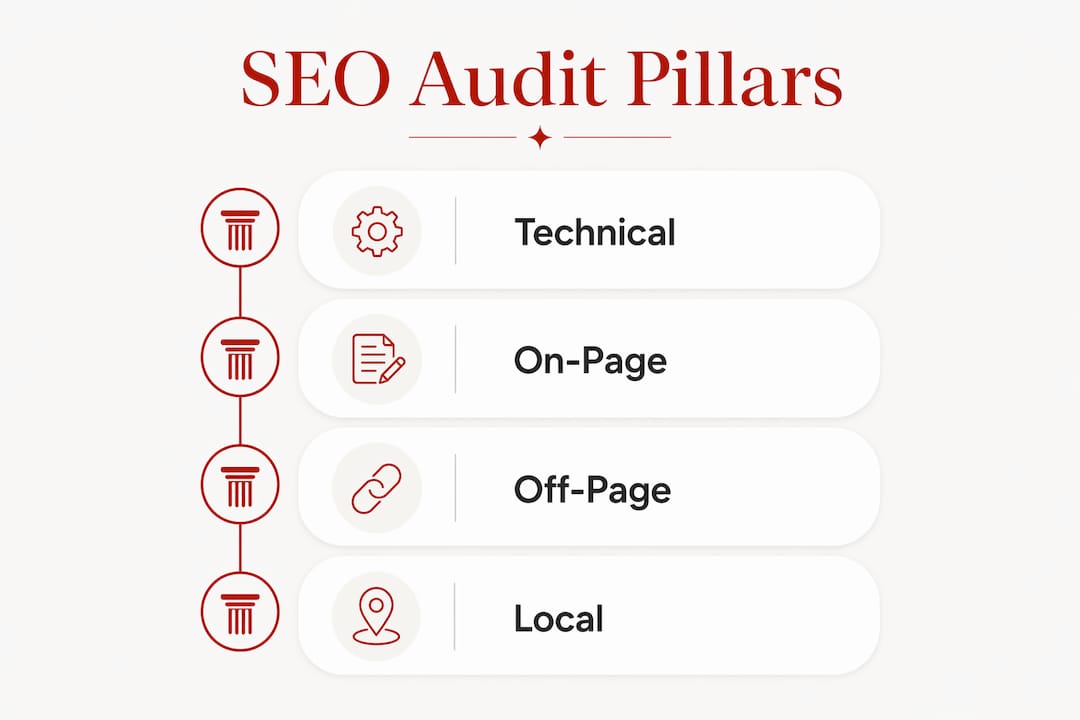
On-page SEO covers what each page says and how it says it: title tags, meta descriptions, heading structure, content quality, keyword targeting, and schema markup. This pillar also includes internal linking, which affects how authority flows through a site and how users navigate it.
Off-page SEO covers the external signals pointing to a site: the backlink profile, referring domain authority, brand mentions, and the overall trust signals that inform how Google assesses a site’s credibility. Ahrefs and Semrush are the most widely used tools for this layer.
Local SEO is particularly relevant for Australian organisations serving a defined geographic area. It covers Google Business Profile accuracy, NAP (name, address, phone) consistency across directories, and local citation health. Automated tools often miss these signals, so a manual check is necessary for reliable results.
| Pillar | What it examines | Primary tools |
|---|---|---|
| Technical | Crawlability, speed, indexation, mobile | Screaming Frog, Google Search Console, Lighthouse |
| On-page | Titles, content, headings, schema | Semrush, Ahrefs, manual review |
| Off-page | Backlinks, authority, brand signals | Ahrefs, Semrush |
| Local | GBP, NAP, citations | Google Business Profile, manual directory checks |
For small, mission-driven Australian organisations, the local and on-page pillars are often where the most immediate gains sit. A community health service or not-for-profit with inconsistent directory listings and thin service pages will see more benefit from fixing those two areas than from a deep technical overhaul.
How an SEO audit works, step by step
A professional audit does not begin with a tool crawl. It begins with a scoping conversation that establishes which pages matter, which keywords are priorities, and what business outcomes the audit should serve. That context shapes every subsequent stage.
The audit workflow
- Define scope — agree on the site sections, keyword priorities, and business goals the audit will address.
- Gather crawl data — run a full site crawl using Screaming Frog or a comparable tool to map every accessible URL and collect technical attributes.
- Pull Search Console and analytics data — export Google Search Console data (crawl errors, index coverage, Core Web Vitals) and Google Analytics 4 behavioural data.
- Technical analysis — identify systemic patterns: redirect chains, duplicate content, broken links, indexation gaps, and speed issues.
- Content review — assess page-level targeting, content depth, meta data, heading structure, and internal linking.
- Backlink review — analyse the referring domain profile, identify toxic or low-quality links, and benchmark against competitors.
- Local SEO check — verify GBP accuracy, NAP consistency across Australian directories (True Local, Yellow Pages, Yelp AU), and local citation completeness.
- Prioritised recommendations — map findings to a roadmap ordered by impact and effort.
- Report and walkthrough — deliver a structured report and walk through findings with the client.
- Recheck — schedule a follow-up review 8–12 weeks after implementation begins.
Sample report outline
A well-structured audit report contains:
- Executive summary — three to five key findings and the single most important action
- Technical findings — issues by severity with CMS-specific fix guidance
- Content findings — page-level gaps, thin content, and targeting misalignments
- Backlink findings — profile health, toxic links, and authority gaps
- Local SEO findings — GBP status, NAP inconsistencies, citation gaps
- Prioritised action table — each recommendation with an effort estimate (hours) and expected impact (high/medium/low)
Timeline by site size
A small site audit takes a few days; a medium site typically requires about one to two weeks; large or enterprise sites take multiple weeks or longer. Any audit delivered within 24 hours is an automated data export, not a professional diagnostic.
Common audit findings and how to prioritise fixes
Most audits surface a similar set of issues. The question is not which ones to fix, but which ones to fix first.
Common findings include: broken internal and external links, missing or duplicate title tags and meta descriptions, thin or duplicated page content, slow Core Web Vitals scores, poor mobile usability, pages blocked from indexation unintentionally, toxic or low-quality backlinks, and inconsistent local citations. A full audit also includes competitor benchmarking to identify gaps the site is not currently addressing.

Prioritisation works best as an impact-versus-effort matrix. Place each finding in one of four quadrants:
| Finding | Impact | Effort | Priority |
|---|---|---|---|
| Missing meta descriptions | Medium | Low | Quick win |
| GBP category corrections | High | Low | Quick win |
| Core Web Vitals (LCP/CLS) | High | Medium–High | Major project |
| Broken internal links | Medium | Low | Quick win |
| Thin service pages | High | Medium | Planned work |
| Toxic backlink disavow | Low–Medium | Medium | Low priority |
| Site architecture restructure | High | High | Major project |
Quick wins sit in the top-left: high impact, low effort. These are the fixes that should happen in the first two weeks after an audit is delivered. Major projects sit in the top-right: high impact but significant developer or content time required. Low-priority items can wait or be batched.
Pro Tip: The fastest visibility improvements usually come from fixes that require no developer time at all: updating title tags, correcting meta descriptions, and completing a Google Business Profile. These can often be done within a week of receiving the audit report.
Which tools do auditors use, and which do you need?
The most widely referenced audit tools in 2026 are Ahrefs, Semrush, Screaming Frog, Google Search Console, and Google PageSpeed Insights / Lighthouse. Each serves a distinct purpose.
- Google Search Console (free) — shows how Google indexes the site, surfaces crawl errors, Core Web Vitals status, and search performance data by query and page. The starting point for any audit.
- Google Analytics 4 (free) — provides behavioural data: which pages users visit, how long they stay, and where they exit. Useful for identifying content that fails to convert.
- Google PageSpeed Insights / Lighthouse (free) — diagnoses page speed and Core Web Vitals at the URL level. Produces a scored report with specific fix recommendations.
- Screaming Frog SEO Spider (free up to 500 URLs, paid for larger sites) — crawls the site and collects technical data on every URL: status codes, meta data, heading structure, canonical tags, and more.
- Semrush (paid) — covers keyword research, on-page auditing, backlink analysis, and competitor benchmarking in a single platform. Widely used for mid-size to enterprise audits.
- Ahrefs (paid) — particularly strong for backlink analysis and referring domain profiling. Also provides site audit and keyword tools.
For a basic DIY audit of a small site, Google Search Console, Google Analytics 4, Google PageSpeed Insights, and the free tier of Screaming Frog are sufficient. Semrush or Ahrefs become necessary when backlink analysis or competitor benchmarking is part of the scope.
No single tool gives a complete picture. Search Console shows indexation but not content quality. Screaming Frog maps technical issues but not backlink health. Reliable conclusions come from combining sources, not from trusting any one platform’s summary score.
How long does an audit take, and what does it cost in Australia?
The short answer: a small site audit takes a few days and a large site can take 2–4 weeks. Cost in Australia varies by scope, site size, and the auditor’s model.
| Site size | Audit depth | Typical duration | Indicative cost (AUD) |
|---|---|---|---|
| Small sites | Basic | a few days | prices vary |
| Small to medium sites | Standard | about 1 to 2 weeks | prices vary |
| Medium sites | Comprehensive | a few weeks | prices vary |
| Large or enterprise sites | Full scope | multiple weeks | prices vary |
These figures are indicative. Actual pricing depends on CMS complexity, availability of log files, whether competitor benchmarking is included, and the auditor’s experience.
Common pricing models in Australia include fixed-fee basic audits for small sites, scoped fixed-fee engagements for medium and enterprise sites, hourly consultancy for targeted reviews, and retainer arrangements for ongoing monthly monitoring. A retainer suits organisations that want continuous visibility into site health rather than a point-in-time snapshot.
A basic audit is appropriate when a site is new, has never been audited, or when the goal is a quick health check before a content push. A comprehensive audit is warranted before a site migration, after a significant traffic drop, or when an organisation is investing in a sustained SEO programme.
Can you do your own SEO audit?
A DIY audit is feasible for a small site when the right tools are available and the person running it has a working knowledge of SEO fundamentals. For complex sites, or when strategic prioritisation matters, a professional auditor adds significant value.
DIY readiness checklist
- Do you have access to Google Search Console and Google Analytics 4 for the site?
- Can you install and run Screaming Frog (or use the free tier for sites under 500 pages)?
- Do you have time to review findings methodically — at least one to two full days?
- Do you have a developer or CMS access to implement technical fixes?
- Do you understand the difference between a crawl error and an indexation issue?
If you answered no to two or more of these, a professional audit is likely a better use of resources.
What AI tools can and cannot do
AI tools including ChatGPT can assist with generating checklists, drafting report sections, and interpreting basic data outputs. They are useful for structuring a DIY audit and summarising findings in plain language.
What they cannot do is reconcile conflicting data across tools, apply contextual judgement about which findings matter most for a specific business, or account for the competitive dynamics of a particular market. An AI tool does not know that a traffic drop coincided with a site migration, or that a particular service page drives most of the organisation’s enquiries. That context shapes every prioritisation decision.
Pro Tip: Use AI to generate your initial checklist and draft the report structure, then apply human judgement to the prioritisation. The checklist is the easy part. Deciding what to fix first, given your resources and goals, is where the real value sits.
How Marzipan approaches an SEO audit for purpose-driven organisations
Marzipan’s audit process produces a prioritised, values-aligned roadmap that balances search performance with accessibility and sustainability. The output is not simply a list of errors. It is a structured plan that connects website health to the organisation’s actual goals.
Methodology
- Scope and briefing — understand the organisation’s goals, audience, and the pages that matter most
- Crawl and technical analysis — full site crawl using Screaming Frog, cross-referenced with Google Search Console data
- Analytics review — Google Analytics 4 behavioural data to identify conversion and engagement gaps
- Content review — page-level assessment of targeting, depth, and accessibility
- Backlink and authority review — profile health and local citation consistency
- Prioritised roadmap — findings mapped to impact and effort, with accessibility and sustainability considerations noted
- Handover and walkthrough — structured report delivered with a live walkthrough session
Sample report structure
| Section | Contents |
|---|---|
| Executive summary | Top three findings and single most important action |
| Technical findings | Issues by severity with fix guidance |
| Content findings | Gaps, thin pages, targeting misalignments |
| Backlink findings | Profile health, citation gaps |
| Accessibility notes | WCAG compliance gaps identified during content review |
| Prioritised action table | Effort, impact, and recommended sequence |
A quality audit should be a diagnostic for growth — a prioritised roadmap that connects website health to business outcomes, not a document that catalogues every error a crawl tool can find.
Marzipan’s approach reflects the view that stewardship, accessibility, and sustainability are not constraints on good SEO. They are part of what good SEO looks like for organisations that hold public trust.
Key takeaways
An SEO audit is a structured diagnostic that produces a prioritised roadmap, not a list of errors, and its value lies in connecting website health to the organisation’s specific goals.
| Point | Details |
|---|---|
| Definition | An SEO audit diagnoses the factors affecting organic visibility across four pillars: technical, on-page, off-page, and local. |
| Prioritise by impact and effort | Fix quick wins first (meta data, GBP corrections) before committing developer time to major technical projects. |
| Timeline expectations | Small site audits take a few days; technical fixes take several weeks to show in search; content improvements take a number of weeks. |
| DIY vs professional | DIY is feasible for small sites with Search Console access; complex sites or strategic decisions warrant a professional auditor. |
| Marzipan’s approach | Marzipan delivers values-aligned audit roadmaps for purpose-driven Australian organisations, balancing performance with accessibility and sustainability. |
Within 48 hours, connect Google Search Console to your site and run a free crawl using Screaming Frog’s free tier to identify your most pressing technical issues before commissioning or conducting a full audit.
Audits as governance, not just optimisation
SEO audits are often framed as a technical exercise. For mission-driven organisations, they are also a governance question. A website that is slow, inaccessible, or invisible in local search is not just underperforming commercially. It is failing the people it was built to serve.
The trade-offs in an audit are real. Improving page speed sometimes means removing content. Fixing crawl architecture can require developer time that competes with other priorities. Choosing what to fix, and in what order, is a decision that belongs at a leadership level, not just with a developer or an agency. Governance checkpoints — a brief quarterly review of Search Console data, an annual full audit, and a pre-migration audit before any significant site change — give leadership the visibility to make those decisions with confidence rather than reacting to traffic drops after the fact.
Marzipan’s audit service for purpose-driven organisations
Marzipan works with purpose-driven Australian organisations that want a clear, honest picture of their website’s search performance and a practical plan for improving it. The search visibility service covers a full audit across all four pillars, a prioritised roadmap, and a walkthrough session so your team understands what to act on and why.
The audit is scoped to your organisation’s size, goals, and capacity. There is no pressure to commission a rebuild or a long-term retainer. The starting point is a conversation about what you need. If you would like to discuss the scope of an audit for your organisation, get in touch through the search visibility page.
Useful sources and further reading
| Resource | What it covers |
|---|---|
| Google Search Console | Free tool for indexation, crawl errors, Core Web Vitals, and search performance data |
| Screaming Frog SEO Spider | Site crawl tool; free up to 500 URLs, paid for larger sites |
| Semrush | Keyword research, on-page audit, backlink analysis, and competitor benchmarking |
| Ahrefs | Backlink profiling, site audit, and keyword tools |
| Google PageSpeed Insights | Page speed and Core Web Vitals diagnostics at URL level |
| Business Queensland — SEO guidance | Australian government guidance on SEO scope and audit components |
| Marzipan — SEO audit guide for Australian nonprofits | Step-by-step audit guidance tailored to Australian nonprofit and community organisations |
| Marzipan — audit template for community organisations | Practical audit template for values-aligned organisations |


