

TL;DR:
- Value-driven SEO emphasizes authentic, helpful content aligned with community needs over manipulative tactics. It builds trust, enhances long-term visibility, and complies with local regulations, supporting mission-driven organisations’ reputations. Implementing these principles fosters sustainable growth rooted in integrity and genuine community engagement.
Many Australian mission-driven organisations assume that strong SEO results require tactics that feel uncomfortable or out of step with their values. That assumption is outdated. Value-driven SEO prioritises creating content that delivers genuine user value, solves real problems, and aligns with search intent, rather than relying on manipulative tactics or volume-focused production. For charities, community groups, and purpose-led brands operating in Australia, this approach offers a direct path to online visibility that does not require compromising integrity or chasing metrics that have little to do with actual impact.
Table of Contents
- Understanding value-driven SEO
- Key principles of value-driven SEO
- Why value-driven SEO matters after Google’s updates
- How mission-driven organisations can put value-driven SEO into practice
- The uncomfortable truth: what most SEO advice gets wrong for ethical organisations
- Grow ethically with value-driven SEO expertise
- Frequently asked questions
Key Takeaways
| Point | Details |
|---|---|
| Mission-aligned growth | Value-driven SEO helps organisations grow online without sacrificing ethical values. |
| Long-term impact | User-centred, transparent SEO is rewarded by search engines with lasting visibility. |
| Practical application | Australian nonprofits can adopt value-driven SEO using local strategies and measurable results. |
| Trust matters | Focusing on E-E-A-T and transparent practices builds credibility with both supporters and search engines. |
Understanding value-driven SEO
Value-driven SEO is not a new label for the same old tactics. It represents a meaningful shift in how organisations approach their online presence. At its core, the approach prioritises authenticity, user intent, and genuine helpfulness over keyword stuffing, link schemes, or content produced purely for search engine consumption.
For Australian mission-driven organisations, the distinction matters. Nonprofits, community health services, environmental advocacy groups, and social enterprises all operate within frameworks of public trust. Their audiences, whether donors, volunteers, or service users, need to feel confident that the information they encounter online is accurate and honestly presented.
“Value-driven SEO prioritizes creating content that delivers genuine user value, solves real problems, and aligns with search intent over manipulative tactics or volume-focused production.” 2025 SEO Essentials
Old-school SEO relied heavily on techniques now classified as manipulative. These include purchasing backlinks in bulk, creating thin content just to target keyword variations, and cloaking pages to show different content to search engines than to real users. Google’s ongoing algorithm updates have systematically devalued these approaches. For organisations whose reputations rest on community trust, the risks of being penalised or publicly associated with such tactics are particularly severe.
Common misconceptions still circulate. Some believe that ethical constraints limit SEO performance. Others think mission-driven organisations simply cannot compete with well-resourced commercial competitors in search results. Neither view holds up to scrutiny. An ethical SEO guide for community organisations demonstrates that clarity of purpose and genuine audience focus are genuine competitive advantages in organic search.
Key differences from traditional SEO include:
- Content produced to answer real audience questions, not just to rank for high-volume terms
- Link building through genuine partnerships, community relationships, and earned media coverage
- Transparency in reporting, so stakeholders and boards can understand what is being done and why
- A focus on long-term audience trust rather than short-term traffic spikes
Key principles of value-driven SEO
Now that the definition is clear, it helps to look at the practical principles that define this approach and how each one aligns with the values most mission-driven organisations already hold.
Transparency in methods and reporting is foundational. Organisations should be able to explain exactly what SEO work is being done, why specific content is being published, and how progress is measured. This matters for board accountability, funder reporting, and simply maintaining staff confidence in the digital strategy.
E-E-A-T stands for Experience, Expertise, Authority, and Trust. Google uses these signals to assess whether a piece of content genuinely serves its audience. For a community health organisation, this means publishing content authored or reviewed by qualified practitioners. For an environmental charity, it means citing credible research and being transparent about the organisation’s own experience in the field. Demonstrating E-E-A-T is not about gaming the algorithm. It is about being genuinely credible.
Compliance and privacy matter in the Australian context. Organisations registered with the Australian Charities and Not-for-profits Commission (ACNC) have specific reporting obligations that extend to how they present their work publicly. Sustainable SEO for mission-driven organisations in Australia aligns directly with these obligations, covering local SEO, transparency, and ACNC compliance as interconnected concerns.

Local SEO and stakeholder trust are closely linked for Australian community groups. Appearing in local search results, maintaining an accurate Google Business Profile, and publishing content relevant to specific communities all contribute to trust within the geographic areas an organisation actually serves.
Pro Tip: Before publishing any content, ask whether it answers a genuine question your audience is already searching for. If it does not serve a real need, it is unlikely to perform well under a value-driven approach.
The following table compares traditional SEO with value-driven SEO at a practical level:
| Dimension | Traditional SEO | Value-driven SEO |
|---|---|---|
| Content focus | Keyword volume and density | Audience intent and genuine usefulness |
| Link building | Purchased or exchanged links | Earned through relationships and credibility |
| Reporting | Traffic and rankings | Engagement, trust signals, and meaningful actions |
| Compliance | Often not considered | Integral to strategy |
| Time horizon | Short-term traffic gains | Long-term compounding growth |
| Audience view | Anonymous traffic source | Community of real people with real needs |
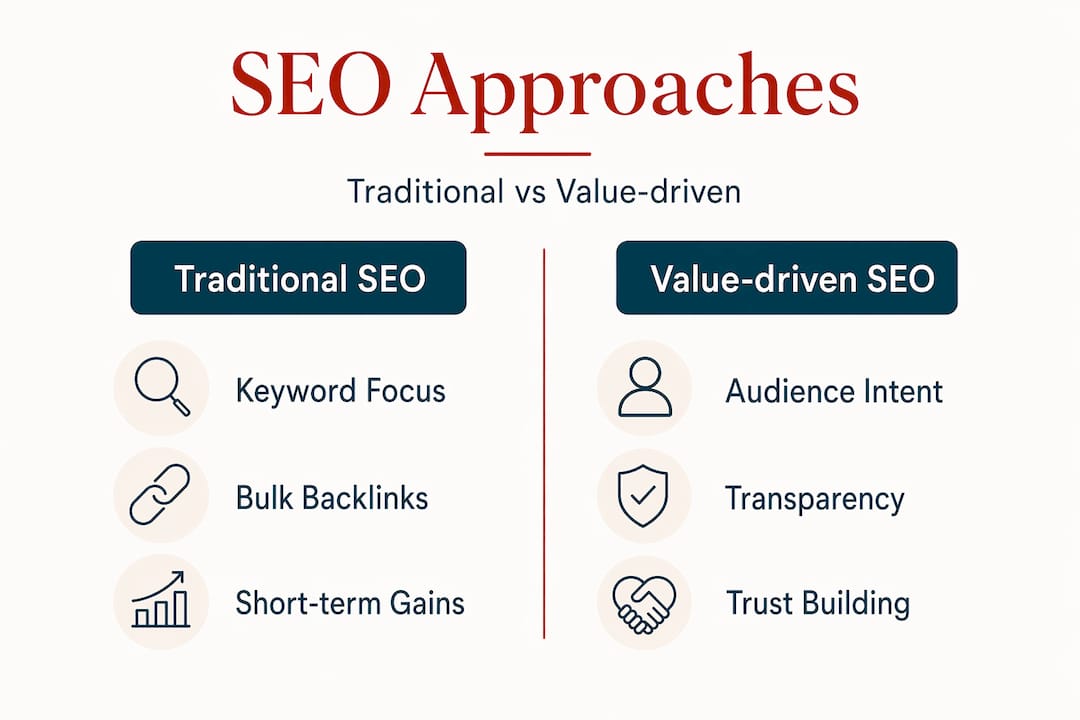
Organisations looking to implement sustainable SEO practices will find that each of these principles reinforces the others. Transparency supports trust. Trust supports E-E-A-T. E-E-A-T supports rankings. For further guidance on avoiding common pitfalls, ethical SEO guidance for nonprofits is a useful reference.
Additional principles to keep in mind:
- Avoid misleading titles or headlines that overpromise what the content delivers
- Keep technical SEO clean: fast page loads, accessible design, and mobile-friendly layouts all serve real users first
- Ensure all content is factually accurate and updated when circumstances change
Why value-driven SEO matters after Google’s updates
Google’s major algorithm updates over the past several years have consistently moved in one direction: rewarding content that genuinely helps users and penalising content that exists primarily to manipulate rankings. The Helpful Content updates, the core updates targeting low-quality content, and the growing role of AI in search all point towards the same conclusion: authentic value is the most durable SEO strategy available.
For mission-driven organisations, this is genuinely good news. Organisations that have always prioritised clear, accurate, and helpful communication are well positioned to benefit from these changes. Those that relied on outsourced bulk content or keyword-stuffed pages face a growing disadvantage.
The risks of shortcuts are substantial. A community legal service that ranks temporarily through manipulative tactics risks a sudden drop in visibility at exactly the moment potential clients need to find it. A charity that uses purchased backlinks may face a manual penalty from Google, which can take months or years to recover from. The reputational damage from being associated with spammy tactics can be equally serious, particularly when it surfaces in media coverage or stakeholder communications.
Research consistently shows that traditional SEO focuses on volume and keywords, while value-driven approaches emphasise quality and E-E-A-T for long-term compounding growth, particularly following Google updates favouring genuinely helpful content.
Here is a practical sequence for understanding how ethical organisations benefit from quality-centric updates:
- Google’s algorithm prioritises content that satisfies user intent fully and accurately.
- Mission-driven organisations typically produce content grounded in real expertise and genuine community knowledge.
- That expertise and community grounding maps directly onto E-E-A-T signals.
- Strong E-E-A-T signals support improved rankings over time without the need for manipulation.
- As rankings compound, the organisation reaches more aligned supporters, donors, and volunteers.
- Increased aligned traffic leads to higher engagement rates, which further reinforce rankings.
Pro Tip: Review your existing content annually and update any pages where information has changed, services have evolved, or community needs have shifted. Freshness and accuracy are both trust signals and ranking factors.
For organisations committed to ethical SEO growth, the post-update search landscape represents an opportunity rather than a challenge. The organisations that consistently invest in quality content and genuine community service are precisely those that the current algorithm is designed to reward.
How mission-driven organisations can put value-driven SEO into practice
Understanding the theory is one thing, but what does value-driven SEO look like day-to-day for an Australian mission-driven organisation? Here is how to get started.
The process begins with intent, not keywords. Before any content is planned, the organisation should clarify what questions its community is actually asking. This can come from direct conversations with service users, from reviewing enquiry emails, or from studying what related searches bring people to the website already.
Step-by-step adoption process:
- Audit existing content to identify pages that serve genuine audience needs versus those created purely for search volume.
- Map audience questions to specific content gaps, focusing on topics the organisation is genuinely qualified to address.
- Produce content that fully answers those questions, authored or reviewed by people with direct experience.
- Optimise for local search by maintaining accurate business listings, using location-specific language naturally, and earning mentions from local media, partner organisations, and community groups.
- Measure meaningful outcomes such as time spent on page, contact form submissions, newsletter sign-ups, and return visits, rather than raw traffic figures alone.
- Report transparently to boards and funders, connecting SEO activity to mission outcomes rather than presenting rankings in isolation.
Ethical local SEO is particularly relevant for organisations serving defined geographic communities. A community food bank in Western Sydney, for example, benefits far more from appearing in searches conducted within that area than from national visibility. Local SEO solutions for Sydney community groups provide a practical framework for this kind of targeted, values-aligned visibility. For broader strategic direction, ethical digital agency tips offer additional context on how to choose partners who share these priorities.
Practical content examples for Australian mission-driven organisations include:
- Publishing transparent annual impact reports as web content, formatted for readability and search visibility
- Creating accessible guides to local services, written in plain language for the communities those services support
- Sharing stories of community outcomes with explicit permission from those involved, demonstrating real-world impact
- Covering local events, advocacy updates, and policy changes that matter to the organisation’s audience
The following table outlines metrics that reflect genuine value rather than volume alone:
| Metric | What it measures | Why it matters |
|---|---|---|
| Engaged sessions | Visitors who interact meaningfully with content | Indicates genuine relevance and usefulness |
| Goal completions | Donations, sign-ups, contact submissions | Connects SEO to mission outcomes |
| Return visitor rate | How often visitors come back | Reflects trust and ongoing relevance |
| Average time on page | Depth of engagement with content | Suggests content fully addresses the user’s need |
| Local search impressions | Visibility in geographic searches | Shows reach within the communities served |
| Bounce rate on key pages | Visitors who leave without engaging | Highlights content that may not match intent |
The uncomfortable truth: what most SEO advice gets wrong for ethical organisations
Most SEO advice circulating in the Australian market is written for commercial businesses whose primary objective is revenue. The strategies it recommends, content velocity, aggressive link acquisition, conversion rate optimisation, are not inherently wrong, but they are often poorly suited to the context of purpose-led organisations.
The deeper problem is that shortcuts in SEO do not just carry technical risks. For nonprofits and community organisations, they carry reputational risks that can take years to repair. If a charity’s website is penalised for manipulative tactics, the story rarely stays inside the marketing team. It surfaces in conversations with major funders, in media enquiries, and in the questions volunteers ask when they notice the organisation’s visibility has dropped. The damage to trust within the community far exceeds whatever temporary ranking gain the shortcut produced.
There is also a hidden cost to chasing volume over values. Organisations that optimise for traffic rather than alignment tend to attract visitors who are not genuinely interested in their mission. High bounce rates, low engagement, and poor conversion on donation pages are frequent symptoms. The resources spent attracting those visitors could have been invested in reaching a smaller, more genuinely aligned audience that converts, donates, advocates, and returns.
The reality is that measurable impact and reputation matter more than rankings alone. A community legal service that ranks on page three but consistently converts visitors to clients, receives genuine editorial mentions from community media, and maintains a strong local presence is performing better in every way that matters than a competitor occupying position one through tactics that do not hold up over time.
Long-term ethical SEO is not the cautious option. It is the strategically sound option for any organisation whose credibility is central to its ability to deliver on its mission.
Grow ethically with value-driven SEO expertise
Implementing value-driven SEO consistently requires time, strategic clarity, and an understanding of both search best practices and the specific regulatory and community context Australian organisations operate within. Having the right support can significantly accelerate the process.
Marzipan works with purpose-driven organisations across Australia to build online presences that reflect their values and deliver measurable results. From ethical digital marketing strategy through to AI-informed SEO services and sustainable web design, every service is designed to support long-term, values-aligned growth. If your organisation is ready to build visibility without compromising what it stands for, a consultation or SEO audit is a practical first step toward a digital presence that genuinely serves your community.
Frequently asked questions
How does value-driven SEO differ from traditional SEO?
Value-driven SEO prioritises user needs, trust, and mission alignment over simply chasing keywords or quick traffic boosts. Where traditional SEO often focuses on volume and ranking mechanics, value-driven approaches centre on genuine usefulness and long-term credibility.
Can value-driven SEO improve visibility for Australian charities?
Yes. By focusing on local SEO, transparency, and ethical content, charities can reach more aligned supporters and enhance their visibility among audiences who share their values and are more likely to engage meaningfully.
Why is E-E-A-T important for ethical organisations?
E-E-A-T (Experience, Expertise, Authority, Trust) builds credibility with both audiences and search engines. Organisations that demonstrate genuine expertise and trustworthiness are rewarded with stronger long-term rankings under Google’s current approach to evaluating content quality.
How do you measure success with value-driven SEO?
Success is tracked through metrics like engaged sessions, goal completions, return visitor rates, and local search impressions, rather than raw traffic volume alone. These indicators connect SEO activity directly to mission outcomes and community impact.


