

TL;DR:
- Remarketing helps community organisations in Sydney re-engage supporters through ethical, relationship-focused digital outreach. It enhances trust, reduces costs, and maintains meaningful connections by targeting warm audiences with tailored, impact-driven messages. Proper tracking and creative strategies ensure sustainable growth aligned with organizational values.
Remarketing is often associated with online retailers pushing abandoned-cart reminders, but this perception sells the strategy short. For community-focused organisations in Sydney, remarketing offers a structured way to re-engage supporters, volunteers, and service users who have already shown genuine interest. The NSW Government’s social media advertising guidelines recognise remarketing as a tool suitable for community-driven objectives, not just commercial ones. This guide defines remarketing clearly, separates it from related concepts, and provides actionable steps suited to high-trust, purpose-led organisations operating in the Sydney region.
Table of Contents
- What is remarketing and why does it matter
- Core remarketing strategies for Sydney’s community sector
- Tailoring creatives and messaging for purpose-led engagement
- Measuring remarketing success in community-driven campaigns
- A fresh take: why Sydney’s communities should rethink remarketing
- Unlock your community impact with expert-driven digital strategies
- Frequently asked questions
Key Takeaways
| Point | Details |
|---|---|
| Remarketing redefined | It’s a relationship-building, impact-driven tool for ethical, community-based organisations. |
| Region-specific strategies | Combining local targeting with creative, transparent remarketing amplifies community engagement. |
| Trust-centred messaging | Stories, testimonials, and ethical data use foster deep connections with Sydney audiences. |
| Measure what matters | Go beyond conversions: focus also on community outcomes, trust, and participation. |
What is remarketing and why does it matter
Remarketing refers to reaching out again to people who have previously interacted with an organisation, whether through a website visit, an email open, or attendance at an event. It operates across several channels, including email sequences, display advertising, and paid social media. The goal is to bring warm audiences back into the conversation rather than spending resources on cold outreach.
A common point of confusion is the distinction between remarketing and retargeting. According to HubSpot’s retargeting guide, remarketing is primarily email and relationship-focused, while retargeting is ad-based and often more immediate in its delivery. In practical terms, a remarketing campaign might send a series of personalised emails to past event attendees, whereas retargeting would serve display ads to users who visited a donation page but did not complete a gift.
For community organisations, this distinction matters. Hard-sell advertising can erode trust quickly in sectors where relationships are the foundation of everything. Impact-oriented messaging that highlights outcomes, stories, and community benefit is far better suited to this audience than promotional urgency tactics.
“Purpose-led organisations build stronger long-term engagement when they frame remarketing around shared values and demonstrated impact, rather than transactional prompts.”
Key reasons why remarketing matters for community groups include:
- Warm audiences convert better. People who have already engaged with your organisation are more likely to respond than those seeing your message for the first time.
- Lower cost per outcome. Because the audience is pre-qualified, you typically spend less to achieve each conversion, whether that is a sign-up, donation, or volunteer application.
- Consistent communication. Remarketing keeps your organisation visible to supporters between major campaigns, maintaining awareness without requiring constant new content production.
- Relationship reinforcement. Regular, relevant touchpoints build familiarity and trust over time, which is particularly important in the community sector.
Pro Tip: Before launching any remarketing campaign, map out the different audience segments you already have, such as past event attendees, newsletter subscribers, and previous donors. Each group deserves a tailored message based on where they are in their relationship with your organisation.
Core remarketing strategies for Sydney’s community sector
With a clear understanding of what remarketing is, the practical question becomes how to apply it effectively within Sydney’s community sector. The following strategies reflect both general best practice and the specific needs of purpose-driven organisations operating in a local context.
1. Build structured audience lists
Effective remarketing starts with organised data. Segment your audiences based on their interactions:
- High-intent website visitors — people who visited key pages such as your volunteer sign-up form or donation page but did not complete an action.
- Past event participants — individuals who attended previous programmes, workshops, or fundraisers.
- Email subscribers who have not engaged recently — a re-engagement sequence can reactivate lapsed supporters.
- Existing donors or members — these audiences warrant separate, appreciation-focused messaging rather than acquisition content.
2. Apply frequency capping and paid social retargeting
Audience fatigue is a real risk when running retargeting ads. Seeing the same advertisement too many times creates negative associations rather than positive ones. The NSW Government’s advertising guidelines advise integrating local targeting with frequency controls and pixel alignment for community organisations. Setting a frequency cap of three to five impressions per week per user is a sensible starting point for most Sydney-based campaigns.
3. Use local targeting for hyper-relevant reach
Region-specific remarketing allows community organisations to layer geographical filters on top of audience lists. This means your ads reach people who are both already familiar with your work and located in the Sydney suburbs you serve. A community garden initiative in Marrickville, for example, benefits little from reaching previous website visitors based in Melbourne.

4. Maximise Google Ad Grants for retargeting
Google Ad Grants provides eligible not-for-profit organisations with up to USD $10,000 per month in free search advertising. Many organisations underutilise this resource for retargeting purposes. Leveraging Google Ad Grants for remarketing campaigns means re-engaging users who have searched relevant terms and previously visited your site, at no direct cost. Pairing Ad Grants with well-structured audience lists dramatically improves campaign efficiency.
5. Align pixels and tracking with privacy standards
Tracking pixels (small pieces of code placed on your website) enable both Google and Meta to build retargeting audiences from your visitors. However, transparent data usage is non-negotiable for community organisations. Ensure your privacy policy discloses the use of tracking pixels, obtain appropriate consent, and consider the community trust implications of your approach to branding for community groups.
The table below compares the primary remarketing channels available to Sydney community organisations:
| Channel | Best use case | Typical cost model | Trust consideration |
|---|---|---|---|
| Google Display / Search | Re-engaging site visitors | Cost per click | Low intrusion if frequency is managed |
| Meta (Facebook/Instagram) | Social proof and storytelling | Cost per impression or click | Higher scrutiny; requires clear consent |
| Email remarketing | Lapsed supporters, donors | Fixed platform cost | High trust when personalised |
| Google Ad Grants | NFP search retargeting | Free (grant funded) | Excellent for budget-limited groups |
Pro Tip: When building communities online and offline, remarketing works best as a support layer rather than a standalone strategy. Pair it with strong organic content and community events to maintain authentic relationships alongside digital touchpoints.
Tailoring creatives and messaging for purpose-led engagement
Once tactics are outlined, tailoring creatives and messaging is what sets community-focused campaigns apart from generic digital advertising. The creative approach, meaning the visuals, copy, and calls to action used in ads and emails, determines whether a remarketing campaign strengthens or weakens trust.
Common pitfalls to avoid
Many organisations make the mistake of repurposing commercial ad templates for their remarketing efforts. Countdown timers, aggressive discounting language, and stock photography all signal inauthenticity to audiences who chose to engage with a mission-led organisation for specific reasons. Purpose-driven creatives that emphasise impact over sales consistently outperform transactional approaches in the community sector.
Other frequent errors include:
- Using the same creative for all audience segments regardless of their prior interactions
- Failing to include a clear, low-pressure call to purpose (such as “See how your support helped” rather than “Donate now”)
- Neglecting to update creatives regularly, which leads to ad fatigue even when frequency caps are in place
- Ignoring mobile optimisation, despite the majority of social media ad consumption occurring on mobile devices
Frameworks for effective community creatives
The following approaches work well for mission-driven campaigns targeting Sydney’s community sector:
- Impact stories. Short narratives, either in text or video, that show the real-world difference your organisation makes. A 30-second video featuring a beneficiary speaking in their own words is far more persuasive than a statistics-heavy banner ad.
- Testimonials from volunteers and participants. Social proof from people within the community carries significant weight. Authentic quotes outperform polished marketing copy in most community contexts.
- Progress updates. If a campaign has a visible goal, such as funding a community programme or reaching a volunteer target, showing progress creates natural urgency without manufactured pressure.
- Local visual references. Using imagery that reflects the specific suburbs, parks, and faces of your community builds immediate affinity with Sydney audiences.
Ethical considerations in creative design
Consent is not just a legal requirement. It reflects the values of organisations that rely on community trust. Always obtain permission before featuring individuals in remarketing materials, be transparent about how data is used, and ensure opt-out options are clearly accessible. Sensitive topics, such as mental health support or family services, require particularly careful handling to avoid causing distress to people who see your ads.
The table below outlines recommended messaging approaches by audience segment:
| Audience segment | Recommended message focus | Tone | Call to action |
|---|---|---|---|
| First-time visitors | What your organisation does and why it matters | Welcoming, informative | Learn more / Explore our work |
| Past event attendees | What happened as a result of their participation | Appreciative, community-focused | Join our next event |
| Lapsed donors | Impact achieved with previous support | Grateful, progress-oriented | See the difference |
| Volunteers who have not returned | Stories from ongoing volunteers | Warm, inclusive | Get involved again |
Pro Tip: Write your remarketing copy as if you are continuing a conversation, not starting one. These audiences already know your organisation. Acknowledge that familiarity in your tone rather than introducing yourself from scratch.
Measuring remarketing success in community-driven campaigns
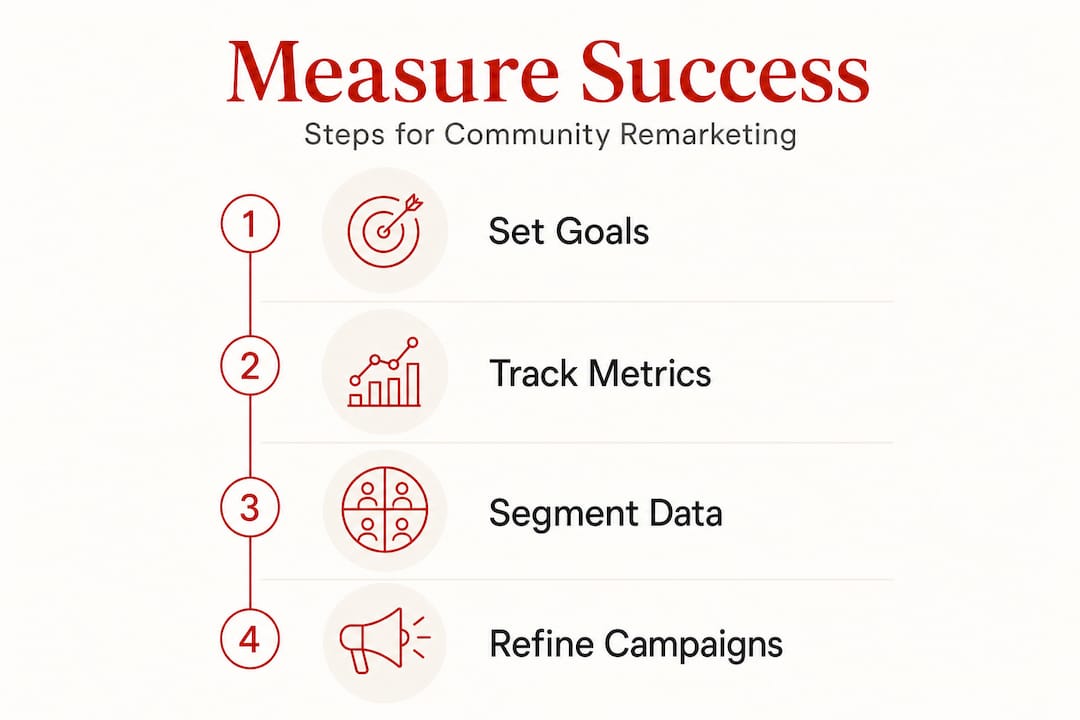
Knowing how to execute remarketing is only half the process. Measuring impact and refining campaigns over time completes it. Community organisations often make the mistake of applying commercial metrics, such as revenue generated, to campaigns that are not primarily transactional. This leads to misleading conclusions about what is and is not working.
Key performance indicators for the community sector
The NSW Government advises using retargeting for lower-funnel objectives, meaning audiences who are close to taking a specific action. For community organisations, those actions might include:
- Event sign-ups and registrations
- Volunteer application form completions
- Newsletter or programme enrolments
- Donation completions or recurring gift sign-ups
- Repeat attendance at community activities
These are your primary conversion metrics. Track them at the campaign level and break them down by audience segment to understand which groups are responding most effectively.
Balancing quantitative and qualitative indicators
Click-through rate (CTR) and cost per conversion are useful but incomplete measures of success. Organisations should also track qualitative signals such as:
- Increases in direct enquiries and community feedback
- Social media sentiment and comment quality on remarketed posts
- Volunteer retention rates over time
- Repeat donor behaviour across multiple campaigns
Ethical growth approaches recognise that community trust is an asset that does not appear directly in a campaign report but has a significant long-term effect on every future campaign’s performance.
Continuous improvement cycles
Effective remarketing requires regular review. A monthly or quarterly cycle of testing, measuring, and refining keeps campaigns relevant and efficient. Test one variable at a time, whether that is the creative format, the message, or the call to action, and allow sufficient time to gather meaningful data before drawing conclusions. Small organisations with limited budgets benefit especially from disciplined testing, as it prevents wasted spend on underperforming approaches.
A fresh take: why Sydney’s communities should rethink remarketing
Much of the mainstream advice around remarketing focuses on conversion rates and cost efficiency. These are valid concerns, but they miss what makes remarketing genuinely valuable for Sydney’s community sector: the ability to sustain and deepen relationships with people who already care about your cause.
There is a common assumption among not-for-profit and community organisations that remarketing feels intrusive or commercially driven, and therefore out of step with their values. This assumption deserves to be challenged. Remarketing, when designed with transparency and genuine respect for the audience, does not undermine trust. It reinforces it. A carefully timed email to a past volunteer sharing the outcomes of a programme they contributed to is not an intrusion. It is a meaningful follow-up that honours their involvement.
The organisations that treat remarketing as a relationship tool rather than a conversion tool consistently report stronger audience engagement. They also find that their audiences become more forgiving of imperfect campaigns because trust has been built over multiple honest interactions rather than extracted through pressure.
Ethical impact for brands in the community sector comes from consistency between organisational values and digital behaviour. If your organisation is built on principles of openness, community ownership, and genuine service, your remarketing should reflect exactly those principles. Audiences notice the difference, and they respond to it.
Sydney’s community sector has an advantage that commercial brands spend millions trying to manufacture: authentic local identity and real relationships with real people. Remarketing, used purposefully, is a way to extend and honour those relationships through digital channels. It is not a compromise of values. It is an extension of them.
Unlock your community impact with expert-driven digital strategies
Sydney’s community organisations are doing important work, and their digital strategies should reflect that.
At Marzipan, we work specifically with purpose-driven organisations that want to grow online without compromising on transparency or trust. Our approach to digital marketing services is built around the goals of community-focused groups, not commercial e-commerce funnels. From remarketing campaign setup and audience segmentation to sustainable web design that supports long-term engagement, we build digital systems that scale impact rather than noise. If your organisation is ready to implement a remarketing strategy that reflects your values and drives genuine community growth, we would welcome the conversation.
Frequently asked questions
Is remarketing suitable for small community organisations?
Yes, local targeting and remarketing are highly effective for Sydney’s small community organisations, particularly when focused on warm audiences such as previous event attendees or website visitors.
How does remarketing protect audience trust?
Using frequency caps and privacy-aligned tracking, combined with messaging grounded in genuine impact stories, keeps audiences engaged without creating negative associations.
What’s the difference between retargeting and remarketing?
Remarketing is relationship-focused, typically delivered through email and ongoing communication, while retargeting uses paid advertising to serve ads to users based on prior website visits or interactions.
What are the best platforms for remarketing community campaigns?
Facebook Ads, Google Ad Grants, and email automation are consistently effective for Sydney-based organisations, with Google Ad Grants offering particular value for eligible not-for-profits due to the free monthly advertising budget.
How do you measure success in purpose-led remarketing?
Track lower-funnel objectives such as event sign-ups, volunteer applications, and repeat attendance alongside standard metrics like click-through rate to get a complete picture of campaign performance.


