

When someone in Melbourne types “physio near me” or a Sydney resident searches “plumber open now,” they are not browsing. They have already decided to act. 46% of all Google searches carry local intent, and 88% of local mobile searchers visit or contact a business within 24 hours. For brick-and-mortar and service businesses across Australia, that conversion window is the commercial opportunity that local search optimisation exists to capture.
“Near me” queries are proximity-driven searches where the user’s device location, not a typed suburb name, determines which results appear. Google treats these differently from general web searches. Its local algorithm weighs three factors: relevance, distance, and prominence. Of these, prominence accounts for roughly 60% of ranking weight, relevance around 25%, and proximity only 15%. That distribution matters because proximity is largely outside a business’s control. Relevance and prominence are not.
The businesses that appear in the local map pack for competitive searches in Australia are there because Google’s algorithm has accumulated enough behavioural evidence to trust them. Reviews, engagement, accurate listings, and consistent signals across the web all feed that trust. The sections below address each of those areas in turn.
How to optimise your Google Business Profile for local search
Google Business Profile (GBP) is the single most visible asset a local business controls in search. GBP and website SEO reinforce each other, but GBP is where most local pack rankings are won or lost first.

Claim and verify your listing. Go to business.google.com, search for your business, and follow the verification steps. Google typically verifies by postcard, phone, or video. An unverified listing cannot be managed and will not rank reliably.
Complete every field accurately. Incomplete profiles are a common and avoidable problem. Only 36% of Australian GBP profiles have all sections filled, yet complete profiles rank in the local pack 2.7 times more often than incomplete ones. Fill in:
- Business name (exactly as it appears on your signage and ABN registration)
- Primary and secondary categories (choose the most specific category available)
- Business description (include your suburb, services, and natural keywords)
- Service areas, if you travel to customers
- Hours, including public holidays
- Phone number, website URL, and attributes relevant to your business type
Keep NAP consistent. Your name, address, and phone number must appear identically across your GBP listing, your website, and every directory where your business is listed. NAP consistency builds trust with Google and strengthens your map pack inclusion.
Update your profile regularly. Active GBP profiles outperform neglected ones. Post updates, add new photos, respond to questions in the Q&A section, and keep your hours current. Google treats engagement as a signal of a live, trustworthy business.
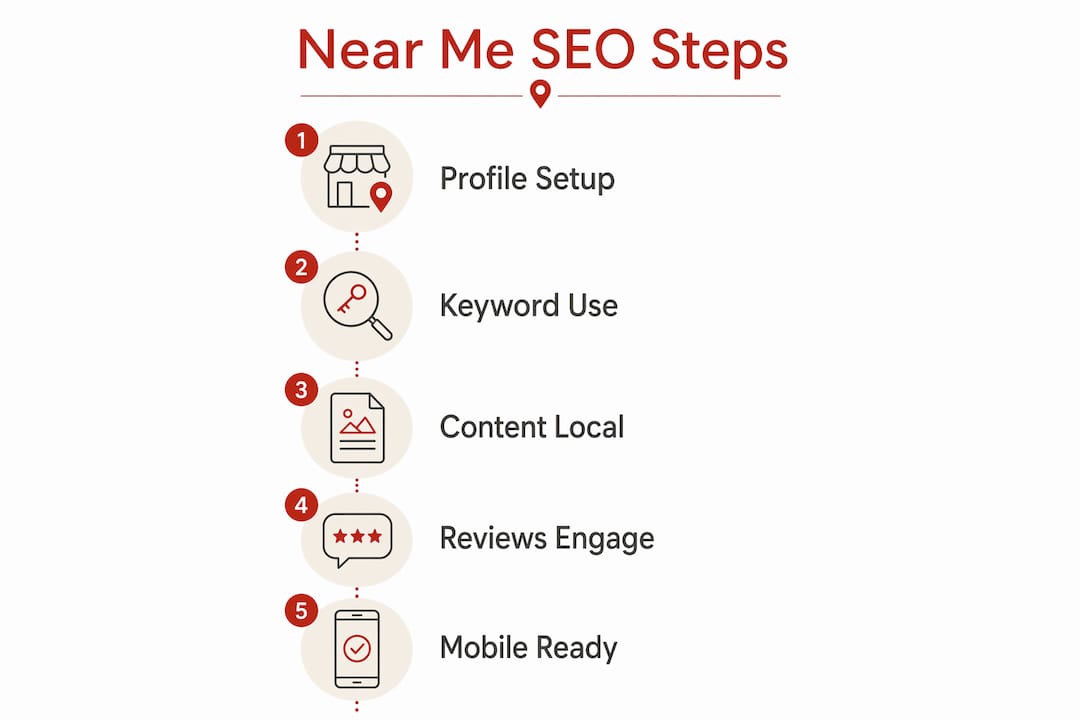
For businesses with multiple locations, each site needs its own GBP listing with a location-specific address, phone number, and photos. A single listing covering five locations will not rank in the local pack for any of them.
How location-based keywords and local content improve your rankings
Your website and your GBP listing work together. Strong local content on your site feeds relevance signals into your GBP, and GBP engagement sends authority signals back to your site.

The starting point is identifying the locations you genuinely serve. For a trades business in Brisbane, that might be Paddington, Ashgrove, and Kelvin Grove rather than “greater Brisbane.” Specificity produces better results than breadth.
Once you have your target locations, incorporate them naturally into:
- Page titles and H1 headings (e.g. “Electrical services in Paddington, Brisbane”)
- Meta descriptions
- Body text, without forcing repetition
- Image alt text where the location is genuinely relevant
Suburb-specific landing pages are one of the most effective tools for local relevance. A page titled “Plumbing services in Newtown” that covers what you offer in that area, includes a local phone number, and answers questions specific to that suburb gives Google a clear relevance signal for searches from that location. These pages should contain genuinely useful content, not thin text that repeats the suburb name without substance.
LocalBusiness schema markup tells search engines exactly what your business is, where it operates, and how to contact you. Adding structured data to your website’s code helps Google surface accurate information in search results and supports your GBP data. Schema is not a ranking shortcut, but it reduces the chance of Google misreading your business type or location.
Pro Tip: Align your website’s service descriptions with the categories you have selected in GBP. If your primary GBP category is “Electrician,” your website’s main service page should use that same language, not a branded alternative.
How reviews and visual content build trust with Google and customers
Reviews are the most direct way to build prominence, the dominant ranking factor. Businesses with 100 or more Google reviews receive 3.4 times more profile clicks than those with fewer. Volume matters, but so does velocity. A business that received 80 reviews three years ago and has since gone quiet is less favoured than one receiving a steady stream of recent feedback.
Encourage genuine reviews consistently. The most reliable method is a simple, direct ask after a positive interaction. Send a follow-up SMS or email with a direct link to your Google review page. Make the process as frictionless as possible.
- Ask at the right moment, shortly after a completed job or positive service experience
- Use a short, direct message rather than a lengthy template
- Respond to every review, positive or negative, within 48 hours
Responding to reviews signals to Google that your business is engaged. It also demonstrates to prospective customers that you take feedback seriously.
Photos and videos improve profile engagement. Listings with photos receive more direction requests and website clicks than those without. Add images of your premises, your team, your work, and your products. Update them periodically rather than uploading a batch once and leaving it.
Pro Tip: Never offer incentives for reviews. Under Australian Consumer Law, incentivised reviews that are not disclosed are misleading conduct. Google’s own guidelines prohibit them, and a penalty to your listing is difficult to recover from.
Building local citations and backlinks to support your authority
Citations are online mentions of your business’s name, address, and phone number. They appear in directories, industry listings, local news sites, and community platforms. Google uses them to verify that your business is real, located where you say it is, and consistently described across the web.
The priority is accuracy, not volume. A citation with a slightly different phone number or an old address actively harms your rankings by creating conflicting signals. Audit your existing citations before building new ones.
High-quality citation sources for Australian businesses include:
- Yellow Pages Australia and True Local
- Localsearch and Hotfrog
- Industry-specific directories (for example, hipages or ServiceSeeking for trades)
- Your local council’s business directory
- Chamber of Commerce listings
Avoid bulk citation services that submit your details to hundreds of low-quality directories. The benefit is minimal, and the risk of inconsistent data is real.
Local backlinks carry more weight for local SEO than generic links from unrelated sites. Useful sources include local newspapers and community publications, sponsorships of local events or sports clubs, partnerships with complementary businesses, and industry associations. A link from a Parramatta community organisation to a Parramatta-based business sends a clear local relevance signal. Understanding why local SEO benefits businesses at this level of specificity helps prioritise where to invest time in outreach.
Why mobile performance directly affects your local search results
The majority of local searches happen on mobile devices. Mobile local searches dominate local search behaviour, and page speed and usability directly affect whether a visitor stays or leaves. A slow or poorly formatted site loses customers before they have read a single line.
Responsive design means your site adapts to any screen size without requiring a separate mobile version. Google uses mobile-first indexing, meaning it crawls and ranks your site based on its mobile version. If your desktop site is well-structured but your mobile version is cluttered or slow, your rankings reflect the mobile experience.
Key mobile optimisation priorities:
- Page load time under three seconds (use Google’s PageSpeed Insights to measure this)
- Tap-friendly buttons and navigation, with no elements too small to press accurately
- Click-to-call phone numbers visible without scrolling
- Address and directions accessible from the homepage or contact page
- No intrusive pop-ups that block content on mobile
Lightweight design choices, such as compressed images and minimal third-party scripts, reduce load times without sacrificing function. For local businesses, the contact details and call-to-action should be the easiest things to find on any page.
How to monitor and refine your local SEO over time
Local SEO is not a one-time setup. Continual updates to listings and active engagement drive top rankings over time. The businesses that hold map pack positions in competitive Australian markets do so because they treat their local presence as something to maintain, not something to launch and leave.
GBP Insights shows how many people found your profile through search, how many requested directions, called your number, or clicked through to your website. Review these figures monthly. A drop in direction requests or calls often signals a change in your ranking position before a rank tracker confirms it.
Google Analytics (or Google Analytics 4) shows which pages on your website attract local traffic, how long visitors stay, and whether they convert. Pair this with GBP data to understand the full journey from search to contact.
Rank tracking for local SEO requires a different approach from standard keyword tracking. Your ranking varies depending on the searcher’s exact location within your service area. A business can rank in the top three for searchers in one suburb and much lower for searchers three kilometres away. Grid-based tracking tools measure your position across a matrix of points within your service area, giving a more accurate picture of your actual local coverage.
What to review each month:
- GBP search impressions and action counts (calls, directions, website clicks)
- New reviews received and whether responses are current
- Any changes to business hours, services, or contact details that need updating
- Rank positions across your target suburbs
- Website traffic from local search terms
Customer feedback, including reviews and direct enquiries, often surfaces content gaps or service questions that are worth addressing on your website or in GBP posts. Treating that feedback as an input to your SEO, rather than just a reputation matter, keeps your content aligned with what local customers are actually asking.
Australian local SEO in 2026: what the data and experience show
The local search environment in Australia has shifted considerably. “Near me” searches grew 41% year-on-year across Australia in 2025–26, with “web design near me” growing at 62% and trades-related queries consistently up across every major city. The local pack captures 27.6% of all SERP clicks for local queries, making it the most valuable piece of search real estate for businesses that serve a defined geographic area.
The practical implication of prominence accounting for 60% of ranking weight is that most businesses should direct the majority of their local SEO effort toward reviews and engagement, not technical adjustments. Technical accuracy matters, but it is the floor, not the ceiling.
Voice search adds another dimension. Queries like “plumber near me open now” or “accountant near me Saturday” are conversational and intent-rich. Businesses that include natural language in their GBP descriptions, service listings, and Q&A sections are better positioned for these queries. Keeping hours accurate, including holiday hours, is particularly important for “open now” searches.
For community-focused organisations and local service providers in Sydney, the local SEO considerations for community groups follow the same principles, with additional weight on trust signals and accessibility.
Key takeaways
Ranking in “near me” searches requires consistent effort across GBP, website content, reviews, citations, and mobile performance, with prominence accounting for roughly 60% of local pack ranking weight.
| Point | Details |
|---|---|
| GBP completeness matters | Complete profiles rank in the local pack 2.7 times more often than incomplete ones. |
| Prominence drives rankings | Reviews, engagement, and online footprint account for around 60% of local pack ranking weight. |
| NAP consistency is foundational | Identical name, address, and phone number across all listings builds Google’s trust in your business data. |
| Mobile performance affects conversions | Page speed and usability on mobile directly influence whether local searchers contact you or leave. |
| Local SEO requires ongoing management | Continual GBP updates, review responses, and rank monitoring sustain map pack positions over time. |
How Com approaches local search for purpose-driven organisations
Com (Marzipan) works with mission-led organisations across Australia to build and maintain websites and SEO that hold up over time. The approach is grounded in the same principles outlined here: accurate listings, genuine engagement, and content that serves real local intent rather than chasing short-term ranking signals.
For organisations ready to take their local search visibility seriously, Com offers tailored guidance that fits the scale and values of each organisation, without unnecessary overhead or generic packages.


