

TL;DR:
- Google ranking positions show where a webpage appears in search results for specific keywords. Most of the ranking outcome depends on content quality, backlinks, topical expertise, and user engagement signals. Monitoring through Google Search Console, focusing on trend analysis, provides the most accurate measurement over time.
A Google ranking website position is defined as where a specific webpage appears in Google’s search results for a targeted keyword or query. For Australian website owners and digital marketers, this position is the primary indicator of organic search performance. The top three results receive the largest share of organic clicks, making position a direct driver of traffic and visibility. Tools like Google Search Console provide the clearest picture of where your pages stand, and understanding what moves those positions is the foundation of any sound SEO strategy.
What key factors determine Google ranking for a website?

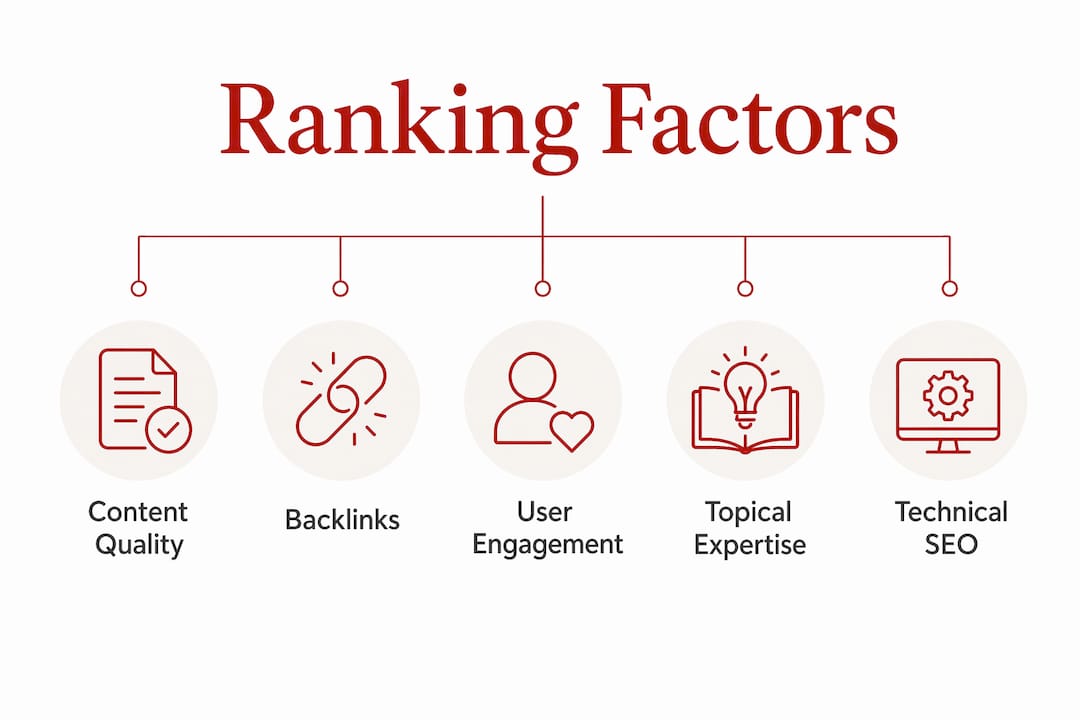
Five primary factors combined account for roughly 75% of ranking influence: content quality (23%), keyword in title tag (14%), backlinks (13%), topical expertise (13%), and searcher engagement signals (12%). That concentration matters. It means you do not need to chase hundreds of variables to make meaningful progress.
The oft-cited notion of 200 ranking factors is outdated. Modern SEO research, including leaked internal data, confirms that Google weighs thousands of internal attributes but prioritises a smaller core set. Practitioners who focus on that core set consistently outperform those who spread effort too thinly.
A critical point that many website owners miss: Google ranks individual pages, not entire websites. A strong domain cannot carry a weak page to the top. Each page must earn its position by matching a specific search intent with relevant, well-structured content.
Key ranking signals to prioritise:
- Content quality and depth. Thin content does not rank. Pages that answer a query thoroughly, with accurate information and clear structure, consistently outperform shorter alternatives.
- Keyword in the title tag. Including the target keyword in the HTML title tag remains one of the highest-weighted on-page signals.
- Backlinks from relevant sources. Links from authoritative, niche-relevant sites signal trust to Google. Volume without relevance carries diminishing returns.
- Topical expertise. A site that covers a subject area in depth across multiple pages builds authority signals that lift individual page rankings.
- User engagement. Click-through rate, time on page, and return visits all feed into Google’s assessment of whether a page satisfies searcher intent.
Pro Tip: Strong domains cannot compensate for thin content. Before building backlinks, audit your pages for depth and relevance. A well-written, intent-matched page on a modest domain will often outrank a shallow page on a high-authority site.
How can Australian website owners measure their Google ranking?
Measurement is where many organisations go wrong. The instinct is to search your own keyword in a browser and note your position. That method is unreliable. Personal browser searches are skewed by your location, search history, device type, and Google’s personalisation algorithms. The result you see is not the result a neutral user in Sydney or Melbourne would see.
The correct approach follows a clear sequence:
- Set up Google Search Console. This free tool from Google is the authoritative source for ranking data on your site. It shows impressions, clicks, average position, and click-through rate for every query your pages appear for.
- Use the Performance report. Filter by country (Australia) and date range to see how specific pages rank for specific queries. Export the data regularly to track trends over time.
- Understand data latency. Google Search Console refreshes data every 24–48 hours. Checking daily for position changes creates noise, not insight. Weekly or fortnightly reviews are more useful.
- Use third-party rank trackers for specific keyword monitoring. Tools like Ahrefs, Semrush, or Moz allow you to track a defined set of keywords over time, independent of your own browsing behaviour. These are useful for benchmarking against competitors and monitoring campaign progress.
- Interpret average position carefully. A page with an average position of 6 may rank 2nd for one query and 14th for another. Average position is a blended metric. Always drill down to query-level data before drawing conclusions.
Pro Tip: Google Search Console is designed for trend analysis, not real-time monitoring. Use it to identify which pages are gaining or losing impressions over 90-day periods. That pattern tells you far more than any single day’s position.
A common mistake for Australian organisations is assuming the home page will rank for all queries. A single URL can rank 3rd for one query and 94th for a closely related one. Effective measurement requires query-level analysis, not page-level assumptions.
How do SERP features affect ranking and traffic in 2026?
Raw position numbers tell an incomplete story. Search results are now fragmented by AI Overviews, featured snippets, local packs, image carousels, and zero-click answers. A page ranking in position 1 for an informational query may receive far fewer clicks than a page ranking in position 3 for a transactional query, simply because the top result is displaced by an AI Overview.
The table below illustrates how different SERP features affect the value of a given ranking position:
| SERP feature | Effect on position 1 clicks | Strategic implication |
|---|---|---|
| AI Overview present | Reduced; users read summary without clicking | Optimise for inclusion in the overview, not just position |
| Featured snippet | Can increase clicks if you own the snippet | Structure content with clear definitions and lists |
| Local pack | Displaces organic results for local queries | Prioritise Google Business Profile for location-based searches |
| Zero-click answer | Minimal click-through regardless of position | Target queries where users need to visit a page for full value |
| Standard blue links | Normal click distribution applies | Position 1–3 delivers the highest traffic share |
Marketers should prioritise business results and overall visibility over position shifts alone. A page that appears in a featured snippet at position 0 may drive more qualified traffic than a page sitting at position 2 in standard results. The metric that matters is clicks and conversions, not position in isolation.
This shift requires a more granular approach to analysis. Reviewing impressions alongside clicks in Google Search Console reveals whether a high-ranking page is actually attracting attention or being bypassed by SERP features above it.
How to improve your website’s Google ranking sustainably
Sustainable improvement in search rankings follows from consistent, well-directed effort across content, authority, and technical health. The integration of content quality, domain authority, and technical SEO is not optional. Neglecting any one area limits what the others can achieve.
Practical steps that produce durable results:
- Create people-first content. Write for the person searching, not for the algorithm. Pages that answer questions clearly, with appropriate depth and accurate information, satisfy both users and Google’s quality assessments. An SEO content workflow helps maintain consistency across a site.
- Build topical authority. Covering a subject area across multiple related pages signals expertise to Google. A community health organisation that publishes thorough, interconnected content on mental health services will outrank a site with a single generic page on the topic.
- Maintain technical health. Site speed, mobile usability, structured data markup, and clean crawlability are baseline requirements. Google cannot rank a page it cannot access or understand.
- Target distinct search intents with dedicated pages. One page cannot rank well for queries with different intents. A page about “volunteering in Sydney” and a page about “donating to Sydney charities” should be separate, each optimised for its own query.
- Avoid tactics that risk penalties. Purchased links, keyword stuffing, and cloaked content produce short-term gains and long-term damage. Google’s spam systems are more capable than they were three years ago.
Pro Tip: Review your ethical SEO practices annually. Algorithm updates in 2024 and 2025 specifically targeted sites that prioritised search engines over users. Pages written for people, updated regularly, and supported by genuine authority signals have proven the most resilient.
For Australian organisations operating in community, health, or advocacy sectors, sustainable SEO is not just an ethical preference. It is the most reliable path to lasting organic visibility without the risk of penalties that can erase years of progress overnight.
Key takeaways
Google ranking position is determined primarily by content quality, backlinks, topical expertise, and user engagement signals, and is best monitored through Google Search Console using trend analysis rather than daily position checks.
| Point | Details |
|---|---|
| Rankings are page-specific | Each page earns its own position; a strong domain cannot lift a weak page. |
| Five factors drive most outcomes | Content quality, title keywords, backlinks, topical expertise, and engagement account for roughly 75% of ranking influence. |
| GSC is the primary measurement tool | Use Google Search Console for trend analysis; data refreshes every 24–48 hours. |
| SERP features change click value | AI Overviews and featured snippets can reduce clicks even for top-ranking pages. |
| Sustainable tactics outperform shortcuts | People-first content, technical health, and genuine authority signals produce durable rankings. |
What I have learned from working with mission-driven organisations on Google ranking
The organisations I work with most often arrive with the same concern: their website is not appearing in search results, and they are not sure why. After reviewing their Google Search Console data, the pattern is almost always the same. Their pages are indexed, they are receiving impressions, but their content is too thin or too broadly targeted to rank well for any specific query.
The instinct is to chase position numbers. I understand it. Position feels concrete and measurable. But position without context is misleading. A page that moves from position 12 to position 8 may see no meaningful change in clicks if a featured snippet sits above both. What matters is whether the right people are finding the right pages and taking the actions that serve the organisation’s goals.
The most effective shift I have seen is when organisations stop treating SEO as a separate activity and start treating it as part of how they communicate. When content is written to genuinely answer the questions their audience is asking, updated regularly, and supported by a technically sound website, rankings follow. Not immediately, and not without effort. But they follow, and they hold.
Google Search Console data trends over 90-day periods are far more instructive than daily position checks. Patience and consistency, applied to a clear content plan, produce better outcomes than any tactical shortcut I have encountered.
— Ben
How Com supports Australian organisations with ethical SEO
Com works with mission-led organisations across Australia to build search visibility that lasts. The approach combines AI-informed SEO, people-first content strategy, and technically sound website foundations to produce rankings that reflect genuine authority rather than short-term tactics.

For organisations that want to improve their Google ranking without compromising their values, Com’s digital marketing services are built around exactly that balance. From initial SEO audits to ongoing content and technical support, the work is grounded in transparency, sustainability, and measurable outcomes. If your organisation is ready to build organic visibility the right way, Com’s team in Sydney is available to help.
FAQ
What does Google ranking position mean for a website?
Google ranking position refers to where a specific webpage appears in search results for a given query. Position 1 is the top organic result; positions beyond 10 fall to page two and receive very little traffic.
How do I check my website’s Google ranking accurately?
Google Search Console is the most reliable free tool. It shows average position, impressions, and clicks for every query your site appears for, without the personalisation bias of a standard browser search.
Why does my ranking differ across devices and locations?
Google personalises results based on device type, location, and search history. A page may rank 4th on mobile in Brisbane and 9th on desktop in Sydney for the same query. Use Google Search Console filtered by country for a consistent baseline.
How long does it take to improve a Google ranking?
Meaningful ranking improvements typically take three to six months of consistent effort. New content on an established site can rank faster; new sites generally require longer to build the authority signals Google needs to trust them.
Does having a good website design affect Google ranking?
Design affects ranking indirectly. Site speed, mobile usability, and clear page structure all influence how Google crawls and assesses a page. A well-designed site that loads quickly and is easy to navigate supports better rankings by improving user engagement signals.


