

TL;DR:
- Most small businesses overlook that SEO is a long-term strategy, essential for sustainable online visibility and growth.
- Consistent SEO efforts, including local optimization and quality content, generate ongoing traffic and build trust over time.
Most small business owners know they need a website, but fewer recognise that having one is only the starting point. Understanding why SEO is important for small business is what separates those who are found online from those who are invisible to potential customers. Organic search accounts for 53% of all online traffic and contributes to 44% of revenue share, yet many small businesses still prioritise paid advertising over building sustainable organic visibility. This article explains how SEO works, what it delivers for local businesses, and how to begin applying it with confidence.
Table of Contents
- Key takeaways
- Why SEO is important for small business visibility
- The measurable benefits of SEO for small businesses
- Common misconceptions about SEO
- Practical steps to improve your SEO in 2026
- My perspective on SEO for small businesses
- How Com can support your SEO growth
- FAQ
Key takeaways
| Point | Details |
|---|---|
| Organic search drives revenue | Over half of all online traffic comes from organic search, making SEO a direct contributor to business income. |
| Ranking on page one matters | Three out of four users never scroll past the first page of results, so visibility at the top is critical. |
| Local SEO builds community trust | A well-maintained Google Business Profile and consistent citations improve local discovery and customer confidence. |
| SEO compounds over time | Unlike paid advertising, SEO continues generating traffic and returns long after the initial work is done. |
| Patience is required | Early SEO gains appear in search impressions before leads increase, so consistent effort over months is necessary. |
Why SEO is important for small business visibility
Search engine optimisation is the practice of making a website more visible in search engine results pages, known as SERPs. When someone types a query into Google, the search engine evaluates hundreds of signals to decide which pages to show. SEO is the process of aligning your website with those signals so it appears where your customers are already looking.
For small businesses, this matters enormously. Three out of four users never scroll past the first page of search results. If your business does not appear on that first page for relevant searches, the majority of potential customers will never find you. Paid advertising can temporarily fill that gap, but SEO sustains traffic without ongoing ad spend, which is a meaningful distinction for businesses managing tight budgets.
The core elements of SEO for a small business include:
- Keyword relevance: Using the words and phrases your customers actually type into search engines. If you run a bakery in Melbourne, appearing for “birthday cakes Melbourne” matters far more than general terms.
- On-page signals: Clear page titles, descriptive meta descriptions, structured headings, and readable content all help search engines understand what each page is about.
- Technical foundations: A website that loads quickly, works well on mobile devices, and has a logical structure performs better in search rankings.
- Local SEO: Claiming and completing your Google Business Profile, collecting genuine customer reviews, and maintaining consistent contact details across directories all improve your presence in local search results.
- Content quality: Pages that answer real customer questions thoroughly tend to rank higher and attract more engaged visitors. Content aligned to customer search language increases site engagement and rankings.
Pro Tip: Set up Google Search Console before you do anything else. It is free, shows you exactly which search terms people use to find your site, and tells you which pages are gaining impressions. It is the clearest starting point for understanding where you stand.
Local SEO deserves particular attention. Google Business Profile completion improves local search clicks and customer engagement directly. When someone searches for a service “near me” or in a specific suburb, Google prioritises businesses with complete, accurate, and regularly updated profiles. This is one of the most direct SEO advantages for local business that requires minimal technical knowledge to implement.
The measurable benefits of SEO for small businesses
The benefits of SEO for small business are well documented, and they extend beyond traffic numbers. Understanding them helps clarify why time and effort invested in SEO is worthwhile compared to other marketing channels.
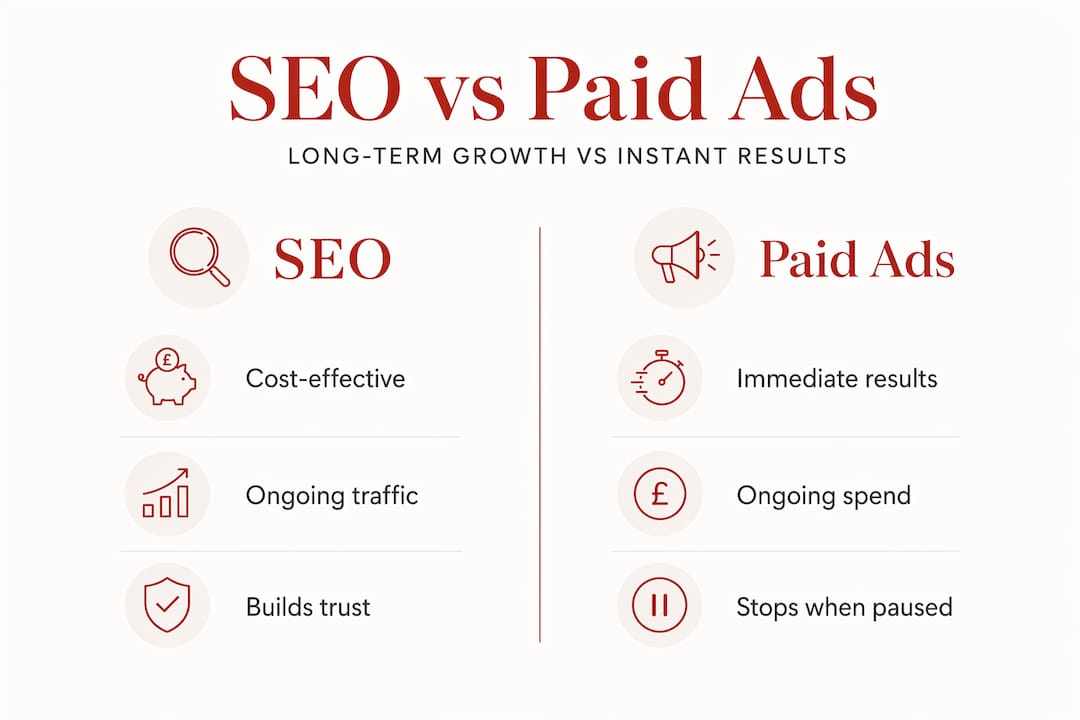
The most direct benefit is cost-effectiveness. SEO is a cost-free alternative to paid keyword buying. Paid advertising delivers results while the budget is active and stops the moment spending does. SEO, by contrast, builds authority gradually. A page that ranks well today can continue attracting visitors for months or years without additional spend. This compounding effect is what makes the role of SEO in business so distinct from other marketing investments.

Trust and credibility follow from strong search visibility. SEO helps build brand awareness, trust, and long-term customer loyalty. When your business appears at the top of organic results, customers often perceive it as more credible than paid listings. For community-based businesses, this trust is particularly valuable because customers are more likely to choose a local provider they recognise from repeated search exposure.
There are also secondary benefits worth noting:
- Improved customer insight: SEO analytics reveal which questions and terms bring visitors to your site, helping you refine products, services, and marketing messages.
- Better website performance: The technical improvements required for strong SEO, such as faster loading times and cleaner navigation, also improve the overall user experience, which reduces the likelihood of visitors leaving without taking action.
- Broader marketing support: Consistent organic visibility strengthens other marketing efforts. It builds email subscriber lists, increases social media awareness, and creates touchpoints that support customer relationships over time.
For businesses focused on local market growth, the practical impact is direct. Strong local SEO involves well-maintained profiles, consistent citations, and technical website signals working together. When those elements align, a business appears in the local “map pack” results, which are the prominent listings shown above standard organic results for location-specific queries. These are the results that generate phone calls, website visits, and foot traffic from people physically nearby.
You can read more about how this applies to community-focused organisations in this overview of local SEO for community brands.
Common misconceptions about SEO
Many small businesses approach SEO with either unrealistic expectations or unnecessary scepticism. Both positions are understandable, but both lead to missed opportunity.
The most common misconception is that SEO is simply a matter of adding keywords to a website. In practice, keywords are one input among many. Technical website health, backlink quality, page experience, and content depth all contribute to rankings. Businesses that focus only on keywords without attending to the underlying website foundation tend to see limited results and conclude that SEO does not work. The reality is that the foundation was incomplete.
“Paid advertising stops delivering the moment spend ends. SEO, when done consistently, continues generating returns long after the initial investment.”
A related misconception is that SEO delivers fast results. SEO payoff is gradual: impressions and top queries improve first before lead growth follows. For most small businesses, meaningful organic traffic improvements take three to six months of consistent effort. This does not mean progress is invisible. Increases in search impressions, improved keyword positions, and growing click-through rates all appear before the phone starts ringing more frequently. Tracking these intermediate signals keeps expectations grounded.
Voice search is also changing the way people find local businesses. Voice search demands optimised natural-language content and fast page loading. Queries spoken aloud tend to be longer and more conversational than typed searches. A small business that only targets short keyword phrases may be missing a growing share of local discovery through voice-enabled devices.
Pro Tip: Review your page titles and meta descriptions at least every six months. Search behaviour changes, and a title that matched common queries two years ago may no longer reflect what people are actually typing today.
Ignoring SEO does not keep a business neutral. It cedes ground to competitors who are actively investing in organic visibility. The importance of SEO strategies lies partly in this competitive reality. A competitor with a well-optimised website and active Google Business Profile will consistently appear ahead of a business that has neither, regardless of the quality of the actual product or service on offer.
Practical steps to improve your SEO in 2026
Starting or improving your SEO does not require a large budget or technical expertise. The following steps provide a clear foundation for any small business.
- Claim and complete your Google Business Profile. Add accurate contact details, opening hours, photos, and a clear business description. Request reviews from satisfied customers and respond to all reviews, including negative ones.
- Check your website on a mobile device. More than half of all searches now happen on mobile. If your website is difficult to use on a phone, it will rank lower and visitors will leave quickly.
- Identify your most important search terms. Use Google Search Console or a free keyword research tool to find the phrases your potential customers use. Focus on specific, local terms rather than broad ones.
- Update your page titles and meta descriptions. Each page should have a unique title that reflects its content and a meta description that clearly explains what a visitor will find there.
- Publish content that answers customer questions. A simple blog post addressing a common question your customers ask can rank for relevant searches and establish credibility.
- Gather consistent citations. Your business name, address, and phone number should appear consistently across directories like Yellow Pages, True Local, and any industry-specific listings.
- Monitor your results. Google Search Console shows which queries bring visitors to your site, which pages receive the most impressions, and where click-through rates could improve.
The following table compares two approaches to online marketing for a local small business:
| Factor | Paid advertising | SEO |
|---|---|---|
| Cost over time | Ongoing spend required | Reduces relative to results gained |
| Traffic when paused | Stops immediately | Continues from established rankings |
| Trust perception | Lower (labelled as ad) | Higher (perceived as organic result) |
| Time to results | Days to weeks | Three to six months typically |
| Local targeting | Precise but expensive | Effective with local SEO tactics |
The benefits of SEO for small business growth become clearer when viewed against this kind of comparison. SEO requires patience, but the returns accumulate in a way that paid channels rarely match over the long term.
My perspective on SEO for small businesses
I have worked with a range of small and community-based businesses on their digital presence, and the pattern I see most often is this: SEO gets treated as an afterthought rather than a foundation. Businesses invest in a new website, then wonder why enquiries have not improved. The website was built without any attention to how people search, what keywords matter locally, or whether Google could even read the pages properly.
What I have found is that the businesses making the most consistent progress are not necessarily doing the most technically sophisticated SEO. They are doing the basics well and doing them continuously. A complete Google Business Profile, a website that loads properly on mobile, and a handful of well-written pages that answer genuine customer questions will outperform a technically impressive site that has been left untouched for two years.
The other thing I would offer is this: the early months of SEO work feel unrewarding. Impressions increase, positions shift, but the phone is not yet ringing differently. That early period is when most businesses lose confidence and stop. Staying consistent through those months is what separates businesses that eventually benefit significantly from those that conclude SEO does not work for them.
There is also an alignment worth noting for purpose-driven businesses. Sustainable SEO practices built on genuine content, honest representation, and technical care tend to hold their rankings better over time than those built on shortcuts. That stability matters for organisations that want growth without the volatility of depending on paid spend.
— Ben
How Com can support your SEO growth
Com, trading as Marzipan, works with small businesses and purpose-driven organisations to build and maintain websites and SEO that deliver lasting results. The approach combines ethical, AI-informed SEO services with sustainable web design and content strategy, so that visibility is built on a reliable foundation rather than short-term tactics. Whether you are starting from scratch or improving an existing website, the work is calibrated to your goals and your community. For businesses that want to grow online without compromising their values, this kind of considered, ongoing partnership is worth exploring. You can learn more at marzipan.com.au.
FAQ
Why does SEO matter more than paid ads for small businesses?
SEO generates traffic that continues without ongoing spend, while paid advertising stops delivering the moment the budget runs out. For small businesses with limited marketing budgets, this compounding return makes SEO a more sustainable long-term investment.
How long does SEO take to show results?
Most small businesses see meaningful improvements in search impressions within the first few months, but significant increases in leads or enquiries typically take three to six months of consistent effort. SEO gains appear in impressions first before converting to direct business outcomes.
What is local SEO and why does it matter?
Local SEO refers to optimisation practices that improve a business’s visibility in location-specific search results, including Google’s map pack. It includes maintaining an accurate Google Business Profile, gathering reviews, and ensuring consistent contact details across directories.
Is SEO relevant if my business mainly gets referrals?
Yes. Even businesses that rely heavily on referrals benefit from SEO because referred customers often search online to verify credibility before making contact. A business with strong organic visibility and positive reviews is more likely to convert those referrals into actual customers.
How do I start SEO with a small budget?
Begin with Google Search Console and Google Business Profile, both of which are free. Focus on ensuring your website is mobile-friendly, your page titles are accurate, and your contact details are consistent across the web. These steps form the foundation of effective local SEO without requiring paid tools or external expertise.


