

TL;DR:
- E-E-A-T SEO emphasizes Google’s framework of Experience, Expertise, Authority, and Trustworthiness to build credible content. It is a lens for evaluating content quality, not a direct ranking signal, but its signals influence search algorithm assessments. Building genuine credibility involves consistent evidence, transparent authorship, verifiable information, and ongoing content maintenance.
E-E-A-T SEO, commonly referred to as “eat seo” in practitioner shorthand, is the deliberate application of Google’s quality evaluation framework covering Experience, Expertise, Authoritativeness, and Trustworthiness to build content that earns genuine credibility with both users and search engines. Google’s Search Quality Rater Guidelines define E-E-A-T as the lens through which human quality raters assess whether a page serves its audience well. The framework is not a direct ranking signal, but the proxy signals it generates, including transparent authorship, verifiable claims, and off-page reputation, do influence how algorithms evaluate content quality. For digital marketers and SEO professionals, understanding this distinction is the foundation of any credible content strategy.
What does eat SEO actually require from your content?
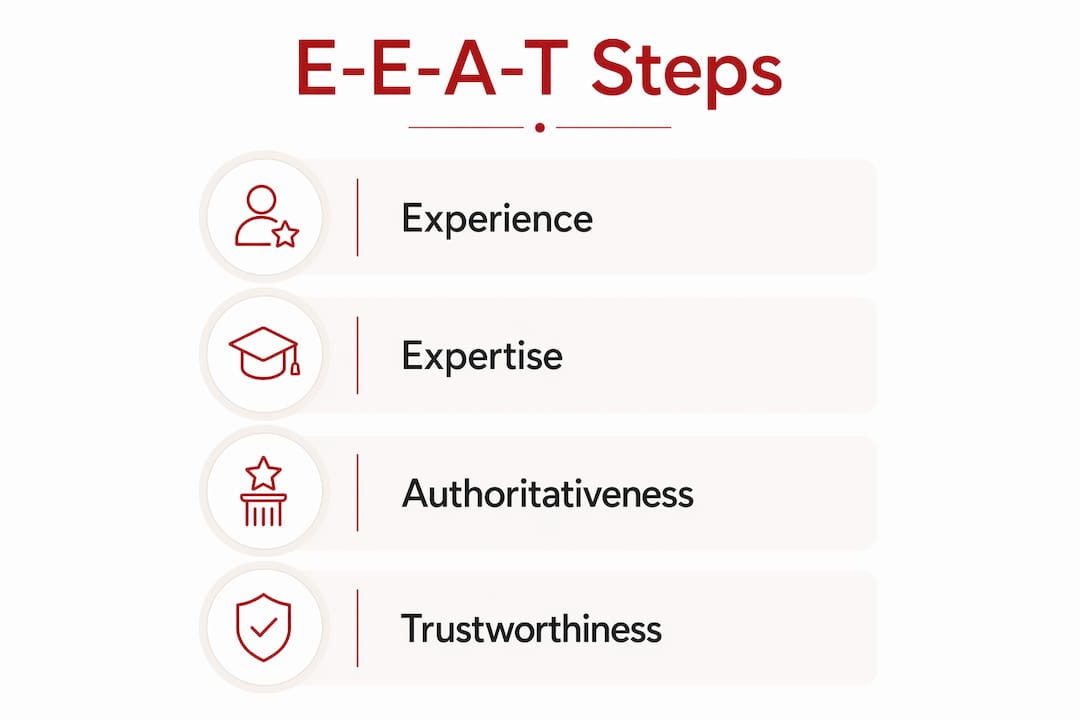
E-E-A-T SEO breaks into four components, each demanding a different type of evidence. Treating them as a single concept leads to shallow implementation.
Experience is the newest addition to the framework, added when Google expanded from E-A-T to E-E-A-T. It requires proof of first-hand involvement with the subject. Generic claims of experience are insufficient; concrete proof through observations, screenshots, and contextual detail is what establishes credibility. A food blog that documents a recipe through original photography and notes on ingredient substitutions demonstrates experience. One that rephrases existing recipes does not.

Expertise refers to depth of knowledge, whether formal or practical. For regulated topics such as health, finance, or legal content, formal credentials carry more weight. For experiential topics, demonstrated knowledge through detailed, accurate content serves the same function. Author bios that name qualifications, professional affiliations, or years of practice give raters and readers a basis for trust.
Authoritativeness is built externally. It reflects how other credible sources regard your content and your organisation. Backlinks from recognised institutions, mentions in trade publications, and consistent topical focus all contribute. A site that covers one subject area thoroughly over time builds more authority than one that publishes broadly across unrelated topics.
Trustworthiness is the most decisive factor. Untrustworthy pages score low E-E-A-T regardless of apparent expertise or authoritativeness. Trust is demonstrated through accuracy, transparency, and accountability. This means clear “About” pages, verifiable contact information, up-to-date content, and legal pages appropriate to the site’s purpose.
- Publish detailed author bios with named credentials and professional links
- Cite primary sources and link to verifiable external references
- Display “last reviewed” dates on content that may become outdated
- Include case studies or original data where the subject allows
- Maintain legal pages: privacy policy, terms of use, and editorial standards
Pro Tip: Add a structured author schema to your page templates. This makes authorship machine-readable and visible to both crawlers and quality raters reviewing your pages.
Is E-E-A-T a direct ranking factor?
E-E-A-T is not a direct ranking factor but an evaluation lens made visible through quality signals. Google has confirmed this position publicly, and SEO practitioners who treat it otherwise tend to waste effort on surface-level fixes that produce no measurable result.
The confusion arises because the signals associated with E-E-A-T, such as authoritative backlinks, accurate content, and transparent authorship, do influence ranking algorithms. The distinction matters because it changes how you allocate effort. Chasing an “E-E-A-T score” is not possible. Building a site that genuinely earns trust is.
“A common industry error is treating E-E-A-T as a checklist rather than a holistic trust framework needing supporting evidence. Originality, citations, transparent authorship, and clear accountability are the substance behind the signals.”
The practical implication is that real E-E-A-T demonstration involves publishing content with proof of lived experience, credible expertise, and verifiable reputation, not just polished writing. A well-formatted article with no named author, no citations, and no external validation will not satisfy quality raters, regardless of how technically sound the on-page SEO is.
Several common pitfalls undermine E-E-A-T efforts:
- Adding an author name without a bio or credentials
- Publishing statistics without linking to primary sources
- Claiming expertise in a topic without any external validation
- Ignoring off-page reputation signals such as reviews and press mentions
- Treating E-E-A-T as a one-time audit rather than an ongoing content standard
The framework applies most stringently to YMYL content, which stands for “Your Money or Your Life.” These are topics where poor information carries real-world risk: health, finance, legal advice, and safety. For high-stakes YMYL content, Google raises the bar for verifiability and reputation considerably. Bios, credentials, citations, and original research are not optional in these niches.
How to build E-E-A-T into your content strategy and site architecture
Sustainable SEO performance requires embedding E-E-A-T signals into site structure, not just individual articles. E-E-A-T functions as an evidence architecture: consistent display of qualified authorship, verifiable claims, and last reviewed dates reduces the risk of credibility gaps across the site.
A structured approach covers four areas:
-
Authorship infrastructure. Create a standard author bio template used across every piece of content. Include the author’s name, credentials, professional role, and a link to a verifiable profile such as LinkedIn or an institutional page. Apply this consistently, not selectively.
-
Content depth and topical focus. Publish content that covers a subject area thoroughly over time. A site with thirty well-researched articles on a single topic builds more authority than one with three hundred thin articles across unrelated subjects. Topical depth signals expertise to both algorithms and human raters.
-
Citation and source standards. Link to primary sources: government bodies, peer-reviewed research, and recognised institutions. Avoid citing secondary aggregators when the original source is accessible. Update citations when sources change or expire.
-
Legal and transparency pages. Every site should carry a privacy policy, a clear “About” page, and contact information that is easy to find. For organisations handling sensitive data or providing professional advice, editorial standards pages add a further layer of accountability.
The following table outlines how each E-E-A-T component maps to a practical site element:
| E-E-A-T component | Practical site element |
|---|---|
| Experience | Original case studies, first-hand observations, documented processes |
| Expertise | Named author bios with credentials and professional links |
| Authoritativeness | Backlinks from recognised sources, trade mentions, topical focus |
| Trustworthiness | Privacy policy, contact page, cited sources, last reviewed dates |
Technical SEO remains necessary but is not sufficient on its own. Technical fundamentals and off-page trust signals must work together. A fast, accessible site with strong technical foundations earns more from its E-E-A-T investment than a slow or broken one. For organisations working toward ethical SEO practices, this integration of technical and trust signals is the standard, not the exception.
Pro Tip: Schedule a content review cycle every six months. Update statistics, refresh citations, and revise author bios. Quality raters and algorithms both favour content that shows active maintenance.
How do you measure and monitor E-E-A-T signals?
E-E-A-T does not produce a single metric. Monitoring it requires tracking a set of indirect indicators that together reflect your site’s credibility and trust.
The most useful signals to track include:
- Branded search volume. Growth in searches for your organisation’s name indicates that users recognise and seek out your content directly. This is a strong trust signal.
- Backlink quality. Monitor the authority and relevance of sites linking to you. Links from recognised institutions, industry bodies, or established publications carry more weight than high-volume links from low-quality directories.
- Engagement metrics. Time on page, scroll depth, and return visit rates reflect whether content genuinely serves its audience. Low engagement on content that ranks well is a warning sign.
- Review and reputation signals. Google Business Profile ratings, third-party review platforms, and press mentions all contribute to off-page trust. Negative or absent reviews on a site claiming expertise create a credibility gap.
- Content accuracy audits. Run periodic checks on factual claims, particularly on YMYL pages. Outdated or inaccurate information is a direct trust liability.
The comparison below outlines two approaches to monitoring E-E-A-T signals:
| Monitoring approach | What it reveals |
|---|---|
| Passive (rankings only) | Surface performance; misses trust and credibility gaps |
| Active (branded search, backlinks, reviews, engagement) | Underlying trust health and reputation trajectory |
Trust signals must be visible in the page source and supported by off-page reputation to avoid credibility gaps during algorithm updates or human review cycles. Sites that rely solely on technical optimisation without building genuine reputation are more exposed to ranking volatility. Understanding why Google rankings matter beyond traffic volume helps frame this monitoring work as a long-term investment rather than a quarterly task.
Aligning E-E-A-T monitoring with broader ethical SEO practices also reduces the risk of short-term tactics that erode trust over time. The organisations that maintain stable search visibility through algorithm changes are typically those that have built genuine credibility, not those that have optimised most aggressively.
Key takeaways
Investing in genuine content quality and topical authority compounds ranking durability, because E-E-A-T signals are built through consistent, verifiable evidence rather than technical shortcuts.
| Point | Details |
|---|---|
| E-E-A-T is not a ranking factor | It is a quality evaluation lens; proxy signals it generates do influence algorithms. |
| Trust is the decisive component | Untrustworthy pages score low E-E-A-T regardless of expertise or authority. |
| Evidence must be visible | Author credentials, citations, and review dates must appear on the page, not just be implied. |
| YMYL content faces a higher bar | Health, finance, and legal topics require formal credentials, citations, and original research. |
| Monitoring requires indirect metrics | Track branded search, backlink quality, engagement, and reputation signals together. |
Why E-E-A-T demands more than most SEO checklists allow
The most common mistake I see is treating E-E-A-T as a documentation exercise. Organisations add an author bio, tick a box, and move on. That approach misses the point entirely.
E-E-A-T is a reflection of how a site actually behaves over time. It shows up in whether content is updated when facts change, whether authors are real people with verifiable histories, and whether the organisation is willing to be held accountable for what it publishes. These are not SEO tasks. They are editorial standards.
What I have observed is that sites with genuine topical depth and transparent authorship tend to hold their rankings through algorithm updates far better than those optimised primarily for technical signals. The E-E-A-T practical guide for Australians published by Com reflects this directly: the organisations that invest in real credibility build a more durable digital presence.
The harder truth is that E-E-A-T cannot be retrofitted quickly. It accumulates through consistent editorial decisions made over months and years. For mission-led organisations in particular, this is actually an advantage. Their work, their people, and their accountability structures are already the substance that E-E-A-T rewards. The task is making that substance visible on the page.
— Ben
How Com approaches E-E-A-T for mission-led organisations
Com works with purpose-driven organisations that need their digital presence to reflect the credibility they have already built in the real world.
The AI-informed SEO services Com provides are built around the same principles that underpin E-E-A-T: transparent authorship, verifiable content, and sustainable reputation signals. Rather than chasing algorithm changes, Com builds content architectures that hold their value over time. For organisations that want search visibility aligned with their values, the sustainable web design and SEO work Com delivers is designed to last. Get in touch to discuss what a trust-first approach looks like for your organisation.
FAQ
What does E-E-A-T stand for in SEO?
E-E-A-T stands for Experience, Expertise, Authoritativeness, and Trustworthiness. Google uses this framework in its Search Quality Rater Guidelines to evaluate whether content genuinely serves its audience.
Is E-E-A-T a direct Google ranking factor?
E-E-A-T is not a direct ranking factor. It is a quality evaluation lens, and the signals associated with it, such as authoritative backlinks and transparent authorship, influence how algorithms assess content quality.
How do I demonstrate experience in my content?
Experience is demonstrated through first-hand proof: original observations, documented processes, screenshots, and contextual detail specific to the subject. Generic claims of experience do not satisfy quality raters.
Which types of content face the strictest E-E-A-T requirements?
YMYL content, covering health, finance, legal advice, and safety topics, faces the highest bar. Formal credentials, citations, and original research are required rather than optional for these subjects.
How often should I review content for E-E-A-T compliance?
A review cycle every six months is a practical standard. Update statistics, refresh citations, revise author bios, and check that all factual claims remain accurate and linked to current primary sources.


