

TL;DR:
- Many small Australian businesses mistakenly believe SEO is only for large teams with big budgets, but practical strategies do not require extensive resources. Focusing on local SEO, website fundamentals, and building authority through consistent content and reviews can significantly improve search visibility. In 2026, well-structured, clear content and a complete Google Business Profile remain essential for attracting local customers and earning AI citations.
Many small business owners in Australia treat SEO as something best left to large marketing teams with deep budgets. That assumption is understandable, but it is also costly. Good SEO advice for small businesses does not require an agency retainer or a technical background. Organic search drives roughly 50% of website traffic in 2026, and that share remains significant even as AI-generated search results change how people find information. This guide covers the practical steps that matter most: foundations, website optimisation, local SEO, and building authority over time, without the jargon or the hype.
Table of Contents
- Key takeaways
- SEO fundamentals for small businesses
- Website and content optimisation in 2026
- Local SEO for Australian small businesses
- Building authority and tracking progress
- A practical perspective on small business SEO
- How Com can help your business grow online
- FAQ
Key takeaways
| Point | Details |
|---|---|
| Organic search still dominates | Around half of all website traffic still comes from organic search, making SEO worth pursuing in 2026. |
| Local SEO offers quick wins | Optimising your Google Business Profile and gathering reviews delivers faster results than broad national campaigns. |
| E-E-A-T builds trust and rankings | Demonstrating experience, expertise, authority, and trustworthiness helps small businesses rank higher and convert visitors. |
| Technical basics matter | Site speed, mobile-friendliness, and structured data are achievable fixes that directly affect search performance. |
| Audits before tactics | Identifying ranking barriers through an audit saves time and money before committing to longer-term SEO efforts. |
SEO fundamentals for small businesses
Search engine optimisation is the process of improving how your website appears in unpaid search results. For a small business, the practical goal is straightforward: when someone nearby searches for what you offer, your website should appear in a relevant position and give them a reason to contact you.
The distinction between local SEO and broader SEO matters here. A plumber in Parramatta benefits most from ranking in local searches like “emergency plumber Parramatta” rather than competing nationally. A software consultancy, by contrast, may target searches across multiple cities or industries. Most small businesses in Australia fall into the first category, which is good news because local SEO delivers faster wins and requires less resource than national campaigns.
In 2026, strong E-E-A-T signals are among the most significant ranking factors for small businesses. E-E-A-T stands for Experience, Expertise, Authoritativeness, and Trustworthiness. Google uses these signals to assess whether a website deserves to rank for a given query. For a small business, this means publishing accurate, clearly attributed content, maintaining a professional website, collecting genuine reviews, and being transparent about who you are and what you do.
Keyword research for small businesses does not need to be complicated. The core question is: what do your customers type into Google when they need your service? Useful starting points include:
- Questions your customers ask you directly (“how much does X cost in Sydney?”)
- Service and location combinations (“bookkeeper Fitzroy”, “dog groomer Northcote”)
- Problem-based phrases (“leaking roof repair Brisbane”)
- Comparison queries (“best accountant for small business Melbourne”)
Free tools such as Google Search Console and Google Keyword Planner can reveal what queries already bring visitors to your site. The goal is to write content that addresses customers’ questions clearly rather than to target high-volume terms you cannot realistically rank for.
Website and content optimisation in 2026
Technical essentials for small business sites
A slow, difficult-to-use website undermines every other SEO effort you make. Site speed problems commonly trace back to large images, excessive third-party scripts such as chat widgets and pop-ups, and hosting that cannot handle traffic spikes. Practical fixes include compressing images to under 150KB, removing scripts that are not actively contributing value, and using a content delivery network to reduce load times for visitors in different locations.

Mobile-friendliness is not optional. Google primarily indexes the mobile version of your site, so if your pages are difficult to read or navigate on a phone, your rankings will suffer regardless of how strong your content is. Core Web Vitals, which measure loading speed, interactivity, and visual stability, are measurable through Google’s free PageSpeed Insights tool.
Structured data and schema markup
Schema markup is a piece of code added to your pages that tells search engines what type of content they contain. For a small business, the most useful schema types are LocalBusiness, FAQPage, and Organisation. These take modest effort to implement but meaningfully improve your chances of appearing in rich search results and being cited by AI-generated answers.
Pro Tip: Add FAQPage schema to any page that answers common customer questions. Clear, declarative answers formatted this way increase the likelihood that AI search engines will cite your content directly.
On-page optimisation
Each page on your website should have a clear purpose and focus on a single topic. The main elements to get right are:
- Title tag: Keep it under 60 characters and include the primary keyword near the front.
- Meta description: Write a clear, accurate summary of the page in under 160 characters.
- Headings: Use H1 for the main page title and H2 or H3 for subsections. Include relevant keywords naturally.
- Body text: Write for the reader first. Keyword placement should feel natural, not forced.
Content strategy and topic clusters
Building topic clusters is one of the most effective content approaches for small businesses with limited publishing capacity. The model works like this: create one detailed pillar page on a broad topic (for example, “bookkeeping for small businesses in Victoria”), then support it with 6 to 15 shorter posts covering related questions and subtopics. Each post links back to the pillar page and to other relevant posts. This signals topical depth to Google and improves the chances of multiple pages ranking.
The table below summarises the two main content approaches and their trade-offs for small businesses.
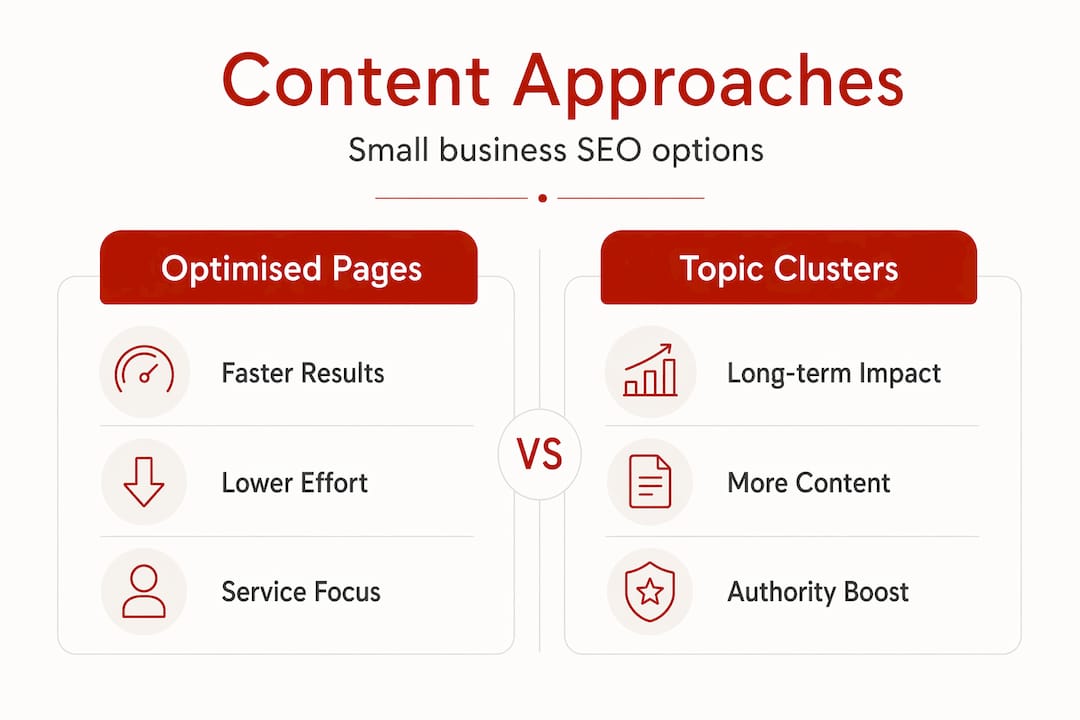
| Approach | Best for | Time investment | Expected impact |
|---|---|---|---|
| Single optimised pages | Service or product pages with clear intent | Low | Steady, reliable |
| Topic cluster model | Building authority in a niche | Medium to high | Stronger long-term rankings |
| FAQ and structured content | Capturing voice and AI search queries | Low | Quick wins in featured results |
Writing for humans first and AI engines second remains the correct approach in 2026. Content that answers questions clearly, in plain language, consistently outperforms content that chases keyword density. For an introduction to building an SEO-friendly website, the architecture decisions made early on have a lasting effect.
Local SEO for Australian small businesses
For the majority of Australian small businesses, local SEO is where effort translates most directly into enquiries and customers. The steps below cover the areas that make the most measurable difference.
-
Claim and fully complete your Google Business Profile. Add your correct business name, address, phone number, website, and trading hours. Choose the most specific primary category available (for example, “conveyancing solicitor” rather than just “legal services”). Upload recent photos of your premises, staff, and work. A complete profile significantly outperforms a partial one.
-
Maintain consistent NAP details across all directories. NAP stands for Name, Address, and Phone number. Inconsistencies across listings on platforms such as Yellow Pages, TrueLocal, and Yelp create confusion for search engines and reduce ranking confidence. Audit your listings regularly and correct any discrepancies.
-
Build a review workflow. Fifty or more reviews with an average of 4.5 stars or higher is a realistic and valuable target for most small businesses. Ask customers directly after a completed transaction, via email or in person. Respond to all reviews, including negative ones, within 48 hours. The response itself signals to Google that your business is active and engaged.
-
Create location-specific pages on your website. If you serve multiple suburbs or regions, write a dedicated page for each location. Reference nearby landmarks, local events, and community context. Hyper-local content referencing specific community details consistently outperforms generic location templates.
-
Audit your local citations. Tools such as BrightLocal allow you to check citation consistency across directories. Cleaning up incorrect or outdated listings is a low-cost task with a direct effect on local rankings.
-
Write about local topics. A landscaper in the Hunter Valley writing about drought-resistant garden choices for that climate, or a café in Fitzroy writing about local coffee culture, builds relevance signals that generic content cannot replicate.
Building authority and tracking progress
Backlinks and what actually works for small businesses
A backlink is a link from another website to yours. Search engines treat these as signals of credibility, but quality matters far more than quantity. A single link from a relevant local business directory or regional news outlet carries more weight than ten links from unrelated overseas sites.
Accessible link-building tactics for small Australian businesses include partnering with complementary local businesses to exchange genuine mentions, contributing a guest post to an industry blog or community newsletter, submitting original data or a local survey to a trade publication, and getting listed in state and local government business directories. Original research pitches to relevant media can achieve response rates of 5 to 10%, making them a practical option even for small teams.
Internal linking also contributes meaningfully to SEO. When you link from one page on your site to another related page, you help search engines understand the relationships between your content and distribute ranking signals across the site. A structured content strategy makes this easier to manage consistently.
Measuring progress without overwhelm
The table below outlines the core free tools and what to use them for.
| Tool | Primary use | How often to check |
|---|---|---|
| Google Search Console | Queries, impressions, clicks, indexing issues | Monthly |
| Google Analytics 4 | Traffic sources, user behaviour, conversions | Monthly |
| Google Business Profile Insights | Local search views, direction requests, calls | Monthly |
| PageSpeed Insights | Core Web Vitals and load time | Quarterly |
SEO results typically emerge 3 to 6 months after consistent effort begins, with more meaningful impact at the 6 to 12 month mark. This is not a reason to delay. It is a reason to start with a clear baseline and track progress steadily.
Pro Tip: Before investing time in content creation, run a basic audit of your existing site. Identifying ranking barriers early through an audit often reveals quick wins that cost nothing to fix and can improve rankings within weeks.
Common mistakes worth avoiding include publishing thin pages with little original content, ignoring mobile performance, letting outdated content accumulate without review, and building links from directories with no relevance to your industry or location. These errors do not just fail to help; they can actively hold rankings back.
A practical perspective on small business SEO
I’ve worked with enough small teams to know that the biggest obstacle to SEO progress is rarely a lack of knowledge. It is the expectation that SEO should work the way it does for large organisations with dedicated content teams and technical budgets.
What I’ve found is that small businesses win SEO not by replicating enterprise strategies but by being clearer and more consistent than their competitors. A well-maintained Google Business Profile, a handful of detailed service pages, and a genuine review-gathering habit will outperform a bloated content calendar with no strategic focus.
The AI-driven changes in search in 2025 and 2026 have shifted some traffic patterns, but they have not eliminated the value of appearing in search results. If anything, businesses that structure content clearly and answer questions directly are better positioned to be cited by AI engines than those producing high-volume generic content.
My recommendation for any small business starting out is to run an SEO audit first, fix the technical barriers on your existing site, and then build content and local presence steadily. Patience and consistency matter more than any single tactic.
— Ben
How Com can help your business grow online
Com is a Sydney-based digital agency that helps purpose-driven organisations build search visibility without shortcuts or unnecessary complexity. For small business owners looking to improve their online presence, Com offers ethical SEO services that are informed by current AI and search trends, covering technical audits, on-page optimisation, content strategy, and local SEO. The approach is grounded in sustainable, long-term growth rather than short-term tactics that degrade over time. If you are ready to understand what is holding your website back and what a focused SEO programme might look like for your business, the digital marketing services page is a practical starting point.
FAQ
What is the most important SEO step for a small business?
Claiming and fully completing your Google Business Profile is typically the highest-impact first step, particularly for businesses that serve customers in a specific local area.
How long does it take for SEO to show results?
Most small businesses see early improvements within 3 to 6 months of consistent effort, with more significant results appearing between 6 and 12 months.
Is SEO still worth doing with AI search results in 2026?
Yes. Organic search still accounts for roughly half of all website traffic, and well-structured, clearly written content is increasingly cited directly within AI-generated search answers.
What is E-E-A-T and why does it matter?
E-E-A-T stands for Experience, Expertise, Authoritativeness, and Trustworthiness. These are signals Google uses to assess content quality, and they are among the most significant ranking factors for small business websites in 2026.
Do small businesses need to hire an SEO agency?
Not necessarily at the outset. A basic audit, technical fixes, and local SEO optimisation can often be managed in-house. Agencies add most value when a business is ready to scale content production or needs ongoing technical oversight.


