

TL;DR:
- Effective SEO builds website visibility through measurable tactics like keyword optimization, content structure, and technical improvements. Implementing schema markup and continuous evaluation enhances search results and user engagement for small businesses. Fundamentals remain vital in 2026, ensuring long-term success regardless of AI search advancements.
Search engine optimisation (SEO) is the practice of improving a website’s visibility in organic search results through technical, structural, and content-based changes. An example of SEO in practice might be a local bakery targeting the phrase “artisan bread delivery” and increasing site visibility by 60% over six months. That outcome is not accidental. It follows a repeatable set of principles that individuals and small business owners can study, adapt, and apply. This article draws on real cases, from Moz’s content authority strategy to Skyscanner’s long-form travel content, to show what effective SEO looks like when it is grounded in evidence rather than guesswork. Google’s own guidance confirms that SEO fundamentals remain foundational even as generative AI reshapes search in 2026.
What are common real-world examples of effective SEO?
Effective SEO implementation takes many forms depending on the site, the audience, and the goal. The clearest way to understand it is through cases where specific changes produced measurable results.
Keyword research and local visibility
The local bakery example above is one of the most instructive SEO case studies for small businesses. By shifting from generic terms like “bread” to niche phrases like “artisan bread delivery,” the business aligned its content with the precise language its customers were already using in search. This is the core logic of keyword research: match your content to real search behaviour, not assumed behaviour.

Moz followed a similar path at scale. The company grew traffic through keyword optimisation and internal linking, using its own tools to identify gaps and build content that established topical authority. The lesson for small business owners is that the same methodology scales down. You do not need enterprise resources to conduct keyword research. Tools like Google Search Console, Ubersuggest, and Google’s own autocomplete function provide usable data at no cost.
Content structure and organic traffic
Content optimisation is often treated as a matter of tone or style. The evidence suggests structure matters more than most owners realise. Rewriting opening paragraphs above 120 words correlated with an 18% increase in organic traffic over three months. That is a structural change, not a stylistic one. It signals to search engines that the page addresses the query thoroughly from the outset.
Skyscanner offers a larger-scale content SEO example. The company grew its audience tenfold within a year by producing long-form travel content with local insights and strategic keyword placement. The content was useful to readers first, and optimised for search second. That ordering matters. Pages written primarily for algorithms tend to underperform pages written for people.
Pro Tip: When auditing your existing content, check whether your opening paragraph is at least 120 words and directly addresses the page’s primary topic. This single change can improve rankings without touching any technical settings.
Technical SEO and user experience
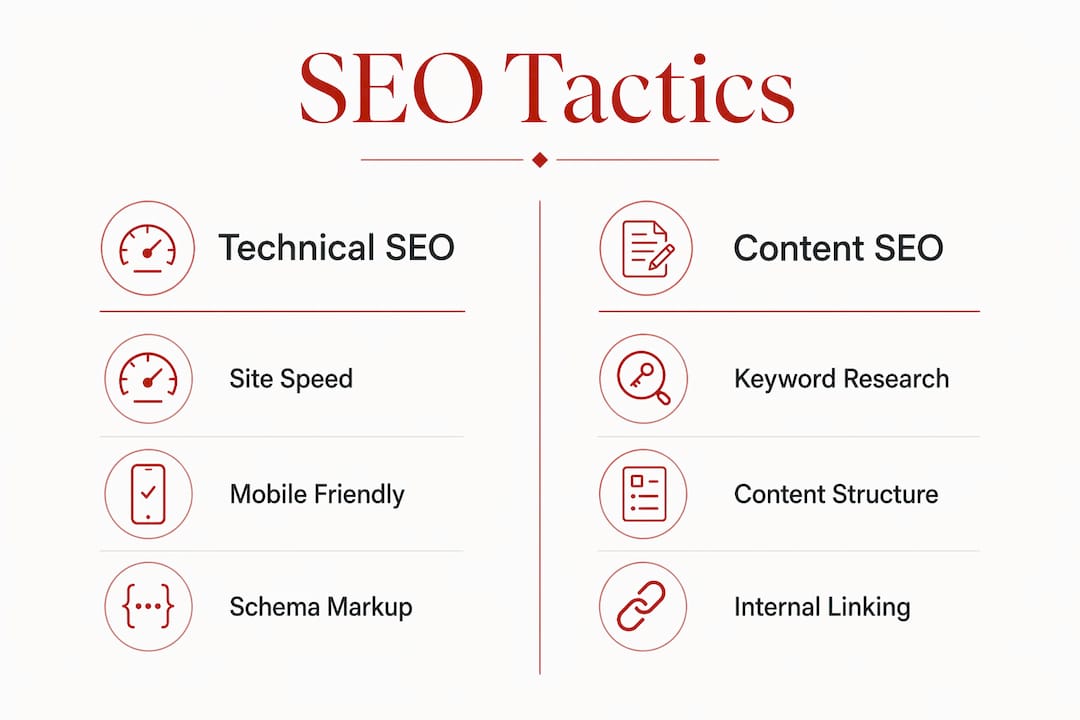
Technical SEO examples include site speed improvements, mobile responsiveness, fixing broken links, and correcting crawl errors. These changes do not produce content, but they remove barriers that prevent search engines from indexing pages correctly. A page that loads slowly on a mobile device will rank below a comparable page that loads quickly, regardless of content quality. For small business owners, a free audit via Google Search Console or PageSpeed Insights identifies the most pressing technical issues without requiring developer expertise.
User experience improvements, such as clearer navigation, reduced page clutter, and accessible design, also contribute to SEO outcomes. Visitors who stay longer and engage more deeply send positive signals to search engines. These are not separate disciplines. They reinforce each other.
How does schema markup work as an SEO technique?
Structured data, commonly implemented through schema markup, is one of the more precise examples of effective SEO because its effects are visible directly in search results. Schema markup is a standardised vocabulary added to a page’s HTML that tells search engines what the content means, not just what it says.
Schema types and their applications
The most commonly used schema types for small business websites include:
- Article — marks up blog posts and news content, helping Google understand publication dates and authorship.
- Product — displays price, availability, and review ratings directly in search results for e-commerce pages.
- FAQPage — surfaces question-and-answer pairs as expandable results beneath the main listing.
- BreadcrumbList — shows the page’s position within the site hierarchy in the search snippet.
- HowTo — presents step-by-step instructions in a structured format eligible for rich results.
Structured data is not a direct ranking signal but improves click-through rates through rich results. Higher click-through rates send engagement signals that can indirectly support rankings over time. For a small business competing against larger sites, a rich result that displays star ratings or FAQ answers can meaningfully increase the proportion of searchers who choose your listing.
Validating schema with Google’s Rich Results Test
Validating schema with Google’s Rich Results Test is the required step before any structured data becomes eligible to display in search. Syntactically correct markup can still fail eligibility if required properties are missing. For example, a Product schema without a "nameoroffers` property will not qualify for rich results even if the JSON-LD is error-free. The Rich Results Test identifies both errors and warnings, and both categories should be resolved.
Pro Tip: After implementing any schema type, paste the page URL into Google’s Rich Results Test before requesting indexing. Addressing warnings at this stage prevents weeks of delay in rich result eligibility.
| Schema type | Typical use case | Rich result format |
|---|---|---|
| FAQPage | Service or product pages with common questions | Expandable Q&A beneath the listing |
| Product | E-commerce or service pricing pages | Star ratings, price, availability |
| HowTo | Tutorial or instructional content | Numbered steps in search results |
| BreadcrumbList | Any multi-level site structure | Path shown in the URL line of the snippet |
How do different SEO tactics compare, and which suits your site?
Choosing the right SEO strategy example depends on the type of site, the competitive environment, and the available resources. Not every tactic produces equal results in every context.
Broad keyword targeting works for high-authority domains that already rank for competitive terms. For most small business websites, long-tail keywords, phrases of three or more words with lower search volume but higher specificity, produce faster and more sustainable results. A plumber in Parramatta is unlikely to rank for “plumber” but can rank for “emergency plumber Parramatta weekend” within a reasonable timeframe.
Content length and structure involve trade-offs. Longer pages tend to rank for more keyword variations, but only when the length reflects genuine depth rather than repetition. Measured content structure constraints, such as a minimum 120-word introduction, no more than one H2 heading per 350 words, and at least four internal links per page, make SEO reproducible and measurable. These are not arbitrary rules. They reflect patterns observed across pages that rank consistently.
| SEO approach | Best suited to | Key trade-off |
|---|---|---|
| Long-tail keyword targeting | Small businesses, new sites | Lower volume, higher conversion rate |
| Technical SEO fixes | Sites with crawl or speed issues | Requires developer access for some fixes |
| Content-led SEO | Blogs, service pages, authority building | Slower results, longer-term compounding |
| Local SEO | Businesses serving a geographic area | Limited reach beyond local intent |
| Schema markup | Product, FAQ, and instructional pages | Requires validation; no direct ranking benefit |
A B2B service provider case study illustrates the value of continuous evaluation. The business refined content and on-page SEO iteratively by analysing user behaviour data, which led to higher qualified leads over time. The SEO strategy did not change dramatically. What changed was the willingness to measure, adjust, and repeat. For small business owners, this means treating SEO as an ongoing process rather than a one-time project.
Local SEO and user-generated content deserve particular attention for community-facing businesses. Google Business Profile optimisation, local citations, and customer reviews all contribute to local search visibility. These are accessible, low-cost tactics that produce disproportionate results for businesses serving a defined geographic area. Marzipan’s guide to local SEO for Sydney community groups provides a practical framework that translates directly to small business contexts.
How can small business owners implement SEO examples in 2026?
Google’s May 2026 guidance confirms that traditional SEO fundamentals should remain a priority even as generative AI features expand. This is a useful anchor for small business owners who feel pressure to chase AI-specific tactics. The fundamentals have not been replaced. They have become more important as the volume of low-quality, AI-generated content increases.
A practical implementation sequence looks like this:
- Start with keyword research. Use Google Search Console to identify which queries already bring visitors to your site, then identify gaps where you have no presence but clear relevance.
- Audit your content structure. Check opening paragraphs for length and relevance, review heading ratios, and confirm that each page has at least four internal links to related content.
- Fix technical issues first. Address crawl errors, broken links, and mobile usability problems before investing in new content. A technically sound site amplifies every other improvement.
- Implement and validate schema. Add the schema types most relevant to your page types and test each one with Google’s Rich Results Test before publishing.
- Monitor and iterate. Review Google Search Console data monthly. Track which pages gain or lose impressions and rankings, and adjust content accordingly.
For those building or rebuilding a site, Marzipan’s guide on how to make an SEO-friendly website covers the structural decisions that affect long-term search performance. Avoiding AI-specific gimmicks, such as keyword stuffing designed to appear in AI overviews, is sound advice. Unique, well-structured content that serves a real user need is what performs consistently across both traditional and AI-assisted search.
Key takeaways
Effective SEO for small businesses is built on measurable, repeatable tactics rather than trends or guesswork.
| Point | Details |
|---|---|
| Keyword specificity matters | Long-tail keywords produce faster results for small businesses than broad, competitive terms. |
| Content structure drives rankings | Opening paragraphs above 120 words and balanced heading ratios correlate with measurable traffic gains. |
| Schema improves visibility, not ranking | Structured data increases click-through rates via rich results but is not a direct ranking factor. |
| Continuous evaluation is the strategy | Iterative improvement based on analytics data produces more qualified traffic over time. |
| Fundamentals hold in 2026 | Google confirms SEO best practices remain the foundation for search visibility, including in AI-driven results. |
What I have found actually works in practice
The cases in this article share a common thread: the results came from doing straightforward things consistently, not from discovering a clever workaround. The bakery targeted specific keywords. Skyscanner wrote useful content at scale. The B2B provider kept measuring and adjusting. None of these are complicated ideas.
What I observe most often with small business owners is not a lack of knowledge about SEO. It is a tendency to delay foundational work while waiting for a clearer picture of what AI search will require. That delay is costly. The businesses that are performing well in search right now are the ones that built clean, well-structured, genuinely useful sites over the past two or three years. They are not scrambling to adapt because their foundations are sound.
The other pattern worth naming is the temptation to treat technical SEO and content SEO as competing priorities. They are not. A technically clean site with thin content will plateau. A content-rich site with crawl errors will underperform. The SEO audit process is the tool that shows you which constraint is binding at any given point. Start there, address what you find, and repeat.
— Ben
How Marzipan supports small businesses with ethical SEO
Com builds and maintains websites and SEO programmes for purpose-driven organisations that want search visibility without compromising their values. The approach combines technical rigour with content strategy grounded in accessibility and sustainability principles.

For small businesses and community organisations seeking practical, AI-informed SEO services that align with long-term growth rather than short-term gains, Marzipan offers tailored support across keyword strategy, structured data implementation, and ongoing performance monitoring. The work is grounded in the same foundational principles this article describes, applied consistently and measured against real outcomes. If you are considering a more structured approach to search visibility, Marzipan’s digital marketing services provide a clear starting point.
FAQ
What is a simple example of SEO in practice?
A local business adding location-specific keywords to its service pages and Google Business Profile is a direct example of SEO. This single change can improve visibility in local search results without any technical development work.
Does schema markup directly improve search rankings?
Schema markup is not a direct ranking signal, but it improves click-through rates by enabling rich results such as star ratings, FAQ panels, and product details in search listings. Higher engagement from these features can support rankings indirectly over time.
How long does SEO take to show results?
Most SEO changes take between three and six months to produce measurable changes in organic traffic. Technical fixes tend to show results faster than content changes, which compound gradually as pages build authority.
What is the difference between technical SEO and content SEO?
Technical SEO addresses how a site is built and indexed, covering areas such as site speed, mobile usability, and crawl errors. Content SEO focuses on the relevance, structure, and depth of the information on each page. Both are required for sustained search performance.
Are SEO fundamentals still relevant with AI in search?
Google’s 2026 guidance confirms that SEO best practices remain foundational for visibility in both traditional and AI-generated search features. Unique, well-structured content that serves genuine user needs continues to be the most reliable path to organic visibility.


