

TL;DR:
- A local SEO provider enhances a business’s visibility in location-based search results through Google Profile optimization, review management, citations, and on-site signals. They focus on fixing foundational elements like NAP consistency and GBP categories before improving rankings, unlike general SEO strategies emphasizing content and backlinks. Business owners should engage in review solicitation, keep profiles current, and monitor rankings to support their provider’s efforts effectively.
A local SEO provider is a specialist service that improves a business’s visibility in location-based search results by managing Google Business Profile (GBP) optimisation, NAP (name, address, phone) consistency, customer reviews, local citations, and on-site local signals. For Sydney businesses competing in suburb-level searches, these are the factors that determine whether a potential customer finds you or a competitor. General SEO agencies focus on domain authority and content at scale. A dedicated local search optimisation specialist works on the signals Google uses to rank businesses in the Local Pack and Maps results, which is where most purchase-intent searches resolve.
What core local SEO services should you expect from a provider?
A qualified local SEO firm should deliver a structured set of services covering every layer of local search visibility. The audit coverage areas that matter most are GBP optimisation, NAP consistency, citation profile health, review velocity, on-site local signals, and rank tracking setup. Each of these feeds into Google’s three local ranking factors: proximity, relevance, and prominence.

Google Business Profile optimisation is the single highest-leverage activity. GBP categories carry more ranking weight than the business description, and providers should add up to nine secondary categories to capture related search queries. Every field, including hours, services, attributes, and photos, should be completed with accurate data.
NAP consistency means your business name, address, and phone number appear in exactly the same format across your website, GBP, and every directory listing. Even minor variations, such as “St” versus “Street,” create conflicting signals. Inconsistent NAP data from low-quality citation blasts is one of the most common causes of stalled local rankings.
Review management requires more than collecting five-star ratings. Providers should target measurable KPIs: 10 or more reviews in the last 90 days, a 90% or higher response rate, and no unanswered negative reviews older than a week. Responding to every review within 48 hours is both a local ranking signal and a direct conversion factor for prospective customers reading your profile.
Local citations should prioritise quality over volume. Trusted directories such as Yellow Pages, True Local, and industry-specific listings carry more weight than hundreds of low-authority submissions.
On-site local SEO includes validating LocalBusiness schema, embedding Google Maps on contact pages, and displaying consistent NAP in the website footer. These signals confirm to Google that your website and GBP represent the same physical business.
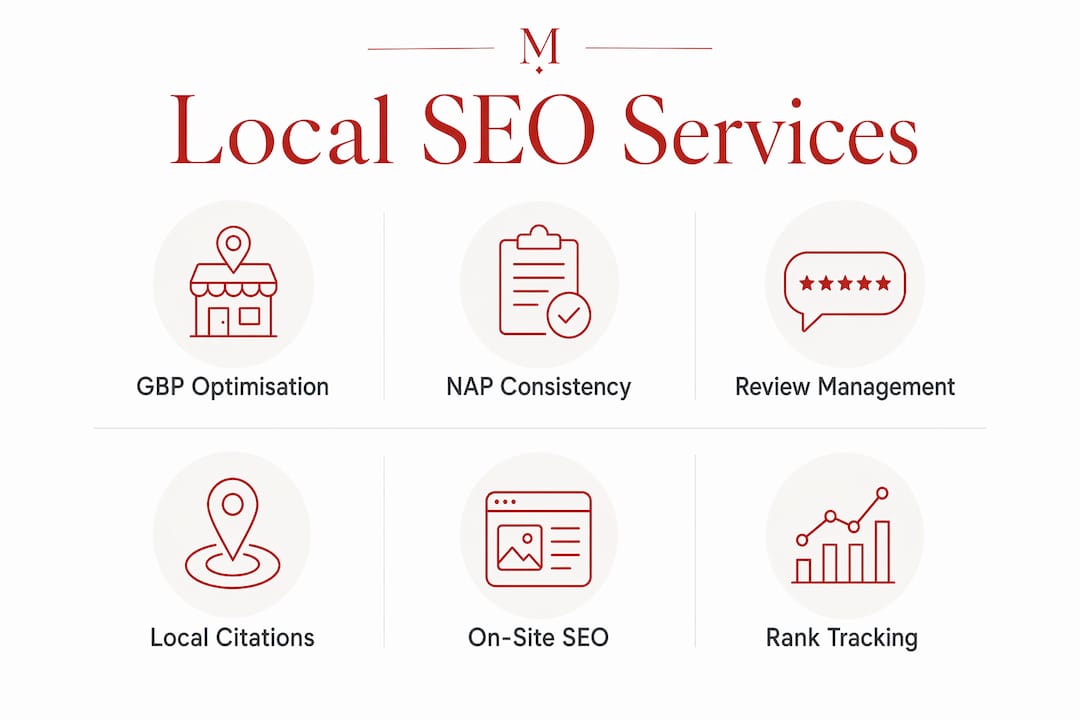
Rank tracking via geo-grid tools monitors how your business ranks across different postcodes and suburbs within your service area. GeoGrid rank tracking shows where you are winning and where competitors are outranking you at a granular level.
Pro Tip: Ask any prospective provider to show you a sample geo-grid report before signing a contract. If they cannot produce one, their reporting is likely limited to broad keyword positions rather than the suburb-level data that matters for local businesses.
How to choose the best local SEO provider for your Sydney business
Selecting the right local SEO consultant requires more than reading testimonials. The following criteria give you a structured basis for comparison.
-
Request a deliverables-based plan. A credible provider will outline specific actions covering GBP, NAP, reviews, citations, and on-site signals before work begins. Vague proposals referencing “local search optimisation” without specifying tasks are a warning sign.
-
Check their experience in Australian local markets. Google’s local algorithm behaves consistently, but directory ecosystems, review platforms, and citation sources differ by country. A provider familiar with Sydney’s market will know which directories carry authority locally.
-
Assess their citation strategy. Providers focusing solely on citation volume risk creating inconsistent NAP data that damages local search prominence. Ask how many directories they target and how they verify data accuracy after submission.
-
Verify their review management process. Confirm they have a system for requesting reviews, monitoring incoming feedback, and responding publicly. The benchmark of 10 or more reviews per 90 days with a 90% response rate is a reasonable standard to hold them to.
-
Ask about rank tracking tools. Providers should use geo-grid tracking rather than simple keyword position reports. This gives you a map of your local visibility across the suburbs you actually serve.
-
Review case studies from comparable businesses. A local SEO marketing firm that has improved rankings for a Sydney café or a Parramatta medical practice has demonstrated relevant competence. Generic case studies without location data are less useful.
-
Clarify multi-location handling. If you operate more than one site, ask whether the provider can manage bulk verification for GBP. Google’s bulk verification process applies to businesses with at least 10 physical locations sharing the same brand name and categories, and it requires manual review by Google support.
Pro Tip: Request a 90-day plan broken into monthly milestones. Providers who can articulate what will be completed in weeks one through four, versus weeks five through eight, understand the sequencing that local SEO requires.
Local SEO versus general SEO: why the distinction matters
Local SEO and general SEO share some foundations but diverge significantly in strategy and ranking signals. Understanding the difference helps Sydney businesses avoid paying for services that do not address their actual search visibility problem.
| Factor | Local SEO | General SEO |
|---|---|---|
| Primary ranking signals | Proximity, GBP prominence, NAP consistency | Domain authority, backlinks, content depth |
| Key platform | Google Business Profile | Google organic search index |
| Review impact | Direct ranking and conversion factor | Indirect trust signal |
| Citation strategy | Consistent NAP in authoritative directories | Not applicable |
| On-site priority | LocalBusiness schema, map embed, NAP | Page speed, content structure, internal links |
| Typical timeline | Improvement visible in 60 to 90 days | Three to six months or longer |
The stepwise audit approach that drives local ranking improvement, fixing GBP first, then NAP and citations, then reviews, then on-site signals, and finally setting up tracking, is specific to local SEO. General SEO agencies typically begin with keyword research and content planning, which is the correct sequence for organic rankings but the wrong starting point for Local Pack visibility.
Traditional SEO agencies may not prioritise GBP categories, review velocity, or geo-grid tracking because these factors are irrelevant to their usual work. A Sydney business that hires a general agency expecting local results will often find that rankings in the Local Pack remain unchanged even as organic content improves. The two outcomes require different inputs.
How Sydney businesses can support their provider’s work
Local SEO is not a fully outsourced activity. Business owners who stay engaged with the process see faster and more durable results. The following actions sit within reach of any business owner without technical expertise.
- Keep GBP information current. Update trading hours for public holidays, add new photos monthly, and publish GBP posts about offers or events. Google treats active profiles as more relevant than dormant ones.
- Ask customers for reviews at the right moment. The best time to request a review is immediately after a positive interaction, whether in person, by email, or via SMS. A simple, direct request with a link to your GBP review page removes friction.
- Respond to every review publicly. Acknowledge positive reviews with a brief, genuine reply. Address negative reviews calmly and factually. This practice supports both local visibility and the trust of prospective customers reading your profile.
- Add local content to your website. Pages referencing specific Sydney suburbs, local landmarks, or community events send relevance signals that support your GBP. This does not require a blog; a well-structured services page mentioning your service areas is sufficient.
- Monitor your local rankings. Free tools such as Google Search Console provide some visibility into search performance. Paid tools including BrightLocal and Whitespark offer geo-grid tracking for more granular suburb-level data.
- Maintain consistent NAP everywhere. Check that your address and phone number match exactly on your website footer, GBP, social media profiles, and any printed materials. Inconsistencies introduced by a website update or a phone number change can undo months of citation work.
For a broader view of local SEO for small businesses, the 2026 guide from Marzipan covers additional strategies relevant to Sydney operators.
Key takeaways
Selecting a local SEO provider requires evaluating their approach to GBP, NAP, reviews, citations, and rank tracking, not just their pricing or general SEO credentials.
| Point | Details |
|---|---|
| GBP is the priority | Optimising Google Business Profile categories and fields is the highest-leverage local SEO action. |
| NAP consistency matters | Exact-match name, address, and phone data across all directories prevents conflicting signals. |
| Review KPIs are measurable | Target 10 or more reviews per 90 days with a 90% or higher response rate. |
| Citation quality beats volume | A smaller number of authoritative, consistent citations outperforms hundreds of low-quality listings. |
| Sequencing drives results | Fixing GBP and NAP before adding content follows the audit order that produces measurable ranking gains. |
What I have learned about choosing local SEO providers
Working with Sydney organisations across different sectors, one pattern stands out clearly. The providers who deliver consistent results are those who treat local SEO as a structured, sequential process rather than a collection of loosely related tasks. They fix the foundation before they build on it.
The most common mistake I see is businesses selecting a provider based on price and a promise of “more citations.” Citation volume without accuracy is counterproductive. A provider who submits your business to 200 directories with slightly inconsistent address formatting creates more problems than they solve. The priority should be authoritative directories with exact data, not bulk submissions.
I am also cautious about providers who cannot explain their review management process in concrete terms. Reviews are not a passive outcome of good service. They require a system: a request mechanism, a monitoring process, and a response protocol. Providers who treat reviews as the client’s responsibility are leaving one of the most significant local ranking factors unmanaged.
The trend worth watching in 2026 is the growing influence of AI-assisted search on local queries. Google’s AI Overviews increasingly surface GBP data and review sentiment in response to local intent searches. This makes the quality of your GBP content and the recency of your reviews more consequential than they were two years ago. Providers who understand this shift will build strategies that account for it. Those still focused purely on citation counts are working from an outdated model.
For organisations wanting to understand how local SEO optimisation applies specifically to community-focused brands in Sydney, the considerations around trust and visibility are worth examining separately.
— Ben
How Marzipan supports Sydney businesses with local SEO

Marzipan provides digital marketing services for purpose-driven organisations in Sydney, including local SEO strategies built on the same structured approach described in this guide. The work covers GBP optimisation, citation management, review processes, and on-site local signals, informed by ethical AI tools and a commitment to long-term visibility rather than short-term gains. For organisations that want AI-informed search visibility without compromising their values, Marzipan’s approach aligns SEO practice with organisational stewardship. Get in touch to discuss what a local SEO programme would look like for your business.
FAQ
What does a local SEO provider actually do?
A local SEO provider manages the specific signals that determine local search rankings: Google Business Profile optimisation, NAP consistency across directories, review acquisition and response, local citations, and on-site schema. These factors are distinct from general SEO and require dedicated attention.
How long does local SEO take to show results?
Structured local SEO audits following the correct sequence of GBP, NAP, citations, reviews, and on-site signals can produce measurable Local Pack improvement within 60 days. Sustained visibility typically requires ongoing management over three to six months.
What is NAP consistency and why does it matter?
NAP stands for name, address, and phone number. Exact-match formatting across your website, GBP, and directory listings tells Google that all entries refer to the same business. Inconsistencies, even minor ones, create conflicting signals that suppress local rankings.
How many reviews does a business need for local SEO?
The operational benchmark is 10 or more reviews in the last 90 days, with a 90% or higher public response rate. Review recency and response behaviour both function as local ranking signals, not just the total number of reviews.
Is local SEO different for businesses with multiple Sydney locations?
Yes. Each location requires its own GBP listing with accurate, location-specific data. Businesses managing 10 or more locations sharing the same brand name and categories can apply for bulk verification through Google, which simplifies the verification process but still requires manual review by Google support.


