

TL;DR:
- Effective small business SEO requires ongoing focus on local visibility, site performance, content quality, and structured data.
- Consistently auditing, optimizing Google profiles, producing targeted content, and implementing schema markup significantly improve visibility and AI recognition.
Search engine optimisation (SEO) is the practice of making your website more visible to people searching for what you offer, without paying for each click. For small businesses, it is the most cost-effective digital marketing channel available. Organic search drives 53% of all online traffic and accounts for 44% of revenue share, which means the majority of your potential customers are already searching. The question is whether your website appears when they do. This guide covers how to improve SEO for small business in practical, measurable steps grounded in 2026 evidence.
What tools and audits do you need before improving SEO?
Improving your SEO without first auditing your site is like adjusting a recipe without tasting it. A structured audit tells you what is working, what is broken, and where to focus effort first.
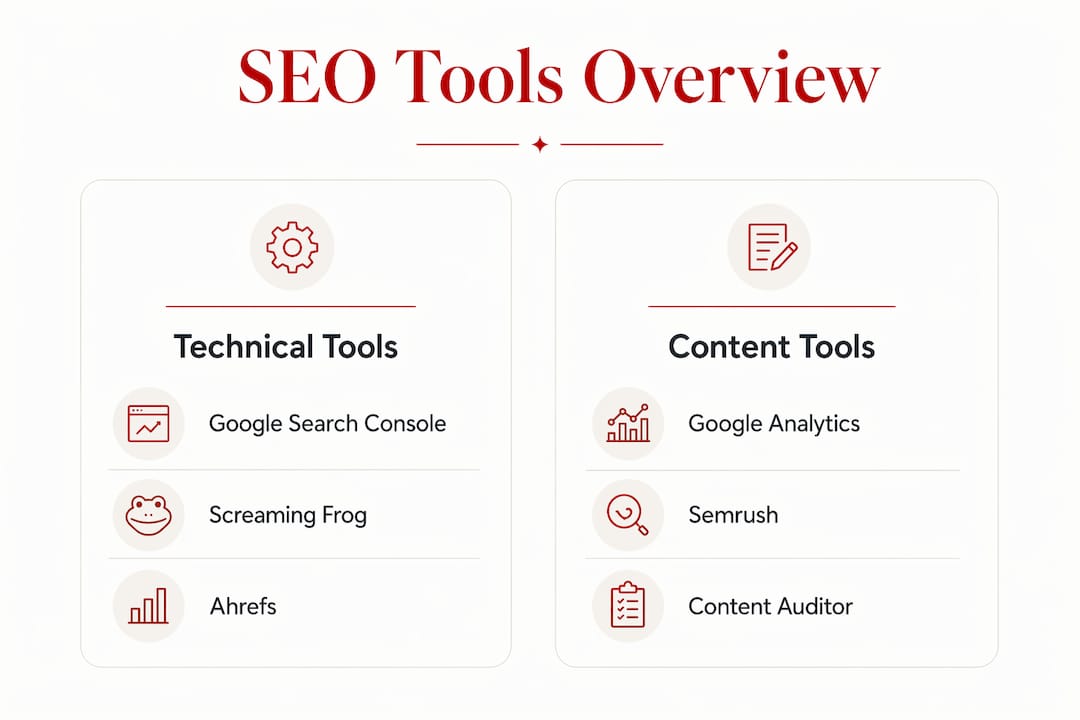
The two non-negotiable starting points are Google Search Console and Google Analytics. Google Search Console shows which search queries bring people to your site, which pages rank, and which technical errors Google has flagged. Google Analytics shows what visitors do once they arrive. Together, they give you a factual baseline rather than guesswork.
Beyond those two free tools, a technical audit should check for the following:
- Page speed: Load times above three seconds increase bounce rates significantly. Aim for under two seconds.
- Mobile friendliness: Google indexes the mobile version of your site first. A site that breaks on a phone will not rank well.
- Broken links: These damage both user experience and crawlability.
- Missing meta tags: Title tags and meta descriptions remain direct signals to search engines.
- Schema markup: Most small business sites lack structured data entirely, which is a missed opportunity covered in detail later.
Tools like Screaming Frog, Ahrefs, or Semrush can automate much of this technical check. For a step-by-step process tailored to Australian organisations, the SEO audit guide from Marzipan covers the key stages clearly.
| Tool | Primary use |
|---|---|
| Google Search Console | Track rankings, indexing errors, and search queries |
| Google Analytics | Monitor traffic behaviour and conversion data |
| Screaming Frog | Crawl site for broken links, missing tags, and redirects |
| Ahrefs or Semrush | Keyword research, backlink analysis, competitor gaps |
| Schema markup generator | Create structured data without writing code manually |
Pro Tip: Run a content audit alongside your technical audit. Export your top 20 pages from Google Analytics, check which ones receive the most organic traffic, and identify which topics have no content at all. Gaps in your content are often easier to fix than technical problems.
How to optimise local SEO for nearby search results
Local SEO should be a foundational priority for any business with a defined geographic market. It offers faster returns than broad SEO because the competition is narrower and the searcher’s intent is stronger.

The starting point is your Google Business Profile (GBP). Claiming and fully completing your profile is free and has a direct impact on whether you appear in the local map pack, which sits above standard organic results for location-based queries. A complete profile includes your business category, opening hours, service areas, and a description written with your target location and service in mind.
Photos matter more than most business owners realise. Adding high-quality photos to your Google Business Profile increases direction requests by 42%. This is not a minor detail. It reflects how much searchers rely on visual cues to assess whether a business is worth visiting.
The steps below cover the core local SEO priorities in order of impact:
- Claim and complete your Google Business Profile with accurate NAP (name, address, phone number) details, categories, and photos.
- Build consistent citations across directories such as True Local, Yellow Pages Australia, and any industry-specific listings relevant to your sector.
- Use geographic keywords in your page titles, headings, and service descriptions. “Accountant in Parramatta” performs differently to “accountant” alone.
- Acquire reviews consistently. Review velocity matters more than total count. Gaining two to three fresh reviews per month outperforms having fifty old ones with nothing recent.
- Implement LocalBusiness schema on your contact or homepage to help search engines and AI tools understand your location, hours, and services precisely.
Local intent keywords convert at 15 to 30% higher rates than general queries. This conversion advantage is the clearest argument for investing in local SEO before broader content efforts.
Pro Tip: Send a direct review link immediately after a positive customer interaction. Timing is the single biggest factor in whether a satisfied customer follows through. A link sent within an hour of a completed job or appointment will outperform a follow-up email sent three days later.
The local SEO tactics used by community brands in Sydney apply equally well to small businesses in any defined service area.
What content strategies work for small businesses with limited resources?
Content is the mechanism through which SEO compounds over time. Each well-written, well-structured page is a permanent asset that can attract traffic for years. The challenge for small businesses is producing content consistently without a dedicated marketing team.
Publishing two to four high-quality content pieces monthly is enough to outpace competitors spending far more on less targeted advertising. The key word is quality. A single page that directly answers a specific customer question will outperform ten thin pages that repeat the same generic information.
The most effective content approach for small businesses with limited resources focuses on:
- Long-tail keywords: Phrases like “emergency plumber Fitzroy” or “vegan catering for corporate events Melbourne” have lower search volume but far higher conversion intent than broad terms.
- Question-based headings: Structuring content around real customer questions improves both readability and the likelihood of appearing in AI-generated answers.
- FAQ schema: Adding FAQPage structured data to question-and-answer content increases the chance of appearing as a rich result in search.
- Content clusters: Group related topics together. A physiotherapy clinic might write one core page on back pain treatment, then supporting pages on specific conditions, exercises, and recovery timelines. This builds topical authority in Google’s eyes.
- Content repurposing: A well-researched blog post can become a social media series, a short video script, or an email newsletter. The research investment is made once and used multiple times.
| Content type | SEO benefit | Effort level |
|---|---|---|
| Long-form service page | Targets high-intent keywords directly | Medium |
| FAQ blog post | Captures question-based searches and rich results | Low |
| Location-specific landing page | Supports local SEO and geographic targeting | Low |
| Case study or client story | Builds trust and earns backlinks naturally | Medium |
Pro Tip: Before writing new content, check Google Search Console for queries where your site already appears on page two or three. Updating and expanding those existing pages is often faster than creating new ones, and the ranking improvement can be significant within weeks.
For a structured approach to content planning, the SEO content strategy guide from Marzipan covers how to build a publishing plan that stays manageable.
Which technical SEO improvements matter most for small business sites?
Technical SEO is the foundation that determines whether your content can be found at all. A well-written page on a slow, poorly structured site will not rank as well as a simpler page on a technically sound one.
Site speed is the most immediate technical priority. Websites loading under two seconds are 40% more likely to be referenced by AI-driven search models. This matters beyond traditional search because tools like ChatGPT and Perplexity increasingly surface web content in their answers. A fast site is not just a ranking signal. It is a prerequisite for AI visibility.
The technical improvements below are listed in order of implementation priority:
- Improve page load speed by compressing images, enabling browser caching, and using a content delivery network (CDN) if your hosting plan supports it.
- Confirm mobile friendliness using Google’s Mobile-Friendly Test tool. Check that buttons are tappable, text is readable without zooming, and no content is cut off on smaller screens.
- Fix broken links and redirect errors identified in your audit. These create dead ends for both users and search engine crawlers.
- Add a sitemap.xml and submit it to Google Search Console so Google can find and index all your pages efficiently.
- Implement structured data. Organisation, LocalBusiness, and FAQPage schemas are the three most useful for small businesses.
On structured data specifically: around 67% of small business websites lack any schema markup at all, yet implementation takes approximately 30 minutes for the core schemas. Structured data enables rich results and lifts click-through rates to over 8%, compared to a 3% baseline without schema. That gap is meaningful at any traffic level.
Entity clarity via structured content is also how AI search engines decide which sources to cite as trusted authorities. A site with clean schema, clear headings, and direct answers to common questions is far more likely to appear in AI-generated responses than one without.
Pro Tip: Use Google’s Rich Results Test tool to check whether your schema markup is valid before publishing. Invalid schema does not cause penalties, but it also provides no benefit. Testing takes two minutes and confirms your implementation is working.
For guidance on building a technically sound site from the ground up, the SEO-friendly website guide from Marzipan covers structure, performance, and content together.
Key takeaways
Effective SEO for small business requires consistent attention to local visibility, site performance, content quality, and structured data working together rather than in isolation.
| Point | Details |
|---|---|
| Audit before acting | Use Google Search Console and a crawl tool to identify technical gaps before creating new content. |
| Local SEO delivers fast returns | A complete Google Business Profile and consistent review acquisition produce measurable results within weeks. |
| Content quality over quantity | Two to four well-researched pages monthly outperforms high-volume, low-quality publishing. |
| Schema markup is underused | Around 67% of small business sites lack structured data, making it a low-effort competitive advantage. |
| Speed affects AI visibility | Sites loading under two seconds are significantly more likely to appear in AI-generated search responses. |
SEO as a discipline, not a project
The most common mistake I see small business owners make with SEO is treating it as something to fix once and move on from. A site audit gets done, a few pages get updated, and then nothing happens for another 18 months. By that point, competitors have moved, search behaviour has shifted, and the gains from the initial work have eroded.
Small businesses can outperform larger competitors by establishing SEO as a monthly discipline rather than a one-off project. This is not a theoretical claim. It reflects what actually happens when a business commits to publishing one or two solid pieces of content per month, responding to every Google review, and checking Search Console quarterly. The compounding effect is real, and it is one of the few areas where a small, consistent investment genuinely rivals a large, sporadic one.
Local SEO deserves particular attention here. For businesses with a defined geographic market, it is the most defensible position available. A large national competitor cannot easily replicate the local review history, the community citations, or the geographic specificity of a well-maintained local presence. That is a genuine competitive moat, and it costs very little to build if you are consistent.
The shift toward AI-driven search is worth taking seriously rather than anxiously. Tools like Perplexity and ChatGPT are increasingly the first place people look for recommendations. Sites with clear entity signals, structured data, and direct answers to common questions are the ones being cited. This is not a reason to chase AI optimisation as a separate project. It is a reason to do the fundamentals well, because the fundamentals are exactly what AI models reward.
If you are working with an SEO provider, ask them to show you data. Not rankings in isolation, but traffic trends, conversion data, and the specific changes they have made. Transparency is a reasonable expectation, and providers who resist it are worth questioning.
— Ben
How Com can help your business grow online
Com, trading as Marzipan, works with small businesses and purpose-driven organisations to build websites and SEO strategies that hold up over time. The approach combines ethical AI tools, sustainable web design, and performance-focused search strategies to improve visibility without compromising values.
For small businesses looking to build a stronger online presence, Marzipan’s digital marketing services cover local SEO, content strategy, and technical site health in plans sized for realistic budgets. The AI-informed SEO service is designed specifically for organisations that want to appear in both traditional search results and AI-generated responses. Com is based in Sydney and works with organisations across Australia.
FAQ
What is the most important first step to improve small business SEO?
Set up Google Search Console and run a basic technical audit before making any changes. This gives you factual data on what is already working and where the gaps are.
How long does SEO take to show results for a small business?
Local SEO improvements, such as completing a Google Business Profile and acquiring fresh reviews, can produce visible results within four to eight weeks. Broader organic SEO typically takes three to six months to show consistent movement.
Does schema markup really make a difference for small businesses?
Yes. Around 67% of small business sites lack structured data, and implementing basic LocalBusiness and FAQPage schemas can lift click-through rates from 3% to over 8%. It takes approximately 30 minutes to implement.
How many blog posts should a small business publish each month?
Two to four high-quality posts monthly is sufficient to build topical authority and outpace many competitors. Consistency matters more than volume.
Why does site speed matter for SEO in 2026?
Sites loading under two seconds are 40% more likely to be cited by AI-driven search tools. Speed is now a factor in both traditional rankings and AI search visibility.


