

TL;DR:
- Influencer marketing involves collaborating with content creators who have established trust within specific audiences. Micro-influencers with engaged niche followers are often more effective and affordable for small businesses than macro-influencers. Compliance with Australian laws requires clear disclosures, written contracts, and measuring success through direct conversion metrics like UTM links and discount codes.
Influencer marketing is defined as a brand’s deliberate collaboration with content creators who hold established trust and reach within a specific audience. The practice has moved well beyond celebrity endorsements. Micro-influencers, brands working with Australian Consumer Law compliance requirements, and performance tracking via UTM links and discount codes now define how effective influencer campaigns operate. For marketers and small business owners, the discipline rewards careful planning over large budgets. This guide covers the core steps for influencer marketing, from selecting the right creators to measuring what actually worked.
How to do influencer marketing: choosing the right influencers
The most common mistake in influencer selection is prioritising follower count over audience fit. A creator with 8,000 highly engaged followers in your niche will almost always outperform one with 200,000 loosely connected ones.
Influencers are generally grouped into two tiers relevant to small businesses:
- Micro-influencers (3,000–100,000 followers): Fees typically range from £0 to £1,500, making them accessible for smaller budgets. They tend to generate higher engagement rates and more authentic conversations with their audiences.
- Macro-influencers (100,000+ followers): Fees typically start from £1,500 and rise to £8,000 or more. Reach is broader, but engagement rates often drop and audience relevance becomes harder to verify.
For Australian small businesses, the most useful filter is geographic and niche alignment. An influencer whose followers are concentrated in Sydney or Melbourne and match your customer profile will deliver better audience fit than a nationally recognised creator whose audience skews differently.
Vetting an influencer’s authenticity requires more than a quick scroll. Genuine engagement shows up as real conversations in the comments, not strings of generic emojis or single-word responses. Follower-growth curves that spike suddenly and then flatten are a reliable signal of purchased followers. Reviewing three to six months of comment quality gives a clearer picture than any single post.

Pro Tip: Before reaching out to any creator, check their most recent ten posts for comment quality. Conversational replies from real accounts indicate genuine community. Rows of fire emojis do not.
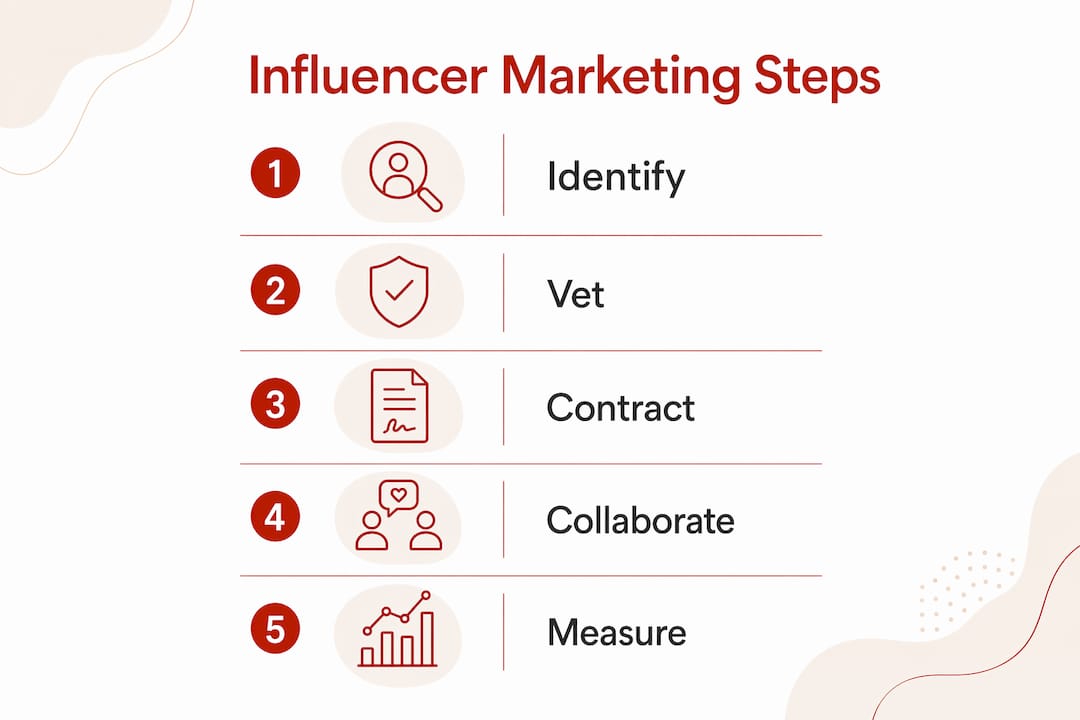
Discovery platforms and social media search functions can help you build a shortlist. Searching relevant hashtags on Instagram or TikTok, reviewing who your existing customers already follow, and asking your network for referrals are all practical starting points that cost nothing.
What are the legal requirements for influencer campaigns in Australia?
Australian Consumer Law requires that paid partnerships are clearly disclosed to audiences. The Australian Competition and Consumer Commission (ACCC) enforces these rules, and penalties apply for brands and creators who fail to disclose commercial relationships.
The disclosure standard is straightforward in practice:
- Use “#ad” or “Paid partnership” labels prominently at the start of a caption or in the first frame of a video. Burying disclosure at the end of a long caption does not meet the standard.
- Draft a written influencer agreement before any content is created. The contract must cover deliverables, approval processes, disclosure obligations, intellectual property rights, and conduct expectations.
- Include moral rights considerations in the contract. This allows your brand to adapt or repurpose content without breaching the creator’s rights under Australian copyright law.
- Address privacy obligations if the campaign involves giveaways or data collection. Collecting entrant details triggers obligations under the Privacy Act 1988.
- Review all content before it goes live. Misleading testimonials or exaggerated product claims can result in brand penalties even when the influencer posts independently.
Pro Tip: Send influencers a one-page brief that includes the exact disclosure wording you require. Do not leave disclosure language to their interpretation. Platforms and the ACCC both monitor this.
Contracts are not bureaucratic formality. They protect both parties and set clear expectations before creative work begins. A well-drafted agreement reduces the risk of content going live without approval, or intellectual property being used in ways you did not intend.
How do you execute an influencer campaign effectively?
Campaign execution depends on clear briefing, appropriate creative freedom, and active monitoring throughout the campaign period.
Start with a written brief that covers your brand’s core message, the specific product or service being promoted, the required disclosure language, content format preferences, and the posting schedule. A brief does not need to be long. It needs to be unambiguous.
- Grant creative freedom within defined limits. Influencers know their audiences. Prescribing every word of a caption typically produces content that reads as scripted and performs poorly. Set the boundaries, then step back.
- Monitor engagement as posts go live. Watch for audience questions, negative sentiment, or misinformation in the comments. Responding promptly to genuine questions reinforces the brand’s credibility.
- Use paid amplification to extend reach. Boosted posts and Meta Ads allow you to push influencer content to highly targeted audiences beyond the creator’s existing followers. This is one of the most cost-effective ways to increase impressions and conversion potential from content you have already paid to produce.
- Repurpose content with permission. Once the initial posting window has passed, influencer content can move into your own channels. Email campaigns, product pages, and paid social ads all benefit from authentic creator content.
For brands building Instagram engagement with an ethical positioning, the tone of influencer content matters as much as the reach. Audiences in mission-led communities are particularly sensitive to content that feels transactional.
The most effective campaigns treat influencers as collaborators rather than distribution channels. Regular check-ins during the campaign, clear feedback on what is working, and genuine appreciation for their effort all contribute to better content and longer-term working relationships.
How do you measure influencer marketing success?
Measuring success requires tracking metrics that connect to business outcomes, not just content performance. Likes and impressions confirm that content was seen. They do not confirm that it drove results.
The key performance indicators worth tracking are:
| Metric | What it measures | How to track it |
|---|---|---|
| Engagement rate | Audience interaction relative to reach | Platform analytics |
| Website traffic | Visits driven by influencer content | UTM links in bio or caption |
| Conversion rate | Purchases or sign-ups from influencer traffic | UTM links plus Google Analytics |
| Sales attribution | Revenue directly linked to the campaign | Unique discount codes |
| Sentiment | Qualitative audience response | Manual comment review |
Unique discount codes and UTM links are the most reliable tools for connecting influencer activity to actual sales. Each influencer receives a distinct code or link, which makes attribution clear even when customers do not convert immediately.
Qualitative feedback matters alongside the numbers. Comment sentiment, direct messages, and the nature of questions asked all indicate whether the campaign landed with the right audience. A campaign that generates ten genuine enquiries from qualified buyers often delivers more value than one that generates thousands of passive impressions.
Pro Tip: Set your measurement framework before the campaign launches, not after. Decide which metrics matter, set up your UTM parameters, and create discount codes in advance. Retrofitting tracking to a live campaign produces incomplete data.
Repurposing influencer content across email, product pages, and paid ads extends the value of your initial investment. User-generated content used in this way also strengthens brand authenticity, because it shows real people engaging with your product rather than polished brand photography. Plan for this from the outset by including content usage rights in your influencer agreement.
Longer-term partnerships with two or three trusted creators consistently outperform one-off campaigns. Repeated exposure builds audience familiarity, and creators who genuinely use your product over time produce more credible content than those briefed for a single post.
Key takeaways
Effective influencer marketing requires audience fit, legal compliance, and conversion-focused measurement working together from the start.
| Point | Details |
|---|---|
| Prioritise audience fit | Choose influencers whose followers match your niche and geography, not just their follower count. |
| Comply with Australian law | Disclose all paid partnerships clearly using #ad or “Paid partnership” labels as required by the ACCC. |
| Use written contracts | Cover deliverables, IP rights, disclosure, and moral rights before any content is created. |
| Track conversions, not vanity metrics | Use UTM links and unique discount codes to connect influencer activity to actual sales. |
| Repurpose content across channels | Extend the value of influencer content through email, product pages, and paid social ads. |
Why micro-influencers deserve more credit than they get
Working with influencers for any length of time makes one thing clear: the obsession with reach is largely misplaced. The most productive campaigns I have seen for small and medium-sized businesses have almost always involved creators with modest but genuinely engaged audiences.
Micro-influencers bring something that macro-influencers rarely can: real trust within a specific community. Their audiences follow them because of shared interests, not because of celebrity. That distinction matters enormously when you are asking someone to consider a product or service.
Compliance is often treated as a constraint. I think it is better understood as a foundation. Brands that disclose clearly, contract properly, and avoid exaggerated claims build a track record that compounds over time. The ACCC’s scrutiny of influencer advertising is increasing, and the brands that have already built compliant processes will not need to scramble when enforcement tightens.
The organic growth potential of a well-run influencer programme is also frequently underestimated. Content that resonates with a niche audience gets shared within that community, often reaching people the original post never targeted. That kind of reach cannot be bought directly. It follows from genuine relevance.
My consistent recommendation to small business owners is to start with two or three micro-influencers, run a properly contracted and tracked campaign, and measure the results honestly before scaling. The discipline of starting small and measuring carefully produces far better long-term outcomes than a single large spend on a creator with impressive numbers but uncertain fit.
— Ben
How Marzipan supports your influencer campaigns
Running an influencer campaign well requires more than finding the right creator. The digital infrastructure behind the campaign, including your website’s landing pages, SEO foundations, and analytics setup, determines how much of that influencer traffic you actually convert. Marzipan works with purpose-driven organisations across Australia to build the digital marketing foundations that make campaigns measurable and sustainable. From UTM tracking setup to content amplification strategy, the team at Marzipan helps you connect influencer activity to real business outcomes. If your organisation is also building long-term search visibility alongside campaign activity, Marzipan’s AI-informed SEO services are designed to compound that effort over time.
FAQ
What is influencer marketing?
Influencer marketing is a paid or gifted collaboration between a brand and a content creator who has an established, trusted audience. The creator promotes the brand’s product or service to their followers in exchange for a fee, free product, or commission.
How do I find influencers for my small business?
Search relevant hashtags on Instagram or TikTok, review who your existing customers follow, and use niche-specific discovery tools. Prioritise creators whose audience geography and interests closely match your customer profile.
What disclosure is required for influencer posts in Australia?
Australian Consumer Law requires clear disclosure of paid partnerships. Use “#ad” or “Paid partnership” at the start of a caption or video. The ACCC enforces these rules and can apply penalties for non-compliance.
How do I measure whether an influencer campaign worked?
Track website traffic with UTM links, attribute sales with unique discount codes, and review comment sentiment for qualitative feedback. Engagement rate and conversion rate are more useful than likes or impressions alone.
How much does influencer marketing cost for small businesses?
Micro-influencers with 3,000 to 100,000 followers typically charge between £0 and £1,500 per post, making them accessible for smaller budgets. Larger creators generally charge from £1,500 upwards, with fees rising significantly at higher follower tiers.


