

TL;DR:
- Google ranking factors rely primarily on content quality, backlink relevance, and technical performance. A domain’s overall content health affects its search visibility more than isolated page optimizations. Sustainable SEO depends on producing valuable, trustworthy content and maintaining site-wide quality standards.
Google ranking factors are the signals Google’s search algorithm uses to determine where a webpage appears in search results. Understanding these signals is the foundation of any credible SEO strategy. Content quality accounts for roughly 23% of the algorithm’s influence, making it the single highest-weighted factor ahead of backlinks, technical performance, and engagement. For website owners and digital marketers, knowing which signals carry real weight and which are myths is the difference between sustainable visibility and wasted effort.
What are the most influential google ranking factors?
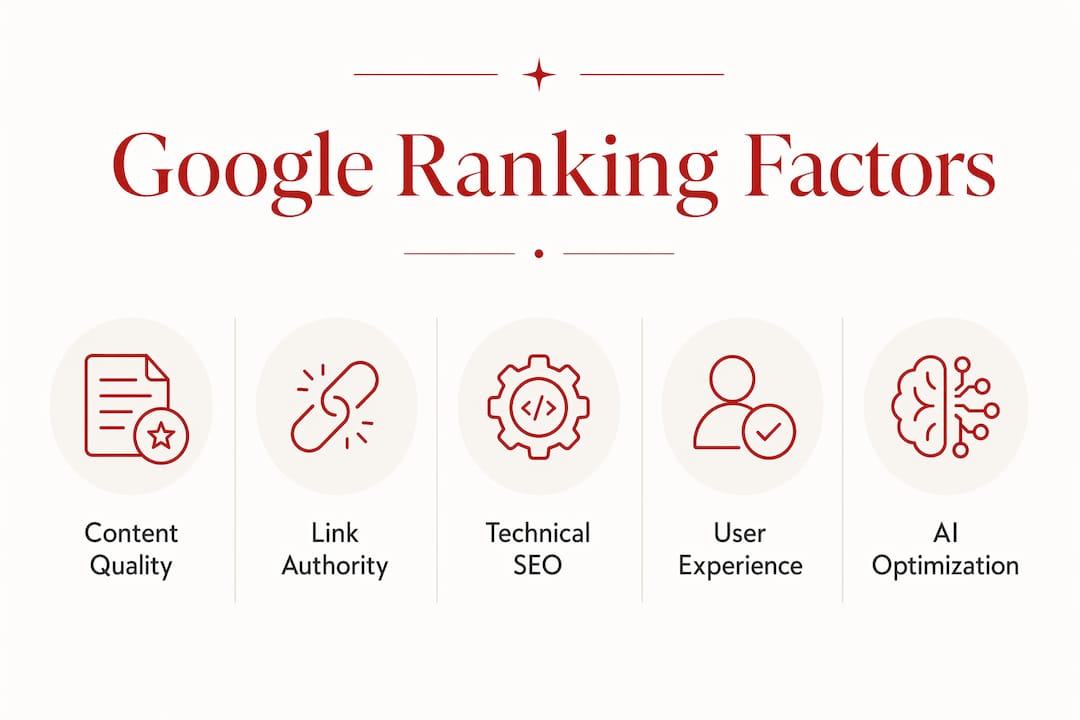
SEO ranking criteria in 2026 are anchored by three categories: content quality, link authority, and technical performance. First Page Sage’s 2026 study confirms content quality as the leading factor, ahead of all others. That finding reflects a consistent direction in Google’s algorithm development over the past several years.

Content quality means producing material that genuinely serves the reader’s intent. Google’s Helpful Content system assesses whether a page was written for people or primarily for search engines. Pages that answer questions clearly, demonstrate subject knowledge, and reflect real experience tend to rank above those optimised purely for keywords.
Backlinks remain a top-three ranking signal. Link quality and relevance now carry more weight than raw link volume, with backlinks accounting for approximately 13% of algorithm weight. A single link from a trusted, topically relevant domain is worth more than dozens of links from unrelated or low-authority sites.
Engagement signals such as click-through rate, time on page, and return visits also contribute. These signals indicate whether users found what they were looking for. Google treats sustained engagement as evidence that a page genuinely satisfies search intent.
- Content quality: approximately 23% of algorithm weight
- Backlinks: approximately 13%, with emphasis on relevance
- Core Web Vitals and technical factors: foundational prerequisites
- Engagement signals: topical authority and user satisfaction indicators
- HTTPS security: a confirmed, though modest, ranking signal
Pro Tip: Before publishing any new content, check whether it answers a specific question your audience is actually asking. Use Google Search Console to identify queries where your site already appears but ranks below position ten. Those pages are candidates for targeted improvement.
How does google’s helpful content system affect whole sites?
Google’s Helpful Content system is a site-wide quality classifier, not a page-level filter. This distinction matters significantly for site management. A domain with a high proportion of thin, outdated, or search-engine-first content can see its well-written pages suppressed alongside the weaker ones.
Recovery from a Helpful Content penalty is not immediate. Re-crawling and reassessment can take weeks to months, depending on site size and crawl frequency. Editing one or two pages rarely moves the needle. Google’s classifier evaluates the overall content balance across the domain.
The Helpful Content system acts as a domain-level risk model. Improvements must be comprehensive to influence the classifier positively. Page-level fixes often produce limited results when the broader content catalogue remains weak.
The practical implication is that content pruning and category-level improvement matter more than isolated rewrites. If a site carries a large volume of low-value posts, removing or substantially improving them is more effective than adding new content on top of the existing problem.
Pro Tip: Audit your content by category, not just by individual page. Use Google Search Console alongside a tool such as Screaming Frog to identify pages with low impressions, high bounce rates, and thin word counts. Treat those as a group, not as isolated cases.
For community organisations managing web content at scale, the Helpful Content system is a governance issue as much as an SEO one. Decisions about what to publish, update, and retire should be made with the site’s overall content health in mind.
Technical SEO factors vs content and links: what takes priority?
Technical SEO factors are best understood as prerequisites rather than primary drivers. Core Web Vitals, HTTPS, and mobile performance are important, but they do not compensate for weak content or poor link authority. A technically sound site with thin content will not outrank a slower site with genuinely useful material and strong backlinks.
The table below summarises the role of key technical factors within the broader ranking framework.
| Technical Factor | Role in Rankings | Priority Level |
|---|---|---|
| Core Web Vitals | Measures loading speed, interactivity, and visual stability | Foundational baseline |
| Mobile-friendliness | Required for mobile-first indexing | Non-negotiable minimum |
| HTTPS security | Confirmed ranking signal, modest weight | Standard requirement |
| Page speed | Contributes to user experience and Core Web Vitals scores | Important but not primary |
| Structured data | Supports rich results and search feature eligibility | Supplementary signal |
Core Web Vitals cover three measurable dimensions: Largest Contentful Paint (loading), Interaction to Next Paint (interactivity), and Cumulative Layout Shift (visual stability). Google uses these to assess whether a page delivers a stable, responsive experience. Failing these thresholds does not guarantee poor rankings, but passing them removes a potential barrier.
Mobile-friendliness is now a baseline requirement rather than a differentiator. Google indexes the mobile version of pages first. A site that performs poorly on mobile devices is working against itself regardless of content quality. HTTPS is a confirmed signal, though its individual weight is modest. Its absence, however, signals a lack of basic site governance and can reduce user trust.
Technical SEO audits for community organisations should address these factors as part of routine site maintenance, not as one-off projects. The goal is to remove friction, not to manufacture ranking advantages.
How do generative AI features change SEO in 2026?
Google’s May 2026 generative AI optimisation guidance confirms that core SEO best practices remain foundational and equally relevant to AI-powered search features. Generative AI results in Google Search draw on the same ranking and quality systems as traditional results. There is no separate algorithm to optimise for.
The guidance places particular emphasis on content that is valuable, unique, and non-commodity. Generic content that aggregates publicly available information without adding original perspective or expertise is less likely to appear in AI-generated summaries. This aligns with the direction Google has been moving for several years.
Several common misconceptions are worth addressing directly:
- AI-generated content is not automatically penalised. Google’s position is that content quality matters, not the method of production. Thin, unhelpful AI content is penalised for being thin and unhelpful, not for being AI-generated.
- There is no separate “AI SEO” discipline. Generative AI optimisation is an extension of existing quality assurance processes, not a new field requiring distinct tactics.
- Originality and expertise remain the differentiators. Content that reflects genuine knowledge, first-hand experience, or unique data is more likely to be cited in AI summaries than content that restates what is already widely available.
For digital marketers, the practical implication is straightforward. Existing SEO workflows built around content quality, topical authority, and user intent are already aligned with what Google’s generative AI features reward. The adjustment is one of emphasis, not direction. Prioritise content that could not be produced by aggregating existing sources. That standard applies whether the reader encounters the content in a traditional search result or an AI-generated overview.
Pro Tip: Review your highest-traffic pages and ask whether each one contains information that is genuinely difficult to find elsewhere. If the answer is no, that page is a candidate for enrichment with original data, case examples, or expert commentary.
For organisations working on ethical SEO strategies, the 2026 guidance reinforces that sustainable visibility comes from serving the reader, not from chasing algorithm updates.
Key takeaways
SEO ranking criteria depend on an interplay of content quality, authority signals, and user experience. No single factor determines ranking success in isolation.
| Point | Details |
|---|---|
| Content quality leads | At approximately 23% of algorithm weight, content quality is the highest-weighted ranking signal. |
| Backlinks require relevance | Link quality and topical relevance matter more than volume; approximately 13% algorithm weight. |
| Helpful Content is site-wide | The classifier assesses the whole domain; category-level content improvement outperforms page-level fixes. |
| Technical factors are prerequisites | Core Web Vitals, HTTPS, and mobile performance remove barriers but do not substitute for strong content. |
| Generative AI uses the same systems | Google’s AI features draw on core ranking signals; existing quality-focused SEO remains the correct approach. |
What i’ve learned about ranking factors after years in the field
The most persistent mistake I see is treating Google ranking factors as a checklist rather than a system. Site owners fix their page titles, add a few backlinks, and expect movement. When it does not come, they assume the algorithm is opaque or unfair. The reality is more straightforward: Google is assessing the overall quality and trustworthiness of a domain, not rewarding isolated optimisations.
The Helpful Content system made this explicit. A site carrying years of thin, outdated, or keyword-stuffed content cannot recover by publishing a handful of strong new articles. The classifier sees the whole picture. That is uncomfortable for organisations with large content archives, but it is also clarifying. The work is not to game the algorithm. The work is to build a site worth trusting.
I have also seen the damage done by chasing ranking myths. Domain age and keyword density have far less influence than commonly assumed, yet both continue to drive misallocated effort. The factors that consistently matter are content quality, genuine backlinks, mobile performance, and internal linking. Those have not changed substantially in several years.
The 2026 generative AI guidance reinforced something I already believed: the organisations that will maintain visibility over time are those producing content that reflects real knowledge and genuine service to their audience. That is not a new SEO strategy. It is what good publishing has always required.
— Ben
How Com supports organisations with sustainable SEO
Com works with mission-led organisations that need search visibility built on sound foundations, not short-term tactics. If your site is carrying content quality issues, technical debt, or an unclear SEO strategy, the right starting point is a clear-eyed assessment of where you stand.

Com’s digital marketing services are designed for high-trust organisations in Sydney and across Australia. The approach integrates Google’s current ranking priorities, including Helpful Content compliance, Core Web Vitals, and generative AI readiness, into a coherent strategy aligned with your organisation’s values. For organisations ready to address search visibility with the same care they bring to their mission, Com offers AI-informed SEO services built for the long term.
FAQ
What is the most important google ranking factor?
Content quality is the single highest-weighted ranking factor, accounting for approximately 23% of algorithm influence according to First Page Sage’s 2026 study. Backlinks and engagement signals follow as the next most significant contributors.
Do backlinks still matter for SEO in 2026?
Backlinks remain a top-three ranking signal, accounting for approximately 13% of algorithm weight. Quality and topical relevance now matter more than volume, with a single authoritative link outweighing many low-relevance ones.
How long does recovery from a helpful content penalty take?
Recovery can take weeks to months, as Google must re-crawl and reassess the site-wide content balance. Improving entire content categories produces better results than rewriting individual pages.
Does ai-generated content hurt google rankings?
Google does not penalise content based on how it was produced. Thin or unhelpful content is penalised regardless of origin. Content that demonstrates genuine expertise and serves the reader’s intent performs well whether written by a person or with AI assistance.
Are technical SEO factors more important than content?
Technical factors such as Core Web Vitals and HTTPS are foundational prerequisites, not primary ranking drivers. A technically sound site with weak content will not outrank a site with strong content and genuine authority.


