

TL;DR:
- E-E-A-T is a Google framework evaluating experience, expertise, authoritativeness, and trustworthiness to determine content quality. For Australian small businesses, demonstrating these signals enhances local SEO, trust, and AI content discoverability. Building genuine credibility through consistent identity signals and valuable content remains essential for long-term search success.
E-E-A-T is the foundational framework Google uses to evaluate website content based on experience, expertise, authoritativeness, and trustworthiness. For individuals and small business owners in Australia, understanding how E-E-A-T shapes Google SEO is the clearest path to building lasting search visibility. The framework originates from Google’s Search Quality Rater Guidelines and guides both human raters and algorithmic signals. As AI platforms like ChatGPT and Google’s own AI Overviews become primary discovery tools, the signals that define quality content are more consequential than ever.
What is E-E-A-T in Google SEO?
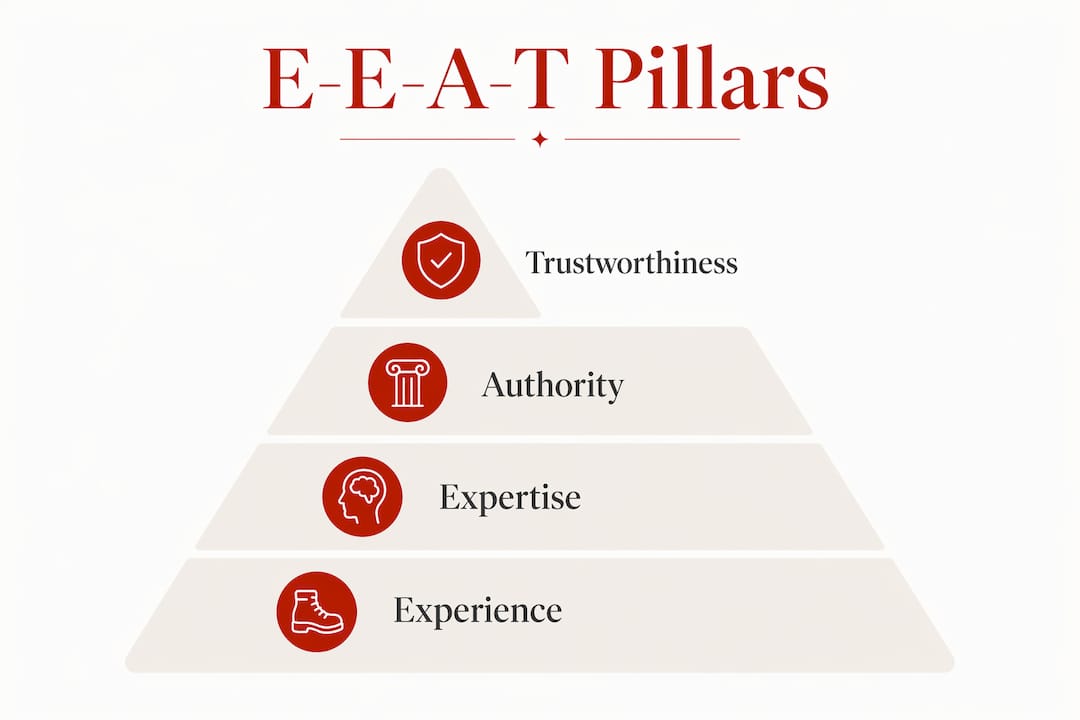
E-E-A-T stands for experience, expertise, authoritativeness, and trustworthiness. It is a user-focused quality framework, not a direct ranking score. Google’s search quality raters use it to assess whether content genuinely serves the person reading it, particularly for high-stakes topics such as health, finance, and legal matters. The informal phrase “eat Google SEO” refers to this same framework, and the two terms are interchangeable in practice.
Each pillar carries distinct weight:
- Experience refers to first-hand involvement with a topic. A plumber writing about pipe repairs, or a café owner describing their sourcing process, demonstrates lived knowledge that purely theoretical content cannot replicate. Experience-backed content consistently outranks less experiential but more comprehensive texts.
- Expertise covers credentials, depth of knowledge, and demonstrated understanding. This applies both to formally qualified professionals and to individuals with deep practical knowledge in a specific field.
- Authoritativeness is measured by external recognition. Backlinks from reputable sources, citations in industry publications, and mentions across credible platforms all signal that others regard your content as reliable.
- Trustworthiness is the synthesis pillar. Untrustworthy pages rank poorly regardless of how strong the other three pillars appear. Trust includes verifiable claims, clear business identity, site security via HTTPS, and accurate information throughout.
Trust acts as a gating factor: low trust produces a low overall quality evaluation even when expertise or authority appear strong. For small businesses, this means a well-written service page can still underperform if the site lacks contact details, a clear privacy policy, or an SSL certificate.
Pro Tip: Review your website’s footer and About page. If a visitor cannot quickly identify who runs the business, where it is located, and how to make contact, your trust signals are weaker than they should be.

How does E-E-A-T affect Australian small business SEO?
For Australian small businesses, E-E-A-T for SEO is not an abstract concept. It translates directly into local search performance, Google Business Profile visibility, and the likelihood of appearing in AI-generated recommendations. Optimising Google Business Profile and creating crawlable, conversion-focused web pages align local search with E-E-A-T principles.
The following steps reflect how local businesses can demonstrate these quality signals in practice:
- Complete and verify your Google Business Profile. Include accurate trading hours, a physical address, service categories, and photographs. Incomplete profiles send weak trust signals to both Google and prospective customers.
- Collect and respond to reviews consistently. Reviews are a direct expression of public trust. Responding to them, including critical ones, demonstrates accountability and active engagement.
- Create service or product pages that reflect real expertise. A landscaper in Melbourne who writes specifically about drought-tolerant planting for Victorian conditions demonstrates local, experience-backed knowledge that a generic gardening article cannot match.
- Align content with conversational search queries. As AI-driven search becomes more common, content that answers specific, natural-language questions performs better. A question like “which accountant in Brisbane handles small business tax returns” rewards businesses whose pages directly address that intent.
- Maintain consistent business data across directories. NAP consistency (name, address, phone number) across platforms such as True Local, Yellow Pages Australia, and Yelp reinforces the identity signals that Google uses to assess trustworthiness.
Local presence signals paired with E-E-A-T content produce stronger local and AI search visibility than either approach alone. For a Sydney-based physiotherapy clinic or a Hobart bookshop, this combination is the most direct way to improve website SEO without relying on paid advertising.
Pro Tip: Ask satisfied clients to leave a Google review that mentions the specific service they received and your location. Reviews containing service-specific language reinforce both relevance and trust signals for local search.
Is E-E-A-T a direct Google ranking factor?
E-E-A-T is not a direct ranking factor and there is no E-E-A-T score that Google calculates or publishes. Google uses correlated signals that reflect E-E-A-T principles to train and refine its ranking algorithms. This distinction matters because it redirects effort away from gaming a checklist and towards building genuine credibility.
The table below contrasts what E-E-A-T represents against the concrete signals Google actually processes:
| E-E-A-T concept | Correlated Google signal |
|---|---|
| Experience | Original content, first-hand accounts, author attribution |
| Expertise | Depth of topic coverage, structured data, author credentials |
| Authoritativeness | Quality backlinks, brand mentions, citations from trusted sources |
| Trustworthiness | HTTPS, clear contact information, accurate and updated content |
Credibility comes from consistent identity signals across the site, including business ownership, clear content authorship, contact details, and aligned evidence supporting claims. A common mistake is treating E-E-A-T as a matter of adding author bios to blog posts. That is a start, but the signals must be consistent and verifiable across the entire site.
Practical SEO strategies for Google that reflect these principles include: publishing content under named authors with verifiable credentials, earning backlinks through genuine industry participation, keeping content updated with accurate information, and using structured data markup to help Google understand page context. Avoiding keyword stuffing is equally important. Google raters prioritise real user trust and helpfulness, not keyword density, especially for Your Money or Your Life topics such as medical advice or financial guidance.
For those improving Google ranking ethically, the focus should be on repeatable editorial practices rather than one-off optimisation tasks.
How does E-E-A-T shape AI search and content discovery?
Google’s AI Overviews and platforms such as ChatGPT and Perplexity draw from sources they assess as high-trust and authoritative when generating summaries and recommendations. Strong E-E-A-T signals increase the likelihood of being cited in AI-generated content. This represents a significant shift in how search visibility works, particularly for small businesses that previously relied on ranking in the top ten blue links.
Several content practices improve discoverability in AI-driven search environments:
- Write with verifiable specificity. AI systems favour content that makes clear, attributable claims. Vague generalisations are less likely to be cited than precise, experience-backed statements.
- Structure content around questions. Google’s Search Generative Experience (SGE) and AI Overviews are built to answer questions directly. Pages that mirror this structure, with clear headings and direct answers, align with how AI systems extract and present information.
- Cite credible sources within your content. Linking to reputable references, such as the Australian Taxation Office for financial content or the Australian Health Practitioner Regulation Agency for health content, reinforces the authority of your own pages.
- Keep content current. AI platforms weight recency alongside authority. Outdated statistics or superseded regulations reduce the perceived reliability of a page.
- Build a consistent online presence across platforms. When a business appears credibly across its website, Google Business Profile, LinkedIn, and relevant industry directories, AI systems have more corroborating evidence to draw on when assessing trustworthiness.
For Australian small businesses, this means that sustainable SEO practices built around genuine authority are now directly relevant to AI search visibility, not just traditional Google rankings.
Key takeaways
E-E-A-T requires consistent, verifiable trust signals across a website, not a one-time optimisation task or a checklist of surface-level fixes.
| Point | Details |
|---|---|
| Trust is the foundation | Low trust undermines expertise and authority, regardless of content quality. |
| Local signals matter | Google Business Profile, consistent NAP data, and reviews directly support E-E-A-T for Australian businesses. |
| No E-E-A-T score exists | Focus on concrete signals: author attribution, backlinks, HTTPS, and updated content. |
| AI search rewards authority | High-trust, experience-backed content is more likely to be cited in AI Overviews and platforms like ChatGPT. |
| Identity must be sitewide | Author bios alone are insufficient; business ownership, contact details, and credentials must be visible throughout the site. |
Why authenticity outperforms optimisation tactics
There is a pattern worth noting in how small businesses approach E-E-A-T. Many invest time adding author bios and schema markup, then wonder why their rankings do not shift. The issue is usually that the underlying content lacks genuine depth or the site’s identity signals are inconsistent. A bio that lists credentials but links to no verifiable profile, or a contact page with a form but no address, creates a gap between the appearance of trust and its substance.
What I have observed working with purpose-driven organisations is that the businesses with the strongest long-term search performance are not those who optimise most aggressively. They are the ones who communicate clearly about who they are, what they do, and why they do it. That clarity produces the kind of content that earns backlinks naturally, attracts reviews without prompting, and gets cited by AI systems because it is genuinely useful.
For Australian small businesses, the most productive shift is to stop thinking about SEO as a technical task separate from how you run your business. Your expertise is real. Your local knowledge is real. The work is to make that visible online in a form that Google and its quality raters can recognise and trust. That is not a shortcut. It is the only approach that holds up across algorithm updates.
— Ben
How Marzipan can help you build E-E-A-T in 2026
Com builds websites and SEO programmes for mission-led organisations that need their online presence to reflect the trust they have earned in the real world. For Australian individuals and small businesses working to improve their search visibility, that means combining technically sound web design with content and SEO strategies grounded in E-E-A-T principles.
Com’s AI-informed SEO services are designed for organisations that want search visibility built on genuine authority, not short-term tactics. From Google Business Profile optimisation to structured content programmes that demonstrate real expertise, the work is grounded in the same principles this article describes. If you are ready to build an online presence that performs with integrity, explore Com’s digital marketing services to see how the approach applies to your organisation.
FAQ
What does E-E-A-T stand for in SEO?
E-E-A-T stands for experience, expertise, authoritativeness, and trustworthiness. It is the quality framework Google’s search quality raters use to assess whether content is genuinely helpful and credible.
Does E-E-A-T directly affect Google rankings?
E-E-A-T is not a direct ranking factor and Google does not calculate an E-E-A-T score. Google uses correlated signals that reflect E-E-A-T principles, such as backlinks, author attribution, and site security, to inform its ranking algorithms.
How can Australian small businesses improve their E-E-A-T?
Completing and verifying a Google Business Profile, collecting consistent reviews, publishing content under named authors, and maintaining accurate business data across directories are the most direct steps for local businesses.
Why is trustworthiness the most important E-E-A-T pillar?
Trustworthiness acts as a gating factor: a page with low trust receives a poor overall quality rating regardless of how strong its expertise or authority signals appear. HTTPS, clear contact information, and accurate content are the baseline requirements.
Does E-E-A-T matter for AI search results?
Yes. AI platforms such as ChatGPT and Google’s AI Overviews prefer high-trust, authoritative sources when generating summaries. Strong E-E-A-T signals increase the likelihood that your content will be cited or surfaced in AI-generated responses.


