

TL;DR:
- Digital marketing involves promoting products or services through online channels with measurable campaign adjustments.
- It includes categories like SEO, content, email, social media, and paid advertising, which work best when integrated.
Digital marketing is defined as the promotion of products, brands, or services through digital channels such as search engines, social media, email, and websites to connect with audiences online. This digital marketing explanation covers the core categories, strategic benefits, and practical steps that Sydney-based individuals and organisations need to engage responsibly and effectively online. Platforms like Google Ads, HubSpot, and Mailchimp are among the most widely used tools in this space. Unlike traditional advertising, digital marketing allows organisations to measure campaign performance daily and adjust their approach based on real data.
What are the main types and categories of digital marketing?

Digital marketing categories include SEO and SEM, content marketing, email marketing, pay-per-click advertising, social media marketing, influencer marketing, and affiliate marketing. Each category serves a distinct purpose, but they work most effectively when used together rather than in isolation.
A useful framework for understanding these categories is the owned, earned, and paid media model. Owned media includes your website, email newsletters, and social profiles. Earned media refers to organic mentions, shares, and search rankings you have not paid for. Paid media covers advertising spend on platforms such as Google Ads, Meta Ads, and LinkedIn.
| Category | Primary Use | Key Advantage |
|---|---|---|
| SEO / SEM | Improving search visibility | Drives sustained organic and paid traffic |
| Content marketing | Building authority through blogs and video | Generates trust and long-term audience engagement |
| Email marketing | Direct communication with subscribers | High return on investment with precise targeting |
| Pay-per-click advertising | Paid placement in search and social feeds | Immediate visibility with measurable spend |
| Social media marketing | Community building and brand awareness | Broad reach across demographic segments |
| Influencer and affiliate marketing | Third-party endorsement and referral | Extends reach through trusted voices |
Pro Tip: Avoid treating each channel as a separate project. Audiences encounter your organisation across multiple touchpoints before they act. Consistent messaging across owned, earned, and paid channels produces stronger results than any single channel alone.
Why is digital marketing important for sydney organisations?
Digital marketing allows organisations to reach larger audiences more cost-effectively than traditional advertising, with targeting focused on the people most likely to engage or convert. For Sydney organisations operating in competitive or community-focused sectors, that precision matters considerably.
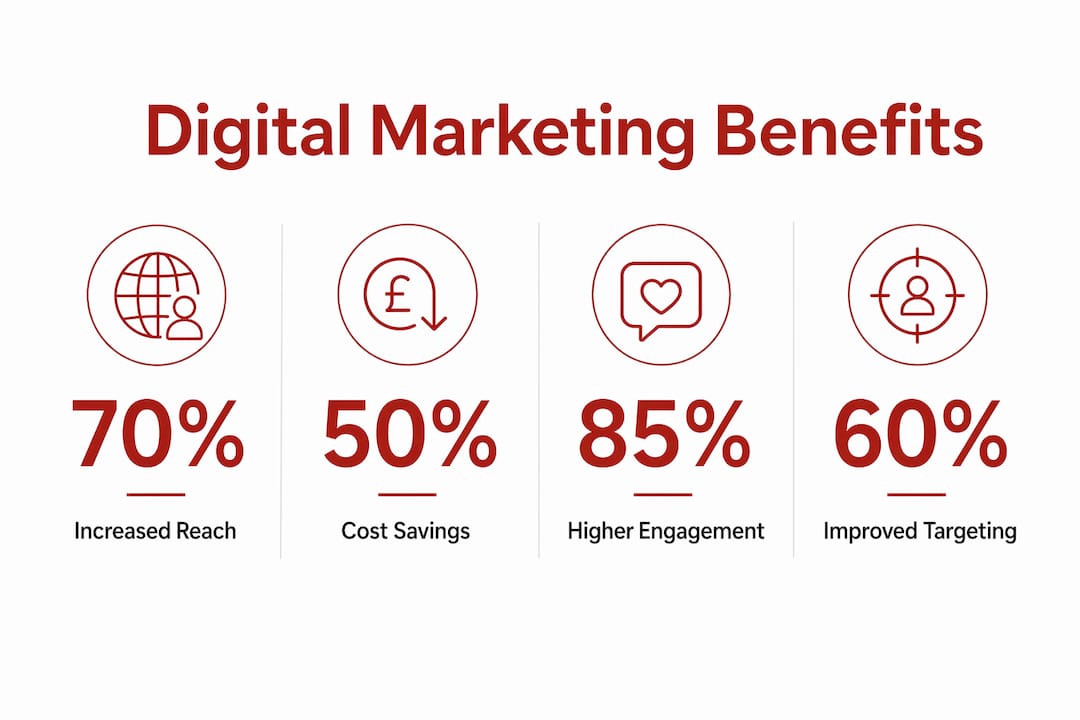
The ability to measure and iterate is the most significant practical advantage. A print campaign is fixed once it runs. A digital campaign can be adjusted mid-flight based on what the data shows. This shifts the focus from planning to continuous improvement.
Measurable performance metrics that Sydney organisations should track include:
- Organic search traffic: the volume of visitors arriving via unpaid search results
- Conversion rate: the percentage of visitors who complete a desired action
- Email open and click-through rates: indicators of audience engagement with direct communications
- Cost per acquisition: the total spend required to gain one new customer or supporter
- Return on ad spend: revenue or value generated relative to paid media investment
- Bounce rate: the proportion of visitors who leave without taking any action
Pro Tip: If your organisation has sustainability or accessibility commitments, align your digital marketing goals with those values from the outset. Audiences in Sydney increasingly scrutinise whether an organisation’s online presence reflects its stated principles. Ethical SEO practices are one practical way to demonstrate that alignment.
How does marketing attribution improve digital strategies?
Marketing attribution is the practice of assigning credit to the touchpoints in a customer’s journey that contributed to a conversion, rather than crediting only the final interaction. Last-click attribution systematically distorts marketing decisions by oversimplifying impact, leading organisations to under-invest in upper-funnel channels that build trust and intent.
For Sydney organisations with complex customer journeys, such as nonprofits, health services, or community groups, this distortion can be particularly damaging. A supporter may discover your organisation through organic search, return via a social post, and finally convert through an email. Last-click attribution would credit only the email, making the earlier touchpoints appear worthless.
Data-driven attribution, available through tools like GA4, uses machine learning to assess the contribution of each touchpoint. GA4’s attribution model requires sufficient conversion volume to function accurately, so smaller organisations may need to use rule-based models such as linear or time-decay attribution as an interim approach.
Steps to implement effective attribution for your organisation:
- Define your conversion events clearly in GA4, including micro-conversions such as newsletter sign-ups and page depth.
- Audit your tracking setup to confirm that all channels are tagged consistently using UTM parameters.
- Select an attribution model appropriate to your conversion volume and journey complexity.
- Review channel contribution reports monthly rather than relying on last-click summaries.
- Adjust budget allocation based on what the full-journey data reveals, not just final-step performance.
Data quality underpins all of this. Poor tagging, missing UTM parameters, or inconsistent channel naming will produce unreliable attribution data regardless of the model used.
What practical steps build an effective digital marketing strategy?
Digital marketing success depends less on fixed plans and more on continuous iteration backed by measurable data. That principle should shape how Sydney organisations approach strategy from the beginning.
Define objectives before choosing channels
Start with clear, specific objectives tied to organisational outcomes. “Increase website traffic” is not an objective. “Increase organic search traffic from Sydney-based visitors by 30% over six months” is. Objectives determine which channels are appropriate and which metrics matter.
Research your audience thoroughly
Understand where your audience spends time online, what questions they ask, and what content they find credible. Keyword research tools such as Google Search Console and Google Keyword Planner reveal the actual language your audience uses. That language should inform your content, your ad copy, and your SEO approach.
Choose channels based on fit, not trend
Channels must be used cohesively to deliver consistent messaging to audiences at different stages. Select channels where your audience is genuinely active. A community health organisation in Sydney may find that email marketing and organic search deliver far stronger results than paid social. A retail brand may find the reverse. There is no universal answer.
Create content that reflects your values
For mission-led organisations, content is not just a marketing tool. It is a representation of your values. Content that is accessible, clearly written, and free of unnecessary jargon builds trust with the audiences that matter most. Semantic SEO strategies help organisations structure content so that it serves both readers and search engines without compromising quality.
Measure, review, and iterate
Set a regular review cadence, monthly at minimum. Examine what is working, what is not, and why. Adjust spend, content, and channel mix accordingly. The organisations that improve fastest are those that treat every campaign as a source of learning.
Common pitfalls Sydney organisations should avoid:
- Channel isolation: running SEO, email, and social as separate programmes with no shared strategy or messaging
- Ignoring accessibility: publishing content that excludes users with disabilities, which also limits search visibility
- Over-relying on paid media: building audience reach on rented platforms without investing in owned channels such as email lists and organic search
- Neglecting data governance: collecting user data without clear consent frameworks or privacy policies, which creates legal and reputational risk
- Chasing vanity metrics: optimising for follower counts or page views rather than outcomes that reflect organisational goals
Google Ads Quality Score offers a useful illustration of this last point. Quality Score is a diagnostic metric, not a target. Organisations that focus on improving ad relevance and landing page experience will see better auction outcomes than those who chase the score itself.
Key takeaways
Effective digital marketing requires a clear strategy, consistent cross-channel messaging, accurate attribution, and a commitment to iterating based on data rather than assumption.
| Point | Details |
|---|---|
| Digital marketing defined | Promotion via search, social, email, and web channels, measured and adjusted in real time. |
| Use channels cohesively | Owned, earned, and paid media work best when aligned around consistent messaging and objectives. |
| Attribution matters | Last-click models distort decisions; data-driven attribution in GA4 gives a fuller picture of what works. |
| Strategy before channels | Define specific objectives first, then select channels based on where your audience is genuinely active. |
| Governance and values | Accessibility, data privacy, and sustainability should be built into digital marketing practice, not added later. |
Why stewardship matters more than scale in digital marketing
I have worked with enough Sydney organisations to notice a consistent pattern. The ones that struggle most with digital marketing are not those with the smallest budgets. They are the ones that treat digital marketing as a volume exercise, more content, more ads, more channels, without a clear sense of what they are trying to achieve or who they are trying to reach.
The organisations that do it well tend to share a different orientation. They are deliberate. They choose fewer channels and use them with care. They invest in owned assets, particularly their website and email list, because those are the channels they control. They treat data as a responsibility, not just a resource.
There is also a tendency in digital marketing to conflate activity with progress. Publishing frequently, running ads continuously, and accumulating followers can all feel productive without producing meaningful outcomes. The discipline of measuring what actually matters, and being willing to stop doing things that do not work, is harder than it sounds.
For purpose-driven organisations in Sydney, the stakes are higher than they might appear. Your digital presence is often the first point of contact for the communities you serve. Sustainable SEO practices and accessible content are not optional extras. They are part of how you demonstrate that your values extend to how you operate online.
— Ben
How Com supports sydney organisations with digital marketing
Com works with mission-led organisations in Sydney to build digital marketing strategies that reflect their values and deliver measurable results. The focus is on quality over volume, with services spanning ethical SEO, AI-informed search visibility, and sustainable web design that supports long-term online performance.
If your organisation is ready to move beyond ad hoc digital activity and build a coherent, responsible online presence, Com’s digital marketing services are designed for exactly that context. For organisations prioritising search visibility, Com’s AI-informed SEO approach integrates technical rigour with ethical practice. The work is grounded in stewardship, not scale.
FAQ
What is digital marketing in simple terms?
Digital marketing is the promotion of a brand, product, or service through online channels such as search engines, social media, email, and websites. It differs from traditional marketing primarily in its measurability and the ability to adjust campaigns based on real-time data.
What are the main forms of digital marketing?
The main forms include SEO and SEM, content marketing, email marketing, pay-per-click advertising, social media marketing, and influencer and affiliate marketing. These categories work most effectively when used together as part of a coordinated strategy rather than in isolation.
Why does marketing attribution matter for sydney organisations?
Attribution determines which channels and touchpoints receive credit for conversions. Last-click attribution distorts resource allocation by ignoring the earlier interactions that build trust and intent, leading organisations to undervalue channels that drive awareness and consideration.
How do small sydney organisations start with digital marketing?
Start by defining one or two specific objectives, researching where your audience is active online, and selecting channels accordingly. Google Search Console and Google Keyword Planner are free tools that provide useful starting data without requiring significant budget.
Is digital marketing suitable for nonprofits and community organisations?
Digital marketing is well suited to nonprofits and community organisations because it allows precise targeting and measurable outcomes at relatively low cost. Organisations focused on purpose-led digital promotion can reach the right audiences without the broad spend that traditional advertising requires.


