

TL;DR:
- Effective SEO content writing focuses on matching user intent and structuring content for both humans and AI. Original content with firsthand examples and precise metadata helps improve search rankings and click-through rates. Prioritizing clarity, brevity, and relevance ensures long-term visibility and trust for purpose-driven organizations.
SEO content writing is defined as the practice of aligning written content with user intent and search engine criteria to earn visibility and qualified traffic. The best practices for SEO content writing in 2026 require more than keyword placement. They demand clear structure, original thinking, and precise metadata. Long-tail keywords account for 70% of total search traffic. That figure alone tells you where most content strategies leave qualified readers behind. Meta titles perform best at 55–60 characters, and sentences under 20 words improve both reader comprehension and AI parsing. These are not stylistic preferences. They are measurable standards that determine whether your content ranks or disappears.
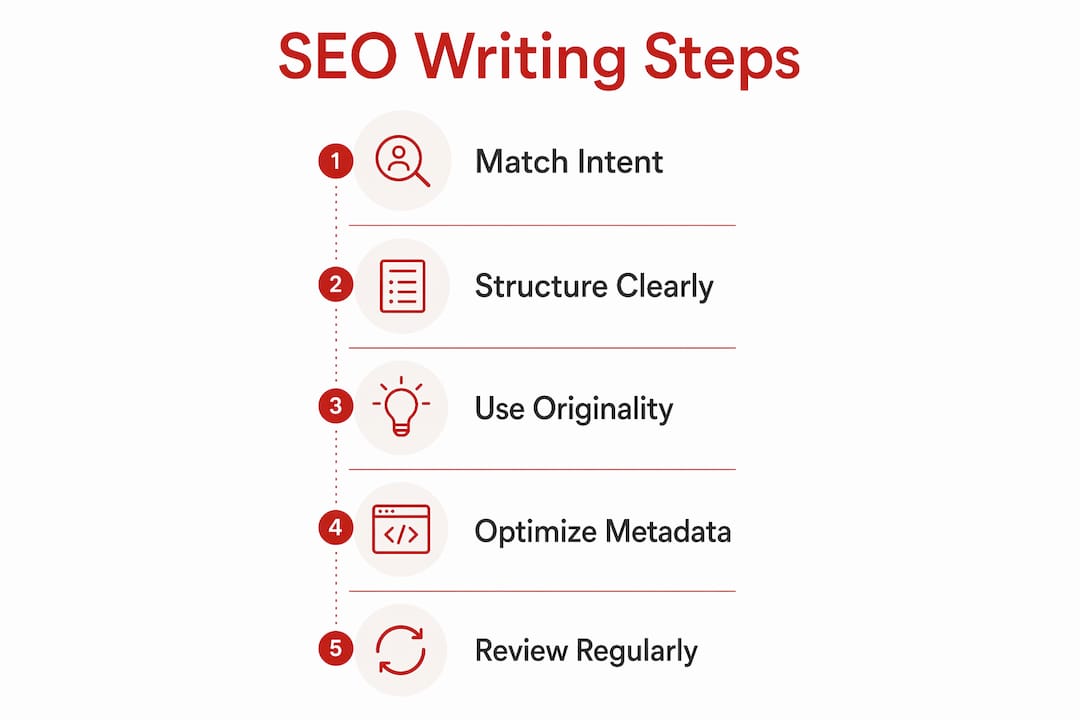
What are the best practices for SEO content writing?
Effective SEO content writing begins with understanding what a reader actually wants when they type a query. Search intent falls into four categories: informational, navigational, commercial, and transactional. Matching your content format to the right category is the single most critical factor in ranking well. Mismatching format and intent harms rankings more than any technical error.
Long-tail keywords are the practical entry point for most content creators. These are phrases of three or more words with specific intent, and they make up 70% of search traffic. A post targeting “sustainable web design for nonprofits” will consistently outperform one targeting “web design” because the audience is more defined and the competition is lower.
Keyword research works best when you layer primary and semantic terms together. A primary keyword anchors the topic. Semantic keywords, which are related phrases and concepts, signal topical depth to search engines. Tools such as Google Search Console, Ahrefs, and Semrush surface these relationships clearly.
- Identify your primary keyword and confirm its search intent before writing.
- Add three to five semantic keywords that cover related subtopics.
- Check the top-ranking pages for your target query to understand what format they use.
- Note the questions people ask in “People Also Ask” sections for FAQ and subheading ideas.
Pro Tip: Write a one-paragraph content brief before you start. Include your target keyword, the user’s intent, the business goal the piece serves, and one metric you will use to measure success. Skipping this brief is the most frequent cause of content drift in SEO projects.
How should you structure content for readability and AI comprehension?
Structure is where most content fails quietly. A page can contain accurate information and still perform poorly because it is formatted in a way that neither readers nor search engines can parse efficiently. The answer-first approach solves this. Each section should open with a direct response to the implied question, then expand with evidence or context. Hybrid content structures that serve both human readers and AI engines are now the baseline expectation, not an advanced technique.

Sentence length is a practical lever. Sentences under 20 words improve scanning speed and AI content parsing. Shorter sentences also reduce the cognitive load on mobile readers, who make up the majority of web traffic. Paragraphs of 2–4 sentences keep content digestible and reduce bounce rates.
HTML heading hierarchy matters for both SEO and accessibility. A single H1 defines the page topic. H2 headings mark major sections. H3 headings organise detail within those sections. Search engines use this hierarchy to understand content relationships. AI overview systems use it to extract summary answers.
| Element | Recommended standard | Why it matters |
|---|---|---|
| Sentence length | Under 20 words | Improves scanning and AI parsing |
| Paragraph length | 2–4 sentences | Reduces bounce rate on mobile |
| Heading hierarchy | H1, H2, H3 in order | Aids SEO indexing and AI summarisation |
| Meta title length | 55–60 characters | Prevents truncation on search results pages |
- Use H2 headings as direct questions where possible. Question headings align with how people search.
- Keep bullet lists to five items or fewer. Longer lists lose readers.
- Use white space deliberately. Dense text signals effort to the writer, not the reader.
Pro Tip: Bold key phrases within paragraphs to create visual anchors. Readers scan before they read, and bolded terms help them decide whether to slow down. Use this sparingly, or it loses its effect.
How does original content build SEO authority?
Original content is the clearest signal of expertise that search engines can detect. Unique lived experience and first-hand examples are currently the most valuable SEO assets for establishing authority. Generic summaries of publicly available information no longer differentiate a page. What differentiates a page is the perspective, the specific example, or the data that exists nowhere else.
Original research, exclusive case studies, and expert commentary consistently outperform shallow articles in search rankings. This is not because search engines reward effort directly. It is because original content earns links, generates engagement, and reduces bounce rates, all of which are measurable ranking signals.
“Shallow content that covers a topic broadly but says nothing specific is the most common reason high-quality websites stagnate in search rankings. Depth on a focused topic outperforms breadth across many topics every time.”
Practical ways to add genuine authority to your content include:
- Conduct a short survey within your community and cite the results.
- Document a process you have actually followed, including what did not work.
- Interview a practitioner and quote them directly with their permission.
- Reference a specific case from your own organisation’s experience, even briefly.
Pro Tip: Include one counterintuitive insight per article. Readers remember the point that surprised them. Search engines reward content that earns time-on-page, and a well-placed unexpected finding earns that time.
Avoiding duplicate content is equally important. Copied or near-identical text across pages dilutes authority and can trigger manual penalties. If you cover a topic across multiple pages, use canonical tags to signal the primary version to search engines. For SEO content strategy in purpose-driven organisations, this is particularly relevant where similar programme descriptions appear across multiple pages.
How do metadata and on-page elements affect click-through rates?
Metadata is the first thing a reader sees before visiting your page. The 75-word principle describes how title tags, meta descriptions, and image alt text collectively use fewer than 100 words but carry disproportionate weight in determining click-through rates and indexing signals. Getting these elements right is a high-return task.
Follow these steps to optimise your on-page metadata:
- Write your meta title first. Keep it between 55 and 60 characters. Include the primary keyword near the front. Do not repeat the keyword twice.
- Write a meta description of 150–160 characters. Summarise the page accurately. Include a clear reason to click, but avoid false promises.
- Write descriptive alt text for every image. Describe what the image shows in plain language. Include a relevant keyword only when it fits naturally.
- Construct your URL from the primary keyword. Use hyphens between words. Keep it short and free of stop words like “and,” “the,” or “for.”
- Check for metadata duplication across your site. Each page needs a unique title and description.
Common mistakes to avoid include keyword stuffing in meta titles, which search engines now penalise, and writing meta descriptions that do not match the page content, which increases bounce rates. Descriptive, well-structured URLs also contribute to click-through rates because readers scan the URL before clicking, particularly on mobile devices.
For organisations managing large content libraries, a periodic SEO audit is the most reliable way to catch metadata drift before it affects rankings.
Key takeaways
Effective SEO content writing requires matching user intent precisely, structuring content for both human readers and AI systems, and grounding every claim in original evidence.
| Point | Details |
|---|---|
| Match intent before keywords | Identify whether a query is informational, navigational, or transactional before choosing a format. |
| Use long-tail keywords | Phrases of three or more words account for 70% of search traffic and attract more qualified readers. |
| Structure for scanning | Keep sentences under 20 words and paragraphs to 2–4 sentences to improve readability and AI parsing. |
| Prioritise original content | First-hand examples, original research, and specific case studies outperform generic summaries in rankings. |
| Optimise metadata precisely | Meta titles of 55–60 characters and accurate meta descriptions directly influence click-through rates. |
Writing for humans first: a note on sustainable SEO
The most persistent mistake I see in SEO content work is writing for the algorithm first and the reader second. The two goals are not in conflict, but the order matters. When you start with the machine, you produce content that is technically correct and experientially hollow. Readers leave quickly. Engagement drops. Rankings follow.
The rise of AI-generated content has made this problem more visible. Automated text can satisfy keyword density and heading structure without saying anything worth reading. The organisations that maintain search authority through this period are the ones producing content that reflects genuine knowledge and considered perspective. That is not a moral argument. It is a practical one.
Sustainability in SEO content also means managing your content library with the same care you give new production. Outdated pages, duplicate descriptions, and orphaned posts accumulate quietly and erode domain authority over time. A sustainable SEO approach treats existing content as an asset to maintain, not a sunk cost to ignore.
For mission-driven organisations in particular, the values embedded in your content matter. Accessibility, plain language, and honest representation of your work are not optional extras. They are the foundation of the trust that makes SEO work over time.
— Ben
SEO content support for purpose-driven organisations
Com works with mission-led organisations across Australia to build content strategies that earn visibility without compromising values. The work starts with understanding what your audience actually searches for, then building content that answers those queries with authority and clarity.
Com’s digital marketing services are designed for high-trust organisations that need search visibility to grow their impact, not their noise. From keyword research and content briefs to metadata audits and AI-informed SEO, the approach is grounded in stewardship and long-term performance. If your content is not earning the visibility your work deserves, that is a solvable problem.
FAQ
What is SEO content writing?
SEO content writing is the practice of creating written content that aligns with user search intent and meets search engine criteria for relevance and authority. It combines keyword research, clear structure, and original evidence to earn organic visibility.
How long should a meta title be for SEO?
Meta titles perform best at 55–60 characters. Titles longer than 60 characters are truncated in search results, reducing click-through rates.
Why do long-tail keywords matter for content writing?
Long-tail keywords, which are phrases of three or more words, account for 70% of total search traffic. They attract readers with specific intent, which typically results in higher engagement and lower bounce rates.
How do I avoid content drift in SEO projects?
Write a content brief before starting each piece. The brief should define the target keyword, user intent, business goal, and one success metric. Skipping this step is the most common cause of content drift and wasted effort.
What is the best sentence length for web content?
Sentences under 20 words improve both reader comprehension and AI content parsing. Shorter sentences also reduce cognitive load on mobile readers, who represent the majority of web traffic.


