

TL;DR:
- Alt SEO emphasizes optimizing alt text and supplementary techniques to enhance visibility in AI-driven search. Properly descriptive, contextually relevant alt text increases AI citations and supports long-term discoverability. Integrating structured data, expert citations, and ongoing governance amplifies these efforts, complementing traditional ranking strategies for sustainable online presence.
Most digital marketers treat SEO as a rankings problem. Get the keyword, build the links, watch the position climb. That framing was reasonable a decade ago. It is increasingly incomplete now. Alt SEO, which encompasses alt text optimisation and the broader field of alternative SEO techniques, has moved from a compliance checkbox to a genuine driver of visibility in AI-powered search. Understanding how these non-traditional SEO practices work alongside conventional methods is not optional for organisations serious about long-term discoverability. This article sets out the evidence, the practices, and the practical steps.
Table of Contents
- Key takeaways
- What alt SEO actually means in 2026
- Writing alt text that works for AI and people
- Integrating alt SEO into a broader alternative strategy
- Misconceptions and challenges in alt SEO
- Practical steps for applying alt SEO
- A practitioner’s view on alt SEO
- How Com supports alt SEO for your organisation
- FAQ
Key takeaways
| Point | Details |
|---|---|
| Alt text drives AI citations | Multimedia content with accurate alt text receives 67% more AI citations than content without descriptions. |
| GEO complements traditional SEO | Generative engine optimisation focuses on being cited in AI answers, not just ranked in search results. |
| Optimal alt text length matters | Keeping alt text between 80 and 140 characters balances accessibility needs and AI crawler efficiency. |
| Structured data multiplies visibility | FAQPage schema pages are significantly more likely to appear in AI-generated overviews than unstructured pages. |
| Alt SEO is not a standalone tactic | It works as part of a layered approach combining content clarity, schema, expert citations, and accessibility practices. |
What alt SEO actually means in 2026
The term “alt SEO” covers two related but distinct ideas. The first is alt text optimisation, the practice of writing descriptive text for images that both screen readers and AI crawlers can interpret. The second is the broader set of alternative SEO techniques that sit outside traditional link building and keyword targeting, including generative engine optimisation (GEO), structured data, and citation-focused content design.
Traditional SEO measures success by position in a ranked list of blue links. GEO measures success differently.
“GEO shifts SEO focus from rankings to citations, requiring a strategic mindset change to write for machines that synthesise and attribute.” (Alt Text Studio)
GEO can boost visibility in AI-generated answers by up to 40%, while keyword stuffing decreases it. That gap is significant. AI engines such as ChatGPT, Perplexity, and Google’s AI Overviews do not rank pages. They synthesise answers and attribute sources. Being cited requires different content signals than being ranked.
Alt text sits at the centre of this shift because AI crawlers cannot see images. They rely entirely on the alt attribute to understand what a visual element contains and how it relates to surrounding content. This means:
- Images without alt text are invisible to AI models, regardless of how relevant they are to the topic.
- Vague alt text such as “image1.jpg” or “photo of team” provides no semantic value.
- Accurate, contextual alt text functions as a semantic anchor that helps AI systems connect visual content to the page’s subject matter.
- Multimedia content with descriptions receives 67% more AI citations than content without them.
Traditional search volume is also shifting. Forecasts suggest traditional search volume could drop by 25% by 2026 as AI-generated answers increasingly satisfy queries without a click. Organisations that do not account for this through alt SEO and related practices will see measurable visibility losses.
Writing alt text that works for AI and people
Effective alt text is specific, contextual, and proportionate. It describes the image clearly, connects it to the surrounding content, and stays within a length that works for both screen readers and AI crawlers.
Optimal alt text length sits between 80 and 140 characters. Below 80 characters, descriptions are often too sparse to carry semantic weight. Above 140, screen readers can become cumbersome for users and AI models may discount the text as verbose.
A practical process for writing alt text that serves both accessibility and SEO:
- Identify the purpose of the image. Is it decorative, informational, or functional? Decorative images (such as background patterns) should use an empty alt attribute (“alt=”"`). Informational images need a full description.
- Describe the image content accurately. State what is shown, who is present if relevant, and what action is taking place. Avoid assumptions or interpretations the image does not support.
- Connect the description to page context. If an image shows a bar chart comparing quarterly revenue, the alt text should name the data it depicts, not just say “bar chart.”
- Use natural language. Write as you would explain the image to someone who cannot see it. Do not force keywords into the description.
- Review for length and clarity. Aim for the 80 to 140 character range. Read it aloud. If it sounds clumsy, revise it.
Keyword stuffing in alt text harms AI visibility. AI models detect unnatural keyword repetition and treat it as a negative signal, which is the opposite of its intended effect.
Pro Tip: Run a batch review of your site’s images using a simple spreadsheet. Log the filename, current alt text, character count, and a revised version. Even a partial audit across your ten most-visited pages will reveal patterns and quick wins.
Common pitfalls to avoid include writing descriptions that are too generic (“woman using laptop”), omitting alt text entirely on informational images, duplicating the same alt text across multiple images on a page, and writing descriptions that contradict the visual content. Each of these errors reduces both accessibility compliance and AI discoverability.
Integrating alt SEO into a broader alternative strategy
Alt text does not operate in isolation. Its value multiplies when it sits alongside structured data, credible citations, and content designed for AI extraction. This is where SEO for alternative content becomes a coherent system rather than a set of disconnected tactics.
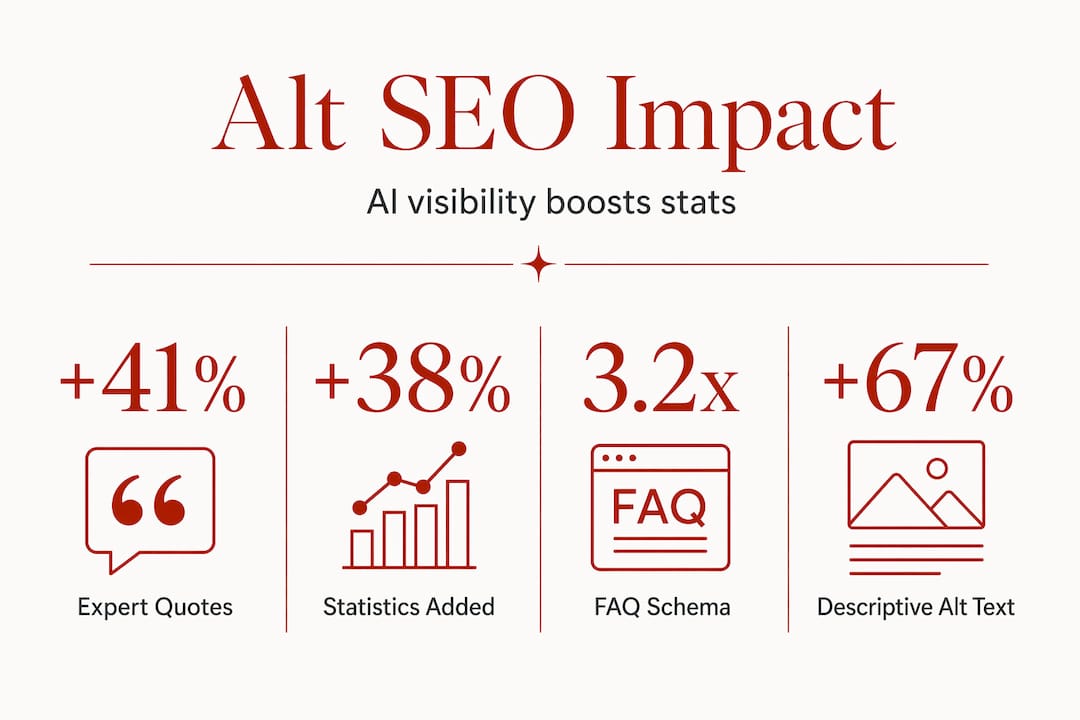
The table below shows how different alternative SEO techniques compare in terms of implementation effort and AI visibility impact.
| Technique | Implementation effort | AI visibility impact |
|---|---|---|
| Alt text optimisation | Low | High (67% more citations for multimedia) |
| FAQPage schema | Medium | Very high (3.2x more likely in AI Overviews) |
| Expert quotations | Medium | High (41% visibility boost) |
| Statistics with citations | Low to medium | High (38% visibility boost) |
| Credible source links | Low | Moderate (30% visibility boost) |
FAQPage schema pages are 3.2 times more likely to appear in AI Overviews than unstructured pages. Article schema helps AI engines understand the type of content, the author, and the publication date, which all contribute to citation credibility.
Expert quotations add another layer. Including expert quotations increases AI visibility by 41%, statistics by 38%, and citing credible sources by 30%. These are not marginal gains. They reflect the way AI models assess trustworthiness before attributing a source.
Content structure also matters. AI engines extract answers at the paragraph level. Short, direct paragraphs that answer a specific question are more extractable than long, discursive prose. A heading hierarchy that signals topic relationships helps AI models understand how sections connect.
Pro Tip: When adding an expert quotation, place it early in the section it supports. AI models tend to extract from the first substantive paragraph under a heading. A well-placed, attributed quote increases the chance that paragraph becomes a cited source.
Tools now exist to track AI visibility directly. Brand Radar and similar platforms monitor how often a brand appears in AI-generated answers across multiple platforms, which is a metric traditional rank trackers cannot capture. A thorough SEO audit for 2026 should include this dimension.
Misconceptions and challenges in alt SEO
Several assumptions from traditional SEO practice actively undermine alt SEO effectiveness. The most persistent is that keyword density still signals relevance. AI models do not respond to density. They respond to topical depth, factual accuracy, and structural clarity.
A related misconception is that alt SEO replaces traditional SEO. It does not. Hybrid SEO strategies combining conventional ranking efforts with AI discovery optimisation produce better overall visibility than either approach alone. Alt text optimisation, GEO, and schema work best on pages that already have baseline authority and ranking strength.
The zero-click problem adds another layer of complexity. AI summaries decrease traditional click-through rates, and well-ranking pages can lose traffic when AI answers satisfy the query without a visit. The response is not to rank higher. It is to be cited as the source of the AI answer, which brings the user to you through attribution rather than a click.
Other challenges practitioners face include:
- Over-reliance on AI-generated content, which can undermine genuine expertise signals that AI citation systems value.
- Neglecting accessibility compliance while chasing AI visibility gains, when both goals are served by the same practices.
- Treating alt text as a one-time task rather than an ongoing content governance responsibility.
- Measuring success only by traditional metrics such as domain authority or keyword position, without tracking AI brand citation presence alongside them.
Understanding these nuances helps organisations make more considered decisions about where to invest SEO effort.
Practical steps for applying alt SEO
Moving from understanding to application requires a structured process. The following steps are suited to digital marketers and business owners who want to implement alt SEO without disrupting existing workflows.
- Audit existing images and alt text. Use a crawl tool or manual spreadsheet to catalogue every image on your site. Flag missing alt text, duplicate descriptions, and character lengths outside the 80 to 140 character range. Prioritise high-traffic pages first.
- Establish a content standard for alt text. Write a brief internal guide specifying what good alt text looks like for your content types. Include examples for photographs, charts, infographics, and icons. Apply this standard to all new content from the outset.
- Add schema markup to key content pages. Implement FAQPage schema on pages that answer specific questions. Add Article schema where authorship and date are relevant. These are modest technical additions with measurable AI visibility returns.
- Incorporate expert citations and statistics. Identify the key claims on your most important pages and attribute them to credible sources. This supports both user trust and AI citation likelihood. For mission-driven organisations, this also aligns with transparency values.
- Monitor AI visibility alongside traditional metrics. Set up tracking that captures brand mentions and citations in AI-generated answers. Review this alongside rank data monthly. Adjust content based on what is being cited versus what is being ranked.
- Apply governance and sustainability considerations. SEO planning for high-trust organisations should account for accessibility obligations, data governance, and the environmental footprint of digital operations. Sustainable SEO practices reduce long-term risk while strengthening credibility.
Pro Tip: Start the alt text audit with your ten most-linked images rather than your most-visited pages. Linked images carry more authority weight and are more likely to be indexed by AI crawlers, so improving their alt text yields faster returns.
A practitioner’s view on alt SEO
I have watched organisations spend significant budget on traditional SEO, achieve reasonable rankings, and still see AI-generated answers attribute their content to competitors. The reason is almost always structural. Their pages rank. They are not citation-ready.
In my experience, alt text is the most underestimated element in this gap. Practitioners treat it as an accessibility requirement, which it is, but then they miss its role as a semantic signal for AI systems. An image of a product, a chart, or a staff member without precise alt text is invisible to the models that are increasingly answering the queries your audience types.
The broader point is that chasing rankings and building citation authority require different disciplines. Rankings depend on authority and relevance signals accumulated over time. Citations depend on how well a specific piece of content can be extracted, attributed, and trusted at the moment a query is processed. Both matter. Neither replaces the other.
What I find encouraging is that ethical and sustainable SEO and alt SEO are not in tension. Writing accurate, accessible, well-structured content is precisely what AI citation systems reward. Organisations that have always prioritised clarity and credibility over keyword games are better positioned for this shift than they may realise. The adjustment is tactical, not strategic. The values are already there.
— Ben
How Com supports alt SEO for your organisation
Com builds and maintains websites designed to perform in the current search environment, including the growing domain of AI-driven discovery. The AI SEO services Com provides are built for organisations that need more than keyword rankings. They include alt text auditing, GEO implementation, schema markup, and content structuring aligned with how AI models select and attribute sources. This work is carried out with a consistent commitment to accessibility, ethical practice, and sustainable web design. If your organisation is ready to move beyond traditional metrics and build visibility that holds, explore Com’s digital marketing services or review the sustainable web design options available.
FAQ
What is alt SEO?
Alt SEO refers to alt text optimisation for images and the broader practice of alternative SEO techniques that support accessibility and AI visibility. It includes strategies beyond conventional keyword ranking, such as generative engine optimisation and structured data implementation.
How does alt text affect AI search results?
AI crawlers cannot see images and rely on alt text to understand visual content. Multimedia with proper descriptions receives 67% more citations in AI-generated answers, making alt text a direct factor in AI visibility.
What is the ideal length for alt text?
Alt text between 80 and 140 characters is recommended. This range supports both screen reader usability and AI crawler efficiency without truncating meaningful description.
Does alt SEO replace traditional SEO?
No. Alt SEO works alongside traditional SEO. Hybrid strategies combining ranking efforts and AI citation optimisation produce better overall visibility than either method used independently.
How do I measure AI visibility from alt SEO improvements?
Track brand citations in AI-generated answers using dedicated monitoring tools. AI visibility tracking tools measure how often your content appears as a cited source across AI platforms, which is a metric traditional rank trackers do not capture.


