

TL;DR:
- Advanced local SEO in 2026 involves optimizing for both Google’s local pack and AI-powered answer engines through entity authority, review velocity, and hyperlocal content. Consistent profile updates, structured data, and targeted local pages significantly boost visibility and AI citation prominence. Maintaining regular engagement and depth in local signals ensures long-term success amidst AI-driven search evolution.
Advanced local SEO is the deliberate practice of optimising a business’s online presence for both Google’s local pack and AI-powered answer engines such as ChatGPT, Gemini, and Google AI Overviews. The discipline has expanded well beyond Google Business Profile (GBP) management. In 2026, it requires a dual strategy: sustaining traditional local search visibility whilst building entity authority across AI platforms. This article covers the ranking factors, content approaches, review tactics, and measurement methods that produce results for digital marketers and local business owners operating in competitive markets.
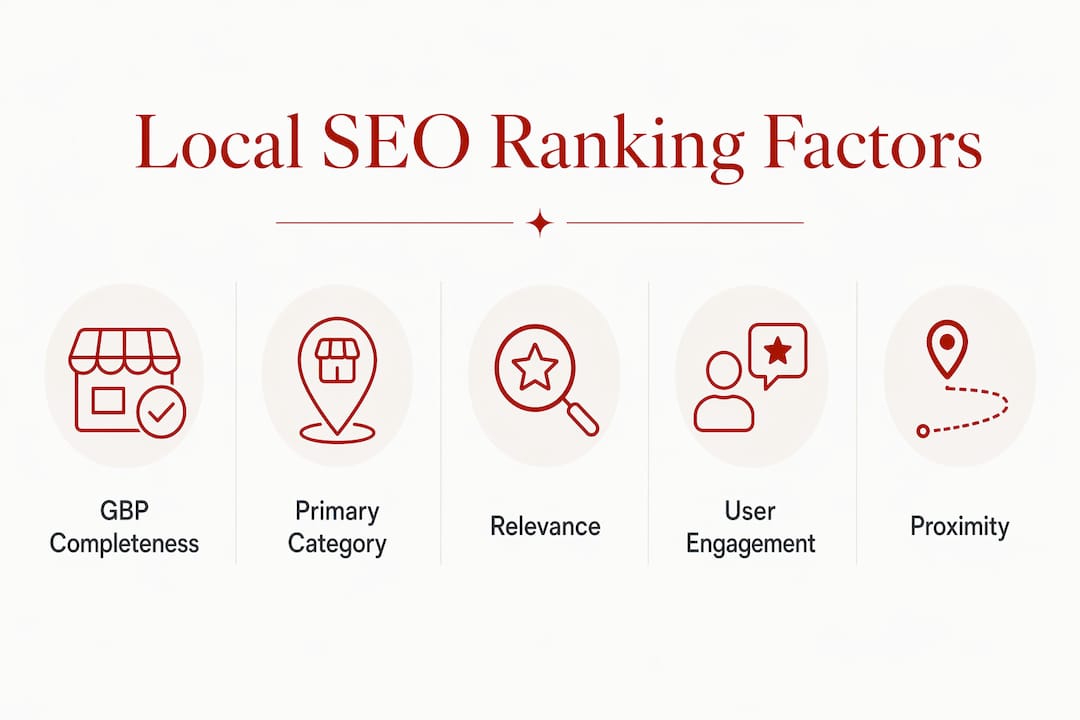
What are the critical ranking factors for advanced local SEO?
The five most critical local ranking factors in 2026 account for over 50% of local search visibility. They are GBP primary category match, proximity, review velocity, GBP completeness and freshness, and on-page localisation. Understanding their relative weight is the starting point for any serious local SEO strategy.
GBP completeness is the single most controllable factor on this list. Businesses with complete, actively managed profiles receive 2.7x more visibility and 70% more direction requests than those with incomplete listings. That gap represents real foot traffic and real revenue.
| Ranking Factor | Weight in Local Algorithm | Primary Action |
|---|---|---|
| GBP primary category match | High | Select the most precise category available |
| Review velocity | Rising (now ranked 11th) | Generate consistent, frequent reviews |
| GBP completeness and freshness | High | Update profile regularly, add photos weekly |
| On-page localisation | Moderate | Include suburb, landmarks, and local terms |
| Behavioural signals | 8% of ranking weight | Improve click-through and call rates |
Proximity remains a factor, but its weight has adjusted as AI platforms prioritise relevance and entity density over pure distance. On-page localisation, meaning the inclusion of suburb names, local landmarks, and area-specific language on your website, now carries measurable ranking influence. Behavioural signals, including clicks, calls, and direction requests, account for 8% of the local ranking algorithm. That figure confirms that user engagement with your profile is not a soft metric. It is a direct input into where you appear.
Pro Tip: Set a recurring calendar reminder to audit your GBP every 30 days. Profiles that go without updates for more than 30 days show measurable ranking drops, according to Scale Growth Digital.
How has AI transformed local search and what is answer engine optimisation?
Answer Engine Optimisation (AEO) is the practice of structuring content so that AI platforms can extract, verify, and cite it in direct answers. It is the formal industry term for what many practitioners are calling “AI SEO.” The distinction matters because AEO requires a different content architecture than traditional search engine optimisation.
30–40% of local search activity now takes place on AI platforms such as ChatGPT, Perplexity, and Gemini rather than traditional search engines. A business not optimising for AI is invisible to roughly a third of its potential market. That is not a marginal risk.
The contrast between traditional local pack results and AI Overviews is significant:
- Google local pack returns 3–7 results based on proximity, GBP completeness, and review signals.
- AI Overviews and ChatGPT reduce local results to 1–3 cited recommendations, selected on the basis of dense entity signals and precise location context.
- Entity-based SEO requires that your business name, address, services, and location appear consistently across multiple trusted sources, not just your website and GBP.
- Citations beyond GBP now include local news mentions, Reddit community threads, and Facebook group discussions, all of which contribute to AI entity prominence.
“The best-ranked businesses in AI Overviews also rank highly in Google Maps but require dedicated entity signals and deeper content integration.” — Surferstack, 2026
Dual optimisation for Google and AI answer engines is no longer optional for businesses that want to dominate local search. The strategies must span entity-based SEO, structured data, review management, and semantic relationships across platforms. Treating these as separate workstreams misses the point. They reinforce each other.
What hyperlocal content and schema strategies drive results?
Hyperlocal content targets a specific neighbourhood, suburb, or precinct rather than a whole city. Generic city-level pages are insufficient for AI-derived local answer citations. AI models filter results using precise location context, and a page that says “we serve Sydney” will lose to one that references Newtown, King Street, and the nearby Erskineville train station.

The practical difference between city-wide and hyperlocal content is specificity. A city-wide page describes services and location in broad terms. A hyperlocal page names the streets, schools, transit stops, and landmarks that residents actually use to orient themselves. That specificity is what AI models extract when forming a local answer.
Here is a structured approach to building hyperlocal content:
- Identify your primary service areas at suburb or neighbourhood level, not city level.
- Create a dedicated page for each area, including the suburb name, nearby landmarks, transit stops, and local institutions such as schools or community centres.
- Implement schema markup beyond the basic LocalBusiness type. Add Service, Review, and FAQPage schema to give AI models structured data to extract.
- Populate your GBP Q&A section with 10–15 relevant questions and answers covering your services, hours, and location specifics.
- Add 3–5 new, high-quality photos to your GBP on a regular cadence. Businesses that maintain fresh GBP content significantly increase their chances of appearing in AI-generated answers.
| Content Type | City-Wide Approach | Hyperlocal Approach |
|---|---|---|
| Location references | “We serve Melbourne” | “We serve Fitzroy, Collingwood, and Carlton” |
| Landmarks | None | “Near the Edinburgh Gardens and Smith Street tram stop” |
| Schema types | LocalBusiness | LocalBusiness + Service + FAQPage + Review |
| GBP photos | Occasional | 3–5 new photos per week |
| Content freshness | Quarterly updates | Monthly page reviews, weekly GBP updates |
Niche local brand mentions in trusted sources such as local news outlets, Reddit communities, and Facebook groups carry influence comparable to backlinks for AI citation and entity prominence. A mention in a local community Facebook group or a neighbourhood subreddit contributes to the entity signals that AI platforms use to verify and rank local businesses.
Pro Tip: Do not use templates to generate multiple suburb pages. AI models and Google both detect thin, templated content. Each hyperlocal page should contain unique observations, local references, and service details specific to that area. A content workflow built for community organisations can help structure this process without sacrificing quality.
How to manage reviews for maximum local ranking impact?
Review velocity has risen from ranking 93rd to 11th in importance for local SEO signals in 2026. That shift reflects how much weight both Google and AI platforms now place on consistent, recent, positive reviews. A business with 20 reviews from three years ago is at a structural disadvantage against one with 15 reviews from the past 90 days.
The mechanics of effective review management involve timing, channel, and response discipline:
- Send review requests via SMS immediately after service completion. SMS requests achieve 90%+ open rates and convert at four times the rate of email requests. Timing matters. A request sent within an hour of a positive service interaction is far more likely to result in a review.
- Route requests to the platform with weakest coverage. If your Google reviews are strong but your Yelp or Facebook presence is thin, direct some requests there. Broader platform coverage strengthens overall entity prominence.
- Respond to every review within 24 hours. Owner responses signal active management to both Google and AI platforms. A business that responds promptly demonstrates credibility and engagement.
- Address negative reviews privately where possible. Many review platforms allow businesses to contact reviewers directly. Resolving issues privately before they escalate protects your overall sentiment score.
Businesses with 100+ photos on their GBP see 520% more calls and 2,717% more direction requests than those with fewer images. That figure is striking. It confirms that visual content on your profile is not cosmetic. It is a direct driver of the behavioural signals that feed the ranking algorithm.
AI platforms analyse review quality, not just quantity. Reviews that mention specific services, staff names, and location details provide richer entity signals than generic five-star ratings. Encouraging customers to write descriptive reviews, without scripting them, improves the quality of the data AI models extract from your profile.
Pro Tip: For local SEO for small businesses, a simple post-service SMS template with a direct link to your GBP review page removes friction and significantly increases completion rates.
What tools and metrics support ongoing local SEO success?
Measuring the right signals is what separates a managed local SEO programme from a set-and-forget approach. GBP Insights provides direct data on calls, direction requests, website clicks, and photo views. These are the behavioural signals that feed the ranking algorithm, and they are available without any third-party tool.
Google Analytics 4 (GA4) with UTM-tagged links extends this measurement to your website. A UTM-tagged link in your GBP profile allows you to track exactly how many sessions, enquiries, and conversions originate from your Google Business Profile. Without UTM tags, that traffic is typically attributed to organic search and the profile’s contribution is invisible.
| Tool | Primary Use | Key Metric to Track |
|---|---|---|
| GBP Insights | Profile engagement | Calls, direction requests, photo views |
| Google Analytics 4 | Website conversion tracking | Sessions and goals from UTM-tagged GBP links |
| Google Search Console | Organic search performance | Local keyword impressions and click-through rates |
| Schema validation tools (e.g. Google Rich Results Test) | Structured data accuracy | Schema errors and eligible rich result types |
| AI citation monitoring | AI answer engine visibility | Brand mentions in ChatGPT, Perplexity, Gemini responses |
Behavioural signals tracked via GBP Insights and GA4 enable precise assessment of which local SEO activities produce measurable outcomes. The data should inform a monthly review cycle: which pages are driving calls, which GBP updates correlate with direction request increases, and which review periods align with ranking improvements.
Internal linking across your website also contributes to topical authority. A network of hyperlocal pages linked to a central services page, and to each other where relevant, signals to both Google and AI platforms that your site has depth and coherence on local topics. This is a local SEO optimisation principle that applies equally to community organisations and commercial businesses.
Key takeaways
Advanced local SEO in 2026 requires simultaneous optimisation for Google’s local pack and AI answer engines, with GBP completeness, review velocity, and hyperlocal content as the primary levers.
| Point | Details |
|---|---|
| GBP completeness drives visibility | Complete, active profiles receive 2.7x more visibility and 70% more direction requests. |
| Review velocity is now a top signal | Review velocity has risen to 11th in ranking importance; consistent recent reviews outperform volume alone. |
| Hyperlocal content beats city-wide pages | Suburb-level content with landmarks and transit references matches AI models’ filtering criteria. |
| AEO requires structured data | Schema markup beyond LocalBusiness type is necessary for AI citation eligibility. |
| Behavioural signals are measurable | GBP Insights and GA4 with UTM tags provide direct data on the signals that influence local rankings. |
Where i think most local SEO efforts fall short
Having worked across local SEO programmes for community organisations and purpose-driven businesses, the pattern I see most often is this: businesses invest in the visible elements, a tidy GBP, a handful of reviews, a suburb mentioned somewhere on the homepage, and then wonder why results plateau.
The gap is almost always in consistency and depth. A GBP that goes 45 days without a photo update loses ground quietly. A review programme that runs for three months and then stops produces a velocity signal that declines just as visibly as it rose. These are not dramatic failures. They are slow erosions that compound over time.
The AI dimension has made this more consequential. When ChatGPT or Gemini selects 1–3 local businesses to recommend, it draws on entity signals that accumulate over months. A business that has been consistently mentioned in local news, community forums, and across structured data sources has a materially different entity profile than one that optimised its GBP once and moved on.
My honest observation is that the businesses winning in AI-driven local search are not doing anything exotic. They are doing the fundamentals with unusual consistency. Regular photo uploads, prompt review responses, hyperlocal pages that are genuinely useful, and schema that is actually validated. The ethical, sustainable SEO approach is also the durable one.
The future of local discovery will involve more AI intermediation, not less. Building entity authority now, before AI platforms consolidate their local recommendation patterns further, is the most considered investment a local business can make.
— Ben
How Com can support your local SEO strategy
Com works with mission-led organisations across Australia to build and maintain websites and SEO programmes that hold up over time. The team at Marzipan takes a measured approach to local search: no shortcuts, no templated content, and no tactics that trade short-term gains for long-term risk.
If your organisation needs support with AI-informed local search visibility, Marzipan’s AI-informed SEO services are built specifically for the dual optimisation environment described in this article. For broader digital marketing support, including content strategy and GBP management, the digital marketing services team works with high-trust organisations that want to grow online without compromising their values. Com is based in Sydney and works with organisations across Australia.
FAQ
What is advanced local SEO?
Advanced local SEO is the practice of optimising a business’s online presence for both Google’s local pack and AI-powered answer engines such as ChatGPT and Gemini. It includes GBP management, hyperlocal content creation, structured data implementation, and review velocity strategies.
How does AI affect local search rankings?
30–40% of local search activity now occurs on AI platforms rather than traditional search engines. AI models reduce local results to 1–3 cited recommendations based on entity signals, structured data, and content specificity.
What is the most important local ranking factor in 2026?
GBP primary category match, combined with profile completeness, is the leading controllable ranking factor. Complete, actively managed profiles receive 2.7x more visibility than incomplete ones, according to Sprout Sage.
How often should i update my google business profile?
GBP profiles that go more than 30 days without updates show measurable ranking drops. A consistent cadence of 3–5 new photos per week and regular Q&A updates is the recommended standard for maintaining AI and Google visibility.
What is answer engine optimisation (AEO)?
AEO is the practice of structuring content so that AI platforms can extract and cite it in direct answers. It requires schema markup, dense entity signals, and hyperlocal specificity that goes beyond standard on-page SEO.


