

TL;DR:
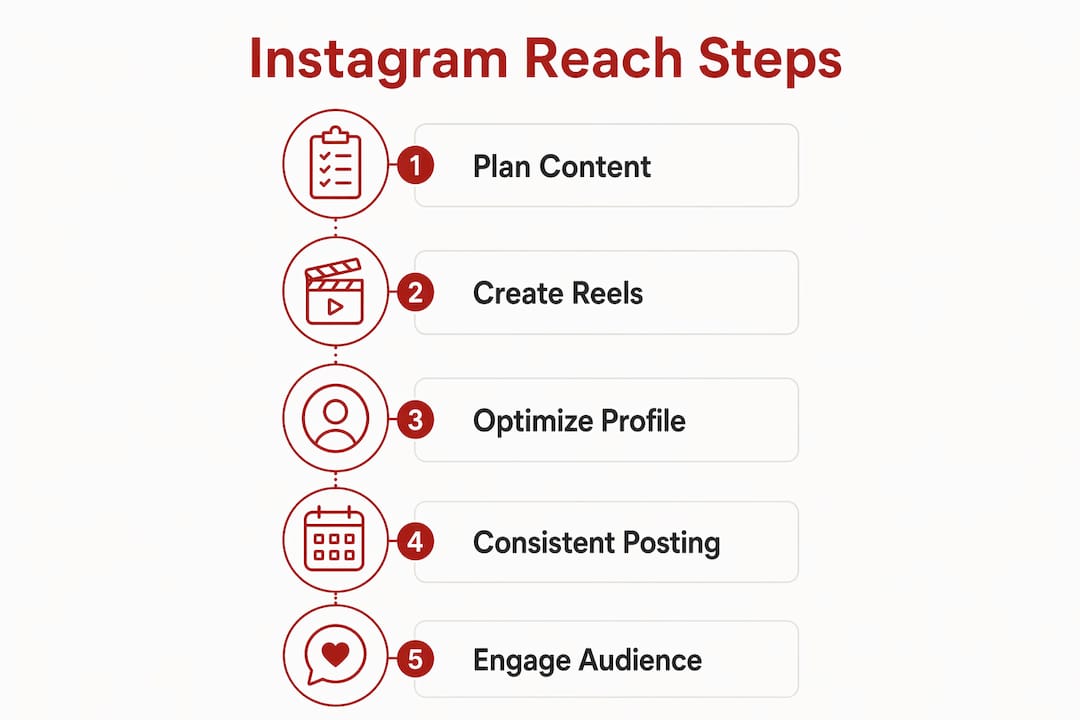
- Instagram reach measures the number of unique accounts that view content, serving as a key success indicator for social strategies. Reels are the most effective format for expanding reach to new audiences, especially with engaging hooks in the first three seconds, while profile SEO and consistent posting amplify discoverability and follower growth. Authentic engagement tactics like commenting, responding, and cross-platform promotion support algorithmic growth and sustainable community building over time.
Instagram reach is defined as the number of unique accounts that see a given piece of content, and it is the primary metric that determines whether a social media strategy is working or stagnating. For social media managers and content creators, knowing how to increase your reach on Instagram requires more than posting frequently. The platform’s 2026 algorithm prioritises saves, shares, and comments over passive views, meaning content design matters as much as content volume. This guide covers the formats, profile tactics, posting cadence, and community practices that produce measurable, sustainable reach growth.
Which content types most effectively boost Instagram reach?
Reels are the single most effective format for expanding reach to new audiences on Instagram. Reels generate 36% more reach than other post types, according to Buffer’s 2026 analysis of over 52 million posts. That gap exists because Instagram surfaces Reels on the Reels tab, the Explore page, and in non-follower feeds simultaneously, giving one piece of content multiple discovery pathways.

The first three seconds of a Reel function as a qualification gate. Viewer retention in early seconds determines whether Instagram places the content on broader discovery surfaces, including Explore and the Reels tab. A direct hook, on-screen text, and accurate captions all contribute to retention. Accessibility features such as subtitles also extend watch time by making content usable without sound, which is how a significant portion of Instagram content is consumed.
Carousels serve a different but complementary purpose. They drive repeat views as users swipe through slides, which increases time spent on a post and signals value to the algorithm. Carousels work well for educational content, step-by-step guides, and data-driven posts where depth rewards attention. They are less effective for cold discovery but strengthen relationships with existing followers.
Stories and Live content maintain community connection but contribute less to new-audience reach. They are best used to sustain engagement between feed posts rather than as primary growth tools.
| Format | Primary reach benefit | Best use case |
|---|---|---|
| Reels | Broadest new-audience discovery | Brand awareness, tutorials, trends |
| Carousels | Deeper engagement with existing followers | Education, data, step-by-step content |
| Stories | Community retention and daily touchpoints | Polls, Q&As, behind-the-scenes |
| Live | Real-time interaction | Events, announcements, AMAs |
The practical implication is clear: a content calendar that allocates the majority of production effort to Reels, supported by carousels for depth and Stories for continuity, reflects how the platform actually distributes content in 2026.
Pro Tip: Test two Reel hooks for the same concept and compare three-second retention rates in Instagram Insights. The version with higher early retention will consistently outperform on reach, regardless of production quality.
How to optimise your Instagram profile for search discovery
Profile SEO is the aspect of Instagram growth most frequently overlooked by social media managers. Keyword placement in the username and name fields directly influences how Instagram ranks accounts in search results. Adam Mosseri, Instagram’s head, has confirmed that the name field in particular carries significant weight in search ranking. A profile named “Sydney Community Gardening” will surface in relevant searches far more reliably than one named with a brand acronym alone.
The bio field supports this further. Including two or three terms that describe what the account does, who it serves, and where it operates signals relevance to both Instagram’s search algorithm and to Google, which indexes public Instagram profiles. The goal is precision, not density. Repeating the same keyword three times in a bio does not improve ranking and reduces readability.
A structured approach to profile optimisation includes the following steps:
- Research the terms your audience uses to find accounts like yours, drawing on Instagram Search, Google Trends, and cross-platform keyword data.
- Place the most descriptive keyword in the name field, not just the username.
- Write a bio that uses two or three distinct terms covering your niche, audience, and location where relevant.
- Add alt text to existing posts via the edit function. Instagram uses alt text for indexing, and most accounts leave it blank.
- Include a location tag on posts where geographic relevance matters. This supports local discovery, which is particularly useful for community-based organisations.
Refreshing older posts with updated alt text and location tags is a low-effort tactic that improves the discoverability of existing content without requiring new production. For organisations with a substantial post archive, this represents a practical way to extract more value from work already done. The broader principle of ethical SEO for discoverability applies here: optimise for clarity and relevance, not manipulation.
Pro Tip: Use the Instagram Search bar to type your niche keyword and observe which accounts and hashtags appear. The language used in those top-ranking profiles is the language your own profile should reflect.
What posting frequency and timing best support consistent reach growth?
Posting frequency has a direct, measurable relationship with follower growth. Posting 3 to 5 times per week doubles follower growth compared to posting 1 to 2 times per week, based on Buffer’s analysis of over 200,000 accounts. The mechanism is straightforward: higher volume increases the probability that some posts will meet the engagement thresholds required for broader algorithmic distribution.
Timing matters within that frequency. Instagram Insights provides data on when a specific account’s followers are most active, broken down by day and hour. Scheduling posts to publish during peak activity windows increases the likelihood of early engagement, which is the signal the algorithm uses to determine whether to push content further. Early engagement compounds: a post that receives saves and comments in the first hour is more likely to appear in non-follower feeds than one that accumulates the same engagement over 24 hours.
A practical approach to cadence management involves three steps:
- Establish a baseline by posting consistently at 3 times per week for four weeks, then review Insights to identify which days and times produced the highest reach.
- Adjust the schedule to concentrate posts around the two or three highest-performing time windows identified in step one.
- Review and revise the schedule monthly, since audience behaviour shifts with seasons, campaigns, and platform changes.
Sustainability is a genuine constraint here. A content calendar that requires daily posting is not viable for most social media managers working across multiple accounts or platforms. A consistent schedule of three to five quality posts per week outperforms an erratic schedule of daily posts followed by gaps. Consistency in publishing increases the cumulative probability that content will reach the engagement thresholds needed for broader distribution. The goal is a rhythm the team can maintain without compromising content quality.
Which engagement tactics support algorithmic reach and community growth?
Engagement signals, specifically saves, shares, and comments, are the primary inputs Instagram uses to determine content distribution. Posts with strong early engagement are pushed to followers’ feeds, the Explore page, and the Reels discovery tab in a compounding sequence. Designing content to invite these signals is therefore a structural decision, not an afterthought.
Captions are one of the most underused tools for generating comments. Captions with specific, easy-to-answer questions produce higher comment rates than captions that simply describe the post. The question should require a short, concrete answer rather than an open-ended opinion. “Which of these would you try first?” outperforms “What do you think?” because it reduces the cognitive effort required to respond.
Replying to comments reinforces the cycle. Responding to comments can increase engagement rates by over 20%, and each reply extends the active life of a post in the algorithm’s distribution path. This is not simply a courtesy practice. It is a measurable reach tactic.
Additional engagement practices worth incorporating include:
- Creating save-worthy content such as checklists, reference guides, and data summaries that followers return to repeatedly.
- Cross-promoting the Instagram account on other platforms, including email newsletters, LinkedIn, and websites, to convert existing audiences into Instagram followers. Cross-platform promotion targets people already engaged with the brand, making them higher-quality followers than those acquired through broad advertising.
- Using Instagram Stories with polls, question stickers, and sliders to maintain daily touchpoints and generate low-friction engagement.
- Exploring Broadcast Channels for direct communication with highly engaged followers, which supports retention without requiring feed content.
For organisations focused on ethical Instagram growth, these tactics align with genuine community building rather than metric manipulation. The distinction matters: engagement loops built on authentic dialogue produce followers who share content and return to it, which is what sustains reach over time.
Pro Tip: Pin a comment on your own post immediately after publishing, asking a specific question. This seeds the comment section and lowers the barrier for others to respond, increasing early engagement velocity.
Key takeaways
Sustainable Instagram reach growth depends on combining the right content formats with profile SEO, consistent posting cadence, and engagement-driven community management.
| Point | Details |
|---|---|
| Prioritise Reels for discovery | Reels generate 36% more reach than other formats and appear across multiple discovery surfaces. |
| Optimise profile fields for search | Place descriptive keywords in the name field and bio to improve ranking in Instagram Search. |
| Post 3 to 5 times per week | This frequency doubles follower growth compared to posting 1 to 2 times, based on large-scale post analysis. |
| Design content for saves and shares | Posts that generate saves and shares receive broader algorithmic distribution than those with passive views only. |
| Reply to comments promptly | Responding to comments can increase engagement rates by over 20% and extends a post’s distribution window. |
What sustainable Instagram growth actually looks like
The accounts that maintain reach growth over 12 months are not the ones chasing every new feature or trend. They are the ones that have made deliberate decisions about what they will and will not do consistently.
From my experience working with purpose-driven organisations, the most common mistake is treating reach as a vanity metric and optimising for follower counts rather than engagement quality. A smaller, highly engaged audience generates more algorithmic signal than a large, passive one. That distinction shapes every content decision, from caption length to posting frequency.
The other pattern worth naming is the tension between consistency and quality under resource constraints. Most social media managers are not working with unlimited production budgets. The practical answer is to build a content system that produces a reliable output of three to four posts per week at a standard the team can sustain, rather than producing ten posts in one week and nothing the next. The algorithm rewards regularity. So do audiences.
Instagram’s algorithm will continue to change. The underlying principle, that content earning genuine attention gets distributed more widely, has remained stable across multiple algorithm updates. Investing in content that is genuinely useful, accessible, and worth saving is a more durable strategy than optimising for any single platform signal. For organisations that care about stewardship and long-term community trust, that alignment between values and strategy is not incidental. It is the point.
— Ben
How Marzipan supports your digital reach goals
Com works with mission-led organisations across Australia to build digital presences that perform without compromising values. If Instagram is part of a broader digital strategy, the foundation matters: a well-structured website, clear SEO signals, and a content approach that connects across channels. Marzipan’s digital marketing services are designed for high-trust organisations that need measurable growth without noise. From ethical SEO to targeted campaigns, the work is built to last. If you are ready to align your social media efforts with a stronger digital foundation, explore how Marzipan can help.
FAQ
What does Instagram reach mean?
Instagram reach is the count of unique accounts that have seen a post at least once. It differs from impressions, which count total views including repeat views from the same account.
How does the Instagram algorithm affect reach in 2026?
The algorithm prioritises saves, shares, and comments over passive views. Posts that generate these signals early receive broader distribution across feeds, Explore, and the Reels tab.
How often should you post to increase followers on Instagram?
Posting 3 to 5 times per week produces double the follower growth of posting 1 to 2 times per week, based on Buffer’s analysis of over 52 million posts across 200,000 accounts.
Do hashtags still help with Instagram reach?
Hashtags contribute to discoverability but have less impact than profile SEO and content quality in 2026. Relevant, specific hashtags support search placement; broad or overused hashtags add little value.
Is paid promotion worth using to grow Instagram reach?
Paid promotion works best when applied to content that has already demonstrated strong organic engagement. Boosting a proven Reel with a modest daily budget amplifies reach efficiently, whereas promoting untested content rarely produces reliable returns.


